

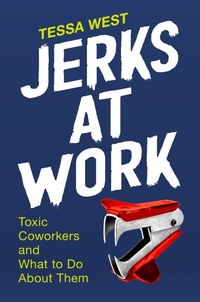
Jerks at Work
Toxic Coworkers and What to Do About Them
Published on 25. January 2022
Book
Hardback
272 pages
978-0-593-19230-6 (ISBN)
Description
For anyone pulling their hair out over an irritating colleague who's not technically breaking any rules, a hilarious guide to getting difficult people off your back from NYU psychology professor Tessa West
Ever watched a coworker charm the pants off management while showing a competitive, Machiavellian side to the lower ranks? The Kiss-Up/Kick-Down coworker doesn't hesitate to throw peers under the bus, but their boss is oblivious to their bad behavior. What to do? In Jerks at Work, West draws on a decade of original research to profile classic workplace archetypes, including the Gaslighter, the Bulldozer, the Credit-Stealer, the Neglector, and the Micromanager, and gives advice to anyone who's ever cried in a bathroom stall at the office.
West digs deep into the inner workings of each bad apple, exploring their motivations and insecurities-for instance, micromanagers develop compulsive habits due to poor managerial training and public shaming-and offers clever strategies for stopping each type of jerk in their tracks, such as:
Bulldozers often gain extra influence in meetings by making sure they're the first person to talk, even by saying "let's start by all sharing our names," which research shows portrays them as powerful. Don't let them speak first!
Kiss-Up/Kick-down coworkers are so endeared to their managers that, if you have to report them, do it in small doses over time-otherwise, you'll trigger cognitive dissonance in your brainwashed boss.
Jerks at Work is the playbook that you wish you didn't need but you'll always turn to-and the answer to your endless "how to deal with a terrible boss" Google searches.
Ever watched a coworker charm the pants off management while showing a competitive, Machiavellian side to the lower ranks? The Kiss-Up/Kick-Down coworker doesn't hesitate to throw peers under the bus, but their boss is oblivious to their bad behavior. What to do? In Jerks at Work, West draws on a decade of original research to profile classic workplace archetypes, including the Gaslighter, the Bulldozer, the Credit-Stealer, the Neglector, and the Micromanager, and gives advice to anyone who's ever cried in a bathroom stall at the office.
West digs deep into the inner workings of each bad apple, exploring their motivations and insecurities-for instance, micromanagers develop compulsive habits due to poor managerial training and public shaming-and offers clever strategies for stopping each type of jerk in their tracks, such as:
Bulldozers often gain extra influence in meetings by making sure they're the first person to talk, even by saying "let's start by all sharing our names," which research shows portrays them as powerful. Don't let them speak first!
Kiss-Up/Kick-down coworkers are so endeared to their managers that, if you have to report them, do it in small doses over time-otherwise, you'll trigger cognitive dissonance in your brainwashed boss.
Jerks at Work is the playbook that you wish you didn't need but you'll always turn to-and the answer to your endless "how to deal with a terrible boss" Google searches.
More details
Language
English
Place of publication
New York
United States
Publishing group
Penguin Putnam Inc
Product notice
sewn/stitched
Cloth over boards
Dimensions
Height: 214 mm
Width: 144 mm
Thickness: 28 mm
Weight
382 gr
ISBN-13
978-0-593-19230-6 (9780593192306)
Copyright in bibliographic data and cover images is held by Nielsen Book Services Limited or by the publishers or by their respective licensors: all rights reserved.
Schweitzer Classification
Person
Tessa West is an Associate Professor of Psychology at New York University, where she is a leading expert on interpersonal interaction and communication. She has published over 60 articles in the field of psychology's most prestigious journals, and has received multiple grants, including from the National Science Foundation and the National Institutes of Health. She is the recipient of the Theoretical Innovation Prize from the Societ for Personality and Social Psychology. She writes regularly about her research in the Wall Street Journal.