

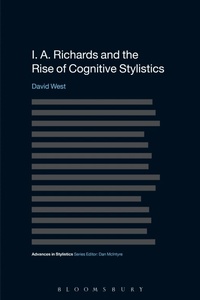
I. A. Richards and the Rise of Cognitive Stylistics
Published on 26. June 2014
Book
Paperback/Softback
176 pages
978-1-4725-7575-3 (ISBN)
Description
I. A. Richards is an influential figure in literary criticism but has rarely been thought of as someone who laid the foundations for cognitive stylistics. This book proposes that Richards was a "protocognitivist".
West argues that Richards anticipated many of the discipline's core aims, methods and assumptions. The book argues that the roots of cognitive psychology lie in early 20th-century psychology, when there was a focus on cognitive processes such as memory and learning, attention, categorisation, perception and consciousness. It was this cognitive psychology that Richards drew upon to build a theory of literature and interpretation - which in itself prefigured cognitive stylistics.
West also suggests that Richards is one of the more influential British intellectuals of the 20th century, and that his work is still relevant today. West argues that cognitive stylistics is not, as Peter Stockwell has written, a "new science of literature and reading", but rather a discipline with a history that it continues to deny itself.
This book will appeal to researchers and advanced students in stylistics and literary studies.
West argues that Richards anticipated many of the discipline's core aims, methods and assumptions. The book argues that the roots of cognitive psychology lie in early 20th-century psychology, when there was a focus on cognitive processes such as memory and learning, attention, categorisation, perception and consciousness. It was this cognitive psychology that Richards drew upon to build a theory of literature and interpretation - which in itself prefigured cognitive stylistics.
West also suggests that Richards is one of the more influential British intellectuals of the 20th century, and that his work is still relevant today. West argues that cognitive stylistics is not, as Peter Stockwell has written, a "new science of literature and reading", but rather a discipline with a history that it continues to deny itself.
This book will appeal to researchers and advanced students in stylistics and literary studies.
Reviews / Votes
Do you think you know who I. A. Richards is and what he stood for? Unless you have already read [this book], think again! ... West's style throughout is lucid and accessible ... [leaving] the reader well equipped to re-engage with Richards' ideas ... This book has a lot to offer anyone interested in understanding Richards' work, and is essential reading for cognitive stylisticians. * Language and Literature * Brilliant, brilliant, brilliant. This is a convincing revaluation of Richards' significance; it is a perfect example of the rational cognitive turn in the arts; and it is an unanswerable polemic for a science of literary study. -- Professor Peter Stockwell, Chair in Literary Linguistics, University of Nottingham, UKMore details
Series
Language
English
Place of publication
London
United Kingdom
Publishing group
Bloomsbury Publishing PLC
Target group
College/higher education
Professional and scholarly
Dimensions
Height: 234 mm
Width: 156 mm
Thickness: 9 mm
Weight
245 gr
ISBN-13
978-1-4725-7575-3 (9781472575753)
Copyright in bibliographic data and cover images is held by Nielsen Book Services Limited or by the publishers or by their respective licensors: all rights reserved.
Schweitzer Classification
Other editions
Additional editions
E-Book
09/2013
1st Edition
Bloomsbury Academic USA
€42.99
Available for download
E-Book
09/2013
1st Edition
Bloomsbury Academic USA
€42.99
Available for download
Person
David West is a Lecturer in English Language, Linguistics and Literature at the University of Muenster, Germany.
Content
Acknowledgements
Introduction
1. The Darwinist Framework
2. Philosophical Psychology and The Foundations of Aesthetics (1922)
3. Behaviourism and The Meaning of Meaning (1923)
4. Sherringtonian Neurology and Principles of Literary Criticism (1924)
5. Experimental Psychology and Practical Criticism (1929)
Conclusion
References
Introduction
1. The Darwinist Framework
2. Philosophical Psychology and The Foundations of Aesthetics (1922)
3. Behaviourism and The Meaning of Meaning (1923)
4. Sherringtonian Neurology and Principles of Literary Criticism (1924)
5. Experimental Psychology and Practical Criticism (1929)
Conclusion
References