

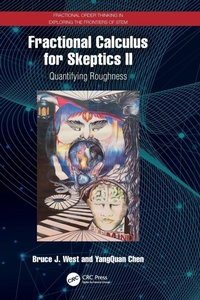
Fractional Calculus for Skeptics II
Quantifying Roughness
1st Edition
Will be published approx. on 17. March 2026
Book
Hardback
184 pages
978-1-041-17118-8 (ISBN)
Description
This second volume of the multi-volume Fractional Calculus for Skeptics explores the concept of "roughness" and its applications in complex systems. It demonstrates how fractional calculus offers valuable insights into modeling real-world phenomena that traditional calculus struggles to address.
Building on the first volume's foundational work advocating a fractal/fractional calculus paradigm shift, this volume offers an in-depth exploration of the concept of "roughness," drawing parallels to what Benoit B. Mandelbrot originally intended to call the "Science of Roughness." The book introduces the novel concept of "body roughness" and demonstrates its practical applications through two case studies of "roughness-informed rehabilitation therapy" with closed-loop control systems. One study involves non-invasive, 40-Hz gamma-frequency sensory stimulation for Alzheimer's disease, and the other involves biologically variable ventilation using roughness-informed, closed-loop control. The four chapters are complemented by valuable appendices and essential chapter-end references, as well as insightful "take-home messages."
This book will appeal to students, researchers, and professionals in STEM fields, including engineering, physics, biology, biomedicine, control engineering, rehabilitation, big data, and machine learning.
Building on the first volume's foundational work advocating a fractal/fractional calculus paradigm shift, this volume offers an in-depth exploration of the concept of "roughness," drawing parallels to what Benoit B. Mandelbrot originally intended to call the "Science of Roughness." The book introduces the novel concept of "body roughness" and demonstrates its practical applications through two case studies of "roughness-informed rehabilitation therapy" with closed-loop control systems. One study involves non-invasive, 40-Hz gamma-frequency sensory stimulation for Alzheimer's disease, and the other involves biologically variable ventilation using roughness-informed, closed-loop control. The four chapters are complemented by valuable appendices and essential chapter-end references, as well as insightful "take-home messages."
This book will appeal to students, researchers, and professionals in STEM fields, including engineering, physics, biology, biomedicine, control engineering, rehabilitation, big data, and machine learning.
More details
Series
Language
English
Place of publication
London
United Kingdom
Publishing group
Taylor & Francis Ltd
Target group
College/higher education
Professional and scholarly
Academic, Postgraduate, Undergraduate Advanced, and Undergraduate Core
Illustrations
20 s/w Zeichnungen, 8 s/w Tabellen, 23 s/w Abbildungen, 3 s/w Photographien bzw. Rasterbilder
8 Tables, black and white; 20 Line drawings, black and white; 3 Halftones, black and white; 23 Illustrations, black and white
Dimensions
Height: 260 mm
Width: 183 mm
Thickness: 14 mm
Weight
527 gr
ISBN-13
978-1-041-17118-8 (9781041171188)
Copyright in bibliographic data and cover images is held by Nielsen Book Services Limited or by the publishers or by their respective licensors: all rights reserved.
Schweitzer Classification
Other editions
Additional editions
E-Book
03/2026
1st Edition
CRC Press
€265.99
Available for download
E-Book
03/2026
1st Edition
CRC Press
€265.99
Available for download
Persons
Bruce J. West, a Physics PhD from the University of Rochester 1970, was the Chief Scientist in Mathematical and Information Science at the Army Research Office of the US, 1999-2021. His awards include the Presidential Meritorious Rank Award 2012 (Obama) and the Presidential Distinguished Rank Award 2017 (Trump).
YangQuan Chen, a Clarivate Highly Cited Researcher, earned his Ph.D. from Nanyang Technological University, Singapore, in 1998. He is a professor at the School of Engineering, University of California, Merced. His research interests include smart control engineering via digital twins and applied fractional calculus in STEM.
YangQuan Chen, a Clarivate Highly Cited Researcher, earned his Ph.D. from Nanyang Technological University, Singapore, in 1998. He is a professor at the School of Engineering, University of California, Merced. His research interests include smart control engineering via digital twins and applied fractional calculus in STEM.
Content
1. The Science of Roughness 2. The Rough Body Concepts 3. The Mathematics of Roughness 4. Roughness-Informed Rehabilitation Therapy 5. Rough Remarks on Complexity and Roughness