

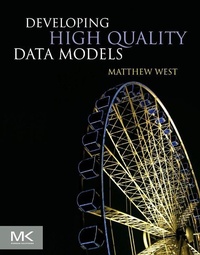
Developing High Quality Data Models
Published on 7. February 2011
Book
Paperback/Softback
408 pages
978-0-12-375106-5 (ISBN)
Description
Developing High Quality Data Models provides an introduction to the key principles of data modeling. It explains the purpose of data models in both developing an Enterprise Architecture and in supporting Information Quality; common problems in data model development; and how to develop high quality data models, in particular conceptual, integration, and enterprise data models.
The book is organized into four parts. Part 1 provides an overview of data models and data modeling including the basics of data model notation; types and uses of data models; and the place of data models in enterprise architecture. Part 2 introduces some general principles for data models, including principles for developing ontologically based data models; and applications of the principles for attributes, relationship types, and entity types. Part 3 presents an ontological framework for developing consistent data models. Part 4 provides the full data model that has been in development throughout the book. The model was created using Jotne EPM Technologys EDMVisualExpress data modeling tool.
This book was designed for all types of modelers: from those who understand data modeling basics but are just starting to learn about data modeling in practice, through to experienced data modelers seeking to expand their knowledge and skills and solve some of the more challenging problems of data modeling.
The book is organized into four parts. Part 1 provides an overview of data models and data modeling including the basics of data model notation; types and uses of data models; and the place of data models in enterprise architecture. Part 2 introduces some general principles for data models, including principles for developing ontologically based data models; and applications of the principles for attributes, relationship types, and entity types. Part 3 presents an ontological framework for developing consistent data models. Part 4 provides the full data model that has been in development throughout the book. The model was created using Jotne EPM Technologys EDMVisualExpress data modeling tool.
This book was designed for all types of modelers: from those who understand data modeling basics but are just starting to learn about data modeling in practice, through to experienced data modelers seeking to expand their knowledge and skills and solve some of the more challenging problems of data modeling.
Reviews / Votes
"This guide to developing high quality data models provides practical instruction in understanding the core principle of data modeling and creating accurate models from complex databases. The work is divided into four sections covering the basics of data model types and uses, general principles for data model components and an ontological framework for consistent data models. A final section presents a complete, standards compliant data model created with the Jotne EPM Technology EDMVisusalExpress data modeling tool. Numerous illustrations, charts and sample programming code are included throughout the work and access to additional online content, including the sample data model, is provided. West is an experienced data modeler working in the energy field." --Book News, Reference & Research"Overall, the book is a helpful guide for those who wish to go deep into the art of developing high quality data models. Readers will appreciate: how West connects data models with EA and business processes; the ontological approach, which offers a framework for formal, generic, and consistent models; the efficient use of diagrams for explaining the notions; and the philosophical concepts discussed throughout the text. The book is highly technical. Although it does not directly address people from academia, it will be very useful for related courses, especially those that deal with IT and business processes. Finally, the book highlights the importance of quality in data modeling for decision making." --Computing reviews.com
More details
Language
English
Place of publication
San Francisco
United States
Publishing group
Elsevier Science & Technology
Target group
Professional and scholarly
This book is intended for data management professionals with job functions that include data modeler; data architect; database designer; database application developer and application architect.
Product notice
Paperback (trade)
Unsewn / adhesive bound
Illustrations
Approx. 120 illustrations
Dimensions
Height: 236 mm
Width: 192 mm
Thickness: 24 mm
Weight
720 gr
ISBN-13
978-0-12-375106-5 (9780123751065)
Copyright in bibliographic data and cover images is held by Nielsen Book Services Limited or by the publishers or by their respective licensors: all rights reserved.
Schweitzer Classification
Other editions
Additional editions
Matthew West
Developing High Quality Data Models
E-Book
02/2011
Morgan Kaufmann
€51.95
Available for download
Person
Matthew West spent over 20 years as a leading data modeler for Shell where he was a key technical contributor to data modeling and data management standards and their application. Matthew was responsible for Shell's Downstream Data Model. He currently serves as the Director of Information Junction, a data architecture and analysis consultancy in the UK. He is also a key contributor to ISO 15926 (Lifecycle integration of process data) and ISO 8000 (Data and Information Quality). Matthew is a Visiting Professor at the University of Leeds
Content
Chapter 1: What are Data Models For?
Chapter 2: Different Sorts of Data Models
Chapter 3: Languages and Notations for Data and Data Models
Chapter 4: Layout of Data Models
Chapter 5: Reviewing and Improving Data Models
Chapter 6: High Quality Data Models
Chapter 7: Principles for Data Models
Chapter 8: A Generic Framework for a Changing World
Chapter 9: Integration of Data Models
Chapter 10: Future Directions
Chapter 2: Different Sorts of Data Models
Chapter 3: Languages and Notations for Data and Data Models
Chapter 4: Layout of Data Models
Chapter 5: Reviewing and Improving Data Models
Chapter 6: High Quality Data Models
Chapter 7: Principles for Data Models
Chapter 8: A Generic Framework for a Changing World
Chapter 9: Integration of Data Models
Chapter 10: Future Directions