

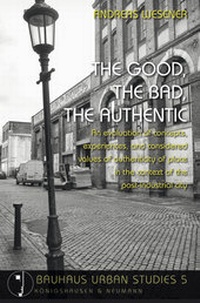
The Good, the Bad, the Authentic
An evaluation of concepts, experiences, and considered values of authenticity of place in the context of the post-industrial city
Published in April 2014
Book
396 pages
978-3-8260-5364-1 (ISBN)
Description
In response to perceived increased global competition, cities try to exhibit distinctive features to attract investors, businesses, skilled workers, and tourists. Authenticity of place has been considered as an influential 'soft' location factor able to enhance urban (re-)development and regeneration. However, despite its suggested significance, authenticity of place has rarely been subject of systematic theoretical and empirical research. The book addresses this apparent research gap. It investigates how authenticity is contextually intertwined with concepts, experiences, constituting elements, meanings and values of place. With the help of a comprehensive theoretical discussion and a case study - the Jewellery Quarter in Birmingham, UK - the author analyses how concepts of authenticity have been conveyed to places and how meanings correspond to particular identity constructions. Two key notions of authenticity of place are identified: First, 'empirical authenticity', second, 'experiential authenticity'.
More details
Person
Dr Andreas Wesener is a Lecturer in Urban Design at Lincoln University, New Zealand. He trained as an architect in Bochum and London and received his PhD from the Bauhaus-University Weimar. Prior to becoming a Lecturer, Andreas worked as an architect in the private sector and as a researcher for higher education and research institutes in Germany and the UK.