

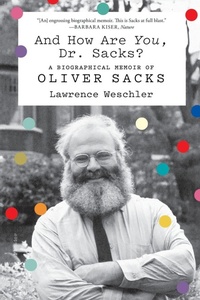
And How Are You, Dr. Sacks?
A Biographical Memoir of Oliver Sacks
Published on 10. November 2020
Book
Paperback/Softback
400 pages
978-1-250-61960-0 (ISBN)
Description
The author Lawrence Weschler began spending time with Oliver Sacks in the early 1980s, when he set out to profile the neurologist for his own new employer, The New Yorker. Almost a decade earlier, Dr. Sacks had published his masterpiece Awakenings - the account of his long-dormant patients miraculous but troubling return to life in a Bronx hospital ward. But the book had hardly been an immediate success, and the rumpled clinician was still largely unknown. Over the ensuing four years, the two men worked closely together until, for wracking personal reasons, Sacks asked Weschler to abandon the profile, a request to which Weschler acceded. The two remained close friends, however, across the next thirty years and then, just as Sacks was dying, he urged Weschler to take up the project once again. This book is the result of that entreaty.
Weschler sets Sacks's brilliant table talk and extravagant personality in vivid relief, casting himself as a beanpole Sancho to Sacks's capacious Quixote. We see Sacks rowing and ranting and caring deeply; composing the essays that would form The Man Who Mistook His Wife for a Hat; recalling his turbulent drug-fueled younger days; helping his patients and exhausting his friends; and waging intellectual war against a medical and scientific establishment that failed to address his greatest concern: the spontaneous specificity of the individual human soul. And all the while he is pouring out a stream of glorious, ribald, hilarious, and often profound conversation that establishes him as one of the great talkers of the age. Here is the definitive portrait of Sacks as our preeminent romantic scientist, a self-described "clinical ontologist" whose entire practice revolved around the single fundamental question he effectively asked each of his patients: How are you? Which is to say, How do you be?
A question which Weschler, with this book, turns back on the good doctor himself.
Weschler sets Sacks's brilliant table talk and extravagant personality in vivid relief, casting himself as a beanpole Sancho to Sacks's capacious Quixote. We see Sacks rowing and ranting and caring deeply; composing the essays that would form The Man Who Mistook His Wife for a Hat; recalling his turbulent drug-fueled younger days; helping his patients and exhausting his friends; and waging intellectual war against a medical and scientific establishment that failed to address his greatest concern: the spontaneous specificity of the individual human soul. And all the while he is pouring out a stream of glorious, ribald, hilarious, and often profound conversation that establishes him as one of the great talkers of the age. Here is the definitive portrait of Sacks as our preeminent romantic scientist, a self-described "clinical ontologist" whose entire practice revolved around the single fundamental question he effectively asked each of his patients: How are you? Which is to say, How do you be?
A question which Weschler, with this book, turns back on the good doctor himself.
More details
Language
English
Place of publication
New York
United States
Publishing group
St Martin's Press
Product notice
Paperback (trade)
Unsewn / adhesive bound
Illustrations
Includes 1 black-and-white frontispiece and 28 black-and-white illustrations throughout; plus index
Dimensions
Height: 208 mm
Width: 134 mm
Thickness: 18 mm
Weight
310 gr
ISBN-13
978-1-250-61960-0 (9781250619600)
Copyright in bibliographic data and cover images is held by Nielsen Book Services Limited or by the publishers or by their respective licensors: all rights reserved.
Schweitzer Classification
Person
Lawrence Weschler, a longtime veteran of The New Yorker and a regular contributor to NPR, is the director emeritus of the New York Institute of the Humanities at NYU, and the author of nearly twenty books, including Seeing Is Forgetting the Name of the Thing One Sees, Mr. Wilson's Cabinet of Wonder, Everything That Rises, and Vermeer in Bosnia.