

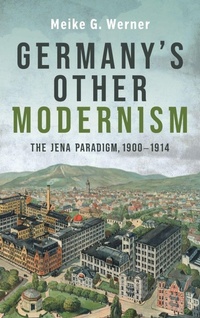
Germany's Other Modernism
The Jena Paradigm, 1900-1914
Published on 25. April 2023
Book
Hardback
346 pages
978-1-64014-139-1 (ISBN)
Description
Demonstrates, contrary to conventional wisdom, that European modernism developed not only in the great metropolitan centers, but also in provincial cities such as Jena.
The conventional wisdom is that the cultural sea change that was European modernism arose in urban centers like Berlin, Paris, Munich, and Vienna. Meike G. Werner's book, now in English translation, is a study of modernism in the provinces. Taking the small provincial city of Jena as a paradigmatic case, it re-creates the very different social and intellectual framework in which modernist experimentation occurred beyond the metropolitan centers. Invented traditions, social and spatial "liminality," and new ideas of social and aesthetic transformation combined in Jena to create a unique moment of cultural innovation.
In the years leading up to the First World War, the Jena publisher Eugen Diederichs envisioned and guided the development of this alternative modernism. Taken up by young writers including Diederichs's wife Helene Voigt-Diederichs, numerous intellectual outsiders from across Germany, Austria, and Switzerland, and members of the Free Student movement and of Jena's Sera Circle, this "other" modernism was above all a youth movement, full of energy and bold optimism. Figures such as Rudolf Carnap, Wilhelm Flitner, Hans Freyer, Karl Korsch, and Elisabeth Busse-Wilson emerged from this Jena paradigm. Werner pieces together the story of Jena's modernism in its full richness, complexity, and inner contradictions.
The conventional wisdom is that the cultural sea change that was European modernism arose in urban centers like Berlin, Paris, Munich, and Vienna. Meike G. Werner's book, now in English translation, is a study of modernism in the provinces. Taking the small provincial city of Jena as a paradigmatic case, it re-creates the very different social and intellectual framework in which modernist experimentation occurred beyond the metropolitan centers. Invented traditions, social and spatial "liminality," and new ideas of social and aesthetic transformation combined in Jena to create a unique moment of cultural innovation.
In the years leading up to the First World War, the Jena publisher Eugen Diederichs envisioned and guided the development of this alternative modernism. Taken up by young writers including Diederichs's wife Helene Voigt-Diederichs, numerous intellectual outsiders from across Germany, Austria, and Switzerland, and members of the Free Student movement and of Jena's Sera Circle, this "other" modernism was above all a youth movement, full of energy and bold optimism. Figures such as Rudolf Carnap, Wilhelm Flitner, Hans Freyer, Karl Korsch, and Elisabeth Busse-Wilson emerged from this Jena paradigm. Werner pieces together the story of Jena's modernism in its full richness, complexity, and inner contradictions.
More details
Series
Language
English
Place of publication
Columbia, MD
United States
Publishing group
Boydell & Brewer Ltd
Target group
Professional and scholarly
Product notice
Cloth over boards
Illustrations
52 illus.
Dimensions
Height: 235 mm
Width: 157 mm
Thickness: 23 mm
Weight
652 gr
ISBN-13
978-1-64014-139-1 (9781640141391)
Copyright in bibliographic data and cover images is held by Nielsen Book Services Limited or by the publishers or by their respective licensors: all rights reserved.
Schweitzer Classification
Other editions
Additional editions
E-Book
04/2023
1st Edition
De Gruyter
€48.99
Available for download
Persons
MEIKE G. WERNER is Associate Professor of German and European Studies at Vanderbilt University and President of the American Friends of the German Literature Archive in Marbach A.N. STEPHEN D. DOWDEN is Professor of Germanic Languages and Chair of the European Cultural Studies Program at Brandeis University.
Content
Acknowledgments
Abbreviations
Prologue
1: The Stage, or: Genius loci
2: The Publisher as Founder of a Cultural Empire: Eugen Diederichs in Jena
3: "Away from Berlin" and Literature in Jena: Helene Voigt-Diederichs
4: Dancing on the Volcano: "Young Jena"
Epilogue: What They Wanted, What They Became
Bibliography
Index
Abbreviations
Prologue
1: The Stage, or: Genius loci
2: The Publisher as Founder of a Cultural Empire: Eugen Diederichs in Jena
3: "Away from Berlin" and Literature in Jena: Helene Voigt-Diederichs
4: Dancing on the Volcano: "Young Jena"
Epilogue: What They Wanted, What They Became
Bibliography
Index