

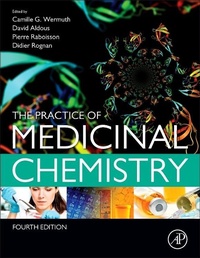
The Practice of Medicinal Chemistry
4th Edition
Published on 17. July 2015
Book
Hardback
902 pages
978-0-12-417205-0 (ISBN)
Description
The Practice of Medicinal Chemistry, Fourth Edition provides a practical and comprehensive overview of the daily issues facing pharmaceutical researchers and chemists. In addition to its thorough treatment of basic medicinal chemistry principles, this updated edition has been revised to provide new and expanded coverage of the latest technologies and approaches in drug discovery.
With topics like high content screening, scoring, docking, binding free energy calculations, polypharmacology, QSAR, chemical collections and databases, and much more, this book is the go-to reference for all academic and pharmaceutical researchers who need a complete understanding of medicinal chemistry and its application to drug discovery and development.
With topics like high content screening, scoring, docking, binding free energy calculations, polypharmacology, QSAR, chemical collections and databases, and much more, this book is the go-to reference for all academic and pharmaceutical researchers who need a complete understanding of medicinal chemistry and its application to drug discovery and development.
Reviews / Votes
"...So that you are a young student of a faculty in the field of pharmacology looking for a formative text, a young researcher at the beginning of his or her experiential work or an expert in the "drug discovery" industry that only wants to deepen theme specifications, most likely in this book you will find what you need." (Google translation) --La Chimica e l'Industria"...provides a diverse, multi-authored yet comprehensive update on the current state of the art in the science of medicinal chemistry...highly recommended for graduate students in the medicinal chemistry and drug discovery sciences." --Drug Development Research
Praise for the Third Edition:
"The third edition of this book, useful to seasoned medicinal chemists as well as to chemists entering the academic or industrial laboratories, provides a hands-on overview of the drug discovery process. This edition differs from the previous two editions by having been updated to reflect developments in the past 5 years, and it includes 11 new chapters. I found this book to be unique, well organized, and overall a useful addition to the medicinal chemistry literature. Having favorably reviewed the first edition, I still highly recommend this third edition to all chemists who are involved in the drug discovery process." --John L. Neumeyer, Harvard Medical School, Journal of Medicinal Chemistry
"...a diverse, multi-authored yet comprehensive update on the current state of the art in the science of medicinal chemistry...highly recommended for graduate students in the medicinal chemistry and drug discovery sciences."--Drug Development Research
More details
Edition
4th edition
Language
English
Place of publication
San Diego
United States
Publishing group
Elsevier Science Publishing Co Inc
Target group
College/higher education
Pharmaceutical researchers and medicinal chemists involved in drug discovery in industry and academic settings, graduate-level students looking for a comprehensive reference on medicinal chemistry
Product notice
sewn/stitched
Cloth over boards
Illustrations
Approx. 175 illustrations (175 in full color)
Dimensions
Height: 284 mm
Width: 217 mm
Thickness: 50 mm
Weight
2642 gr
ISBN-13
978-0-12-417205-0 (9780124172050)
Copyright in bibliographic data and cover images is held by Nielsen Book Services Limited or by the publishers or by their respective licensors: all rights reserved.
Schweitzer Classification
Other editions
Additional editions
Camille Georges Wermuth | David Aldous | Pierre Raboisson
The Practice of Medicinal Chemistry
E-Book
07/2015
4th Edition
Academic Press
€108.00
Available for download
Previous edition
Camille Georges Wermuth
The Practice of Medicinal Chemistry
Book
07/2008
3rd Edition
Academic Press
€188.17
Article exhausted; check for reprint
Persons
Camille-Georges Wermuth PhD, Prof. and Founder of Prestwick Chemical, was Professor of Organic Chemistry and Medicinal Chemistry at the Faculty of Pharmacy, Louis Pasteur University, Strasbourg, France from 1969 to 2002. He became interested in Medicinal Chemistry during his two years of military service in the French Navy at the "Centre d'Etudes Physio-biologiques Appliquees a la Marine" in Toulon. During this time he worked under the supervision of Dr Henri Laborit, the scientist who invented artificial hibernation and discovered chlorpromazine.
Professor Wermuths' main research themes focus on the chemistry and the pharmacology of pyridazine derivatives. The 3-aminopyridazine pharmacophore, in particular, allowed him to accede to an impressive variety of biological activities, including antidepressant and anticonvulsant molecules; inhibitors of enzymes such as mono-amine-oxidases, phosphodiesterases and acetylcholinesterase; ligands for neuro-receptors: GABA-A receptor antagonists, serotonine 5-HT3 receptor antagonists, dopaminergic and muscarinic agonists. More recently, in collaboration with the scientists of the Sanofi Company, he developed potent antagonists of the 41 amino-acid neuropeptide CRF (corticotrophin-releasing factor) which regulates the release of ACTH and thus the synthesis of corticoids in the adrenal glands. Professor Wermuth has also, in collaboration with Professor Jean-Charles Schwartz and Doctor Pierre Sokoloff (INSERM, Paris), developed selective ligands of the newly discovered dopamine D3 receptor. After a three-year exploratory phase, this research has led to nanomolar partial agonists which may prove useful in the treatment of the cocaine-withdrawal syndrome.
Dr. Wermuth is co-author or editor of several books, the author of over 250 scientific papers and holds nearly 60 patents. Professor Wermuth is also the recipient of the Charles Mentzer Prize of the Societe Francaise de Chimie Therapeutique, the Leon Velluz Prize of the French Academy of Science, the Prix de l'Ordre des Pharmaciens by the French Academy of Pharmacy and the Nauta Award of the European Federation for Medicinal Chemistry for Pharmacochemistry in 2010.
Professor Wermuths' main research themes focus on the chemistry and the pharmacology of pyridazine derivatives. The 3-aminopyridazine pharmacophore, in particular, allowed him to accede to an impressive variety of biological activities, including antidepressant and anticonvulsant molecules; inhibitors of enzymes such as mono-amine-oxidases, phosphodiesterases and acetylcholinesterase; ligands for neuro-receptors: GABA-A receptor antagonists, serotonine 5-HT3 receptor antagonists, dopaminergic and muscarinic agonists. More recently, in collaboration with the scientists of the Sanofi Company, he developed potent antagonists of the 41 amino-acid neuropeptide CRF (corticotrophin-releasing factor) which regulates the release of ACTH and thus the synthesis of corticoids in the adrenal glands. Professor Wermuth has also, in collaboration with Professor Jean-Charles Schwartz and Doctor Pierre Sokoloff (INSERM, Paris), developed selective ligands of the newly discovered dopamine D3 receptor. After a three-year exploratory phase, this research has led to nanomolar partial agonists which may prove useful in the treatment of the cocaine-withdrawal syndrome.
Dr. Wermuth is co-author or editor of several books, the author of over 250 scientific papers and holds nearly 60 patents. Professor Wermuth is also the recipient of the Charles Mentzer Prize of the Societe Francaise de Chimie Therapeutique, the Leon Velluz Prize of the French Academy of Science, the Prix de l'Ordre des Pharmaciens by the French Academy of Pharmacy and the Nauta Award of the European Federation for Medicinal Chemistry for Pharmacochemistry in 2010.
Editor
Professor of Organic Chemistry and Medicinal Chemistry at the Faculty of Pharmacy, Louis Pasteur University, Strasbourg, France
Head, LGCR Boston, Sanofi, Boston, MA
Senior Director, Fellow and Head of Infectious Diseases and Vaccines Medicinal Chemistry, Janssen, Pharmaceutical Companies of Johnson & Johnson, Beerse, Belgium
Research Director, Laboratoire d'Innovation Therapeutique, Universite de Strasbourg, France
Content
Section 1 - General Aspects of Medicinal Chemistry
Section 2 - Lead Compound Discovery Strategies
Section 3 - Primary Exploration of Structure-Activity Relationships
Section 4 - Substituents and Functions: Qualitative and Quantitative Aspects of Structure-Activity Relationships
Section 5 - Spatial Organization, Receptor Mapping and Molecular Modeling
Section 6 - Chemical Modifications Influencing the Pharmacokinetic Properties
Section 7 - Pharmaceutical and Chemical Means to Solubility and Formulation Problems
Section 2 - Lead Compound Discovery Strategies
Section 3 - Primary Exploration of Structure-Activity Relationships
Section 4 - Substituents and Functions: Qualitative and Quantitative Aspects of Structure-Activity Relationships
Section 5 - Spatial Organization, Receptor Mapping and Molecular Modeling
Section 6 - Chemical Modifications Influencing the Pharmacokinetic Properties
Section 7 - Pharmaceutical and Chemical Means to Solubility and Formulation Problems