

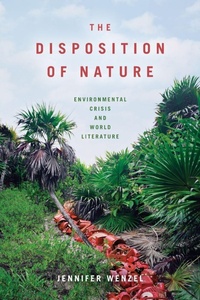
The Disposition of Nature
Environmental Crisis and World Literature
Published on 3. December 2019
Book
Paperback/Softback
352 pages
978-0-8232-8677-5 (ISBN)
Description
Finalist, 2022 Ecocriticism Book Prize, Association for the Study of Literature and the Environment
Shortlisted, 2020 Book Prize, Association for the Study of the Arts of the Present
How do literature and other cultural forms shape how we imagine the planet, for better or worse? In this rich, original, and long awaited book, Jennifer Wenzel tackles the formal innovations, rhetorical appeals, and sociological imbrications of world literature that might help us confront unevenly distributed environmental crises, including global warming.
The Disposition of Nature argues that assumptions about what nature is are at stake in conflicts over how it is inhabited or used. Both environmental discourse and world literature scholarship tend to confuse parts and wholes. Working with writing and film from Africa, South Asia, and beyond, Wenzel takes a contrapuntal approach to sites and subjects dispersed across space and time. Reading for the planet, Wenzel shows, means reading from near to there: across experiential divides, between specific sites, at more than one scale.
Impressive in its disciplinary breadth, Wenzel's book fuses insights from political ecology, geography, anthropology, history, and law, while drawing on active debates between postcolonial theory and world literature, as well as scholarship on the Anthropocene and the material turn. In doing so, the book shows the importance of the literary to environmental thought and practice, elaborating how a supple understanding of cultural imagination and narrative logics can foster more robust accounts of global inequality and energize movements for justice and livable futures.
Shortlisted, 2020 Book Prize, Association for the Study of the Arts of the Present
How do literature and other cultural forms shape how we imagine the planet, for better or worse? In this rich, original, and long awaited book, Jennifer Wenzel tackles the formal innovations, rhetorical appeals, and sociological imbrications of world literature that might help us confront unevenly distributed environmental crises, including global warming.
The Disposition of Nature argues that assumptions about what nature is are at stake in conflicts over how it is inhabited or used. Both environmental discourse and world literature scholarship tend to confuse parts and wholes. Working with writing and film from Africa, South Asia, and beyond, Wenzel takes a contrapuntal approach to sites and subjects dispersed across space and time. Reading for the planet, Wenzel shows, means reading from near to there: across experiential divides, between specific sites, at more than one scale.
Impressive in its disciplinary breadth, Wenzel's book fuses insights from political ecology, geography, anthropology, history, and law, while drawing on active debates between postcolonial theory and world literature, as well as scholarship on the Anthropocene and the material turn. In doing so, the book shows the importance of the literary to environmental thought and practice, elaborating how a supple understanding of cultural imagination and narrative logics can foster more robust accounts of global inequality and energize movements for justice and livable futures.
More details
Edition
New edition
Language
English
Place of publication
New York
United States
Target group
Professional and scholarly
Edition type
New edition
Product notice
Paperback (trade)
Illustrations
8
Dimensions
Height: 229 mm
Width: 152 mm
Thickness: 21 mm
Weight
591 gr
ISBN-13
978-0-8232-8677-5 (9780823286775)
Copyright in bibliographic data and cover images is held by Nielsen Book Services Limited or by the publishers or by their respective licensors: all rights reserved.
Schweitzer Classification
Other editions
Additional editions
E-Book
12/2019
Fordham University Press
€36.99
Available for download
Person
Jennifer Wenzel is Associate Professor of English and Comparative Literature and of Middle Eastern, South Asian, and African Studies at Columbia University. She is the author of Bulletproof: Afterlives of Anticolonial Prophecy in South Africa and Beyond (Chicago and KwaZulu-Natal, 2009). With Imre Szeman and Patricia Yaeger, she co- edited Fueling Culture: 101 Words for Energy and Environment (Fordham, 2017).
Content
Introduction: Reading for the Planet 1
Part I: Citizens and Consumers
1. Consumption for the Common Good? Commodity
Biography in an Era of Postconsumerism 49
2. Hijacking the Imagination: How to Tell the Story
of the Niger Delta 81
Part II: Resource Logics and Risk Logics
3. From Waste Lands to Wasted Lives: Enclosure
as Aesthetic Regime and Property Regime 141
4. How Far Is Bhopal? Inconvenient
Forums and Corporate Comparison 195
Epilogue: Fixing the World 259
Acknowledgments 265
Notes 267
Bibliography 303
Index 327
Part I: Citizens and Consumers
1. Consumption for the Common Good? Commodity
Biography in an Era of Postconsumerism 49
2. Hijacking the Imagination: How to Tell the Story
of the Niger Delta 81
Part II: Resource Logics and Risk Logics
3. From Waste Lands to Wasted Lives: Enclosure
as Aesthetic Regime and Property Regime 141
4. How Far Is Bhopal? Inconvenient
Forums and Corporate Comparison 195
Epilogue: Fixing the World 259
Acknowledgments 265
Notes 267
Bibliography 303
Index 327