

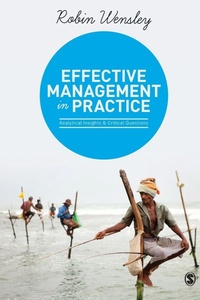
Effective Management in Practice
Analytical Insights and Critical Questions
1st Edition
Published on 31. October 2013
Book
Paperback/Softback
248 pages
978-1-4462-7261-9 (ISBN)
Description
In this lively and entertaining book, Robin Wensley guides the reader through the basic analytical approaches to decision making required for more effective management practice. Packed with diagrams, anecdotes and examples which bring the book to life, Effective Management in Practice:
- clearly presents a wide range of management tools, techniques and theoretical insights in just the right amount of depth for current and future managers
- illustrates the need for a balanced approach, emphasizing the importance of the questioning process in clarifying the nature of action proposals and any underlying assumptions
- eschews any approach which advocates one right way but at the same time encourages a greater appreciation of practical issues through analysis and theory
Students of management, academics and any practitioner interested in exploring a range of different approaches to management will enjoy and treasure this book.
- clearly presents a wide range of management tools, techniques and theoretical insights in just the right amount of depth for current and future managers
- illustrates the need for a balanced approach, emphasizing the importance of the questioning process in clarifying the nature of action proposals and any underlying assumptions
- eschews any approach which advocates one right way but at the same time encourages a greater appreciation of practical issues through analysis and theory
Students of management, academics and any practitioner interested in exploring a range of different approaches to management will enjoy and treasure this book.
Reviews / Votes
'In this book Robin Wensley applies his extensive experience and wisdom in maping four key strands of the managerial process - an interrogative approach of asking key questions, being critical in thinking about our thinking, learning how to organize for both central command and local agility, and appreciating evidence-based management in context specific situations. Through these four strands Wensley provides a treasury of "practical wisdom" that adds to "common sense" in important and insightful ways' -- Professor Andrew H. Van de Ven 'Robin Wensley's new book, "Effective Management in Practice: Analytical Insights and Critical Questions," should be in the bookshelf (or eReader) of every manager, policy-maker, and academic who is interested in understanding and advancing our thinking about management. Wensley's viewpoint emphasizes the clash of interests and perspectives that is central to real organizations. He puts the fact of "multiple truths" on center stage and describes how judgment and action evolve out of questioning, the skillful use of evidence, and "practical wisdom." If you are looking for easy tricks guaranteeing success in management, pass on by. However, if you are intrigued, or even fascinated, by how talented people wring insight and action out of difficult situations, get Robin Wensley's book now' -- Richard Rumelt 'Robin Wensley is one of the most thoughtful management writers around. In this book he avoids advocating simple solutions to managerial problems; there aren't any! However he does provide valuable insights which managers then need to apply to the everyday complex organizational situations that they face' -- Geoff Easton 'Fizzes with ideas and practical wisdom for thoughtful students, managers and academics. Based on a lifetime of research, teaching, management and reflection, Robin Wensley's very personal take on management tools and techniques, frameworks, stories, continuous questioning and the interface between academia and practice is an intellectual tour de force with practical lessons for readers willing and able to listen and reflect' -- Patrick Barwise 'Managers typically use few analytic tools for decision making. Yet we know how susceptible they are to bias and error. Here Robin Wensley brings welcome conceptual clarity and a good deal of common sense to provide real insights and to show how managers can overcome such bias. It is a lively read which managers and academics alike will find useful and illuminating' -- Gerry Johnson 'Books claiming to address the needs of both seasoned practitioners and serious academics rarely work. But, through a subtle analysis of academic research, its impact, and the identity of multiple truths, this book succeeds in its translation and message to both camps-a rare accomplishment' -- Professor Peter McKiernan 'In this book, Robin Wensley has deeply probed and neatly dissected the soft underbelly of academic and practical efforts to build a firm intellectual basis to guide managerial action. Relying on his vast experience, encyclopaedic knowledge, and sharp mind, he puts to flight both the pretensions of academic social science and the casual confidence of not very reflective practitioners in favor of a method that keeps asking questions of particular situations in search of a plausibly effective line of action. If the most common form of managerial error is not the absence of certain knowledge, but the lack of a will and capacity to inquire into particulars, then this book will set both academics and practitioners on a far better course than many are now pursuing' -- Professor Mark MooreMore details
Language
English
Place of publication
London
United Kingdom
Target group
College/higher education
Professional and scholarly
Dimensions
Height: 234 mm
Width: 156 mm
Thickness: 14 mm
Weight
386 gr
ISBN-13
978-1-4462-7261-9 (9781446272619)
Copyright in bibliographic data and cover images is held by Nielsen Book Services Limited or by the publishers or by their respective licensors: all rights reserved.
Schweitzer Classification
Other editions
Additional editions

Book
10/2013
1st Edition
SAGE Publications Ltd
€190.90
Shipment within 15-20 days
E-Book
10/2013
1st Edition
SAGE Publications Ltd
€78.49
Available for download
Person
Robert Wensley is Emeritus Professor of Policy and Marketing at the Warwick Business School.
Professor at Warwick since 1986 and Chair of the School from 1989 to 1994, and Chair of the Faculty of Social Studies from 1997 to 1999. Most recently Director of the AIM Research initiative from 2004 to 2011. He was previously with RHM Foods, Tube Investments and the London Business School and was visiting Professor at UCLA (twice) and University of Florida. He was Chair of the Council of the Tavistock Institute of Human Relations from 1998 until 2003 and a member of the Sunningdale Institute (2008 -11)
He is a Fellow of the British Academy of Management (FBAM), the Chartered Institute of Marketing (FCIM) and The Academy of Social Sciences (FAcSS). He was awarded the BAM Richard Whipp Lifetime Achievement Award in 2012 and previously awarded the 1981 and 1988 Alpha Kappa Psi prize for the most outstanding article in the US Journal of Marketing and the Millennium Prize for the best paper in the Journal of Marketing Management
He was appointed to the Council of the ESRC from 2001 to 2004 and was a Board member of the ESRC Research Grants Board from 1991 to 1995. He is a member of the Advisory Board of the Warburg Institute and the Academic Advisory Board of the Chartered Management Institute. Over his academic career, he has been involved with consultancy and management development for many major organisations.
Professor at Warwick since 1986 and Chair of the School from 1989 to 1994, and Chair of the Faculty of Social Studies from 1997 to 1999. Most recently Director of the AIM Research initiative from 2004 to 2011. He was previously with RHM Foods, Tube Investments and the London Business School and was visiting Professor at UCLA (twice) and University of Florida. He was Chair of the Council of the Tavistock Institute of Human Relations from 1998 until 2003 and a member of the Sunningdale Institute (2008 -11)
He is a Fellow of the British Academy of Management (FBAM), the Chartered Institute of Marketing (FCIM) and The Academy of Social Sciences (FAcSS). He was awarded the BAM Richard Whipp Lifetime Achievement Award in 2012 and previously awarded the 1981 and 1988 Alpha Kappa Psi prize for the most outstanding article in the US Journal of Marketing and the Millennium Prize for the best paper in the Journal of Marketing Management
He was appointed to the Council of the ESRC from 2001 to 2004 and was a Board member of the ESRC Research Grants Board from 1991 to 1995. He is a member of the Advisory Board of the Warburg Institute and the Academic Advisory Board of the Chartered Management Institute. Over his academic career, he has been involved with consultancy and management development for many major organisations.
Content
INTRODUCTION
The Four Starting Issues
The Four Strands
The Chapter Sequence
CHAPTER 1: EXTENDING ANALYSIS IN EFFECTIVE MANAGEMENT
The Legacy of the Sixties
Extended Analysis: Both Analysis and Synthesis
The Interrogative Mood
Issues of Representation
Introducing Time and Movement
Choices, Decisions and Action
Rationality in Practice: Simplification Approaches
Conclusion: Coping with Complex Rationality
CHAPTER 2: NEVER STOP LEARNING
Some Basic Ideas
The Reflective Practitioner
Sources of Learning beyond One's Own Practice
Conclusion: Reprise on the Reflective Practitioner
CHAPTER 3: EVIDENCE AND ENGAGEMENT
Evidence-Based Management
Risk, Uncertainty and Profit
The Wisdom of Crowds (Sometimes)
Isomorphism and Lemmings
Unexpected Events and Isolating Mechanisms
Dialectic, Rhetoric and Consensus
Engagement and Management: Scientific Knowledge and Folk Wisdom
The Nature of Academic Practice: Statistical Analysis and Evidential Claims
Learning from the Clinical Medical Experience of Evidence-Based Practice
Return to Managerial Relevance and the Issue of Timeliness
Conclusion: Getting the Best out of Engagement
CHAPTER 4: TOOLS FOR THINKING
Introduction: Comparing Perspectives in 1975 and 2009
Complexity and Chaos
The Structure of Systems: The Ubiquitous Tree
Open and Closed Systems
Modularisation and Loose-Tight Linkages
Basic Game Theory
Insights from Simple Experimental Games
Conclusion: Bounded but not Restricted
CHAPTER 5: MAKING SENSE OF THE NUMBERS
Concentration and Dispersion of Variables
Forms of Representation: Frquency Plots and Box Diagrams
Understanding Outliers
Significance, Correlation and Causality: What's Significance Got to Do with It?
Type I and Type II Errors
Type III Error: Answering the Wrong Question
Type IV Error: Asking the Wrong Question
The Rule of 10 Per Cent
Mediators and Moderators
Time Series Datasets: Lead and Lag Structures
Casual Causality
Conclusion: Half a Stratistical Loaf may Be Beter than the Whole
CHAPTER 6: RETURNING TO PRACTICAL WISDOM: THE FRAMEWORKS FOR ANALYSIS
Practical Wisdom: Reasoned Analysis and Deliberate Action
Watching Out for Boxes, Linear Diagrams and Other Simplifying Tools
Introducing Dynamics into a Static Representation
Dr Who and the Time Dimension
Specific Representations and Implicit Assumptions
Contradictory Common Sense
Conclusion: Common and Uncommon Sense
CHAPTER 7: THE CENTRAL ROLE OF STORIES
Organisational Success and Failure: The Perils of "Learning from the Past"
Fads and Fashions
Revisiting the Onus of Proof Issue
When and How Does the Decision Get Made?
The Narrative Approach
Conclusion: An Effective Role for Analysis in Management Practice
CHAPTER 8: LINKING THE CLASSROOM TO THE WORKPLACE
Learning from Case Studies
The Challenge of Simulating and Learning from Management Practice
Video Material
Experiential Exercises: Simulations and Projects
Conclusion: Learning through Questioning
CHAPTER 9: AN ONGOING DECISION PROCESS OF QUESTIONING AND DISSONANCE
Thinking, Seeing and Doing
The Case for Slow Thinking and Procrastination
Thinking Fast, Thinking Slow
In Praise of Dissonance
Debates, Dialectics and Dissonance
Making Some Sense of Innovation
Questions and Answers: the Central Role of "Interrogation"
CHAPTER 10: PUTTING THE MASTERS BACK INTO MANAGEMENT EDUCATION AND DEVELOPMENT
Administration, Management and Leadership
Stress Testing and Analysis
Innovation as Hard Work: The 3M Post-it Story
Innovation and Entrepreneurship
Understanding Strategic Leadership
Useful Insights from Writings on Military Strategy
Good Management Research as a Means to Useful Insights
Getting Beyond the False Rhetoric
The Four Starting Issues
The Four Strands
The Chapter Sequence
CHAPTER 1: EXTENDING ANALYSIS IN EFFECTIVE MANAGEMENT
The Legacy of the Sixties
Extended Analysis: Both Analysis and Synthesis
The Interrogative Mood
Issues of Representation
Introducing Time and Movement
Choices, Decisions and Action
Rationality in Practice: Simplification Approaches
Conclusion: Coping with Complex Rationality
CHAPTER 2: NEVER STOP LEARNING
Some Basic Ideas
The Reflective Practitioner
Sources of Learning beyond One's Own Practice
Conclusion: Reprise on the Reflective Practitioner
CHAPTER 3: EVIDENCE AND ENGAGEMENT
Evidence-Based Management
Risk, Uncertainty and Profit
The Wisdom of Crowds (Sometimes)
Isomorphism and Lemmings
Unexpected Events and Isolating Mechanisms
Dialectic, Rhetoric and Consensus
Engagement and Management: Scientific Knowledge and Folk Wisdom
The Nature of Academic Practice: Statistical Analysis and Evidential Claims
Learning from the Clinical Medical Experience of Evidence-Based Practice
Return to Managerial Relevance and the Issue of Timeliness
Conclusion: Getting the Best out of Engagement
CHAPTER 4: TOOLS FOR THINKING
Introduction: Comparing Perspectives in 1975 and 2009
Complexity and Chaos
The Structure of Systems: The Ubiquitous Tree
Open and Closed Systems
Modularisation and Loose-Tight Linkages
Basic Game Theory
Insights from Simple Experimental Games
Conclusion: Bounded but not Restricted
CHAPTER 5: MAKING SENSE OF THE NUMBERS
Concentration and Dispersion of Variables
Forms of Representation: Frquency Plots and Box Diagrams
Understanding Outliers
Significance, Correlation and Causality: What's Significance Got to Do with It?
Type I and Type II Errors
Type III Error: Answering the Wrong Question
Type IV Error: Asking the Wrong Question
The Rule of 10 Per Cent
Mediators and Moderators
Time Series Datasets: Lead and Lag Structures
Casual Causality
Conclusion: Half a Stratistical Loaf may Be Beter than the Whole
CHAPTER 6: RETURNING TO PRACTICAL WISDOM: THE FRAMEWORKS FOR ANALYSIS
Practical Wisdom: Reasoned Analysis and Deliberate Action
Watching Out for Boxes, Linear Diagrams and Other Simplifying Tools
Introducing Dynamics into a Static Representation
Dr Who and the Time Dimension
Specific Representations and Implicit Assumptions
Contradictory Common Sense
Conclusion: Common and Uncommon Sense
CHAPTER 7: THE CENTRAL ROLE OF STORIES
Organisational Success and Failure: The Perils of "Learning from the Past"
Fads and Fashions
Revisiting the Onus of Proof Issue
When and How Does the Decision Get Made?
The Narrative Approach
Conclusion: An Effective Role for Analysis in Management Practice
CHAPTER 8: LINKING THE CLASSROOM TO THE WORKPLACE
Learning from Case Studies
The Challenge of Simulating and Learning from Management Practice
Video Material
Experiential Exercises: Simulations and Projects
Conclusion: Learning through Questioning
CHAPTER 9: AN ONGOING DECISION PROCESS OF QUESTIONING AND DISSONANCE
Thinking, Seeing and Doing
The Case for Slow Thinking and Procrastination
Thinking Fast, Thinking Slow
In Praise of Dissonance
Debates, Dialectics and Dissonance
Making Some Sense of Innovation
Questions and Answers: the Central Role of "Interrogation"
CHAPTER 10: PUTTING THE MASTERS BACK INTO MANAGEMENT EDUCATION AND DEVELOPMENT
Administration, Management and Leadership
Stress Testing and Analysis
Innovation as Hard Work: The 3M Post-it Story
Innovation and Entrepreneurship
Understanding Strategic Leadership
Useful Insights from Writings on Military Strategy
Good Management Research as a Means to Useful Insights
Getting Beyond the False Rhetoric