

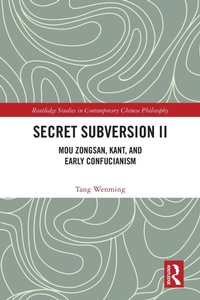
Secret Subversion II
Mou Zongsan, Kant, and Early Confucianism
1st Edition
Published on 19. June 2024
Book
Paperback/Softback
182 pages
978-1-032-30789-3 (ISBN)
Description
This title critically examines Mou Zongsan's philosophical system of moral metaphysics on the level of metaphysics and history philosophy, which combines Confucianism and Kantianism philosophy.
Mou Zongsan (1909-1995) is one of the representatives of Modern Confucianism and an important Chinese philosopher of the twentieth century. The two-volume set looks into the problems in the moral metaphysics by Mou and his systematic subversion of Confucianism on three levels: ethics, metaphysics and historical philosophy. In this second volume the author critiques Mou's philosophical development of Confucianism on the latter two levels. The first part analyzes Mou's view on conscience as ontology and his interpretation of the heavenly principles in Confucianism, arguing that his theory in fact abolishes Confucian cosmology based on modern scientific concepts and speaks for modern humanity. The second part focuses on Mou's remolding of historical philosophy based on the concept of freedom of Kant, Hegel, and modern Western philosophy, then assesses his ideological distortions of historical and political concepts in the Confucian tradition.
The title will appeal to scholars, students and philosophers interested in Chinese philosophy, Confucian ethics, Neo-Confucianism, and Comparative Philosophy.
Mou Zongsan (1909-1995) is one of the representatives of Modern Confucianism and an important Chinese philosopher of the twentieth century. The two-volume set looks into the problems in the moral metaphysics by Mou and his systematic subversion of Confucianism on three levels: ethics, metaphysics and historical philosophy. In this second volume the author critiques Mou's philosophical development of Confucianism on the latter two levels. The first part analyzes Mou's view on conscience as ontology and his interpretation of the heavenly principles in Confucianism, arguing that his theory in fact abolishes Confucian cosmology based on modern scientific concepts and speaks for modern humanity. The second part focuses on Mou's remolding of historical philosophy based on the concept of freedom of Kant, Hegel, and modern Western philosophy, then assesses his ideological distortions of historical and political concepts in the Confucian tradition.
The title will appeal to scholars, students and philosophers interested in Chinese philosophy, Confucian ethics, Neo-Confucianism, and Comparative Philosophy.
More details
Series
Language
English
Place of publication
London
United Kingdom
Publishing group
Taylor & Francis Ltd
Target group
College/higher education
Professional and scholarly
Postgraduate, Professional, and Undergraduate
Dimensions
Height: 234 mm
Width: 156 mm
Thickness: 10 mm
Weight
289 gr
ISBN-13
978-1-032-30789-3 (9781032307893)
Copyright in bibliographic data and cover images is held by Nielsen Book Services Limited or by the publishers or by their respective licensors: all rights reserved.
Schweitzer Classification
Other editions
Additional editions
Book
09/2022
1st Edition
Routledge
€206.00
Shipment within 15-20 days
E-Book
09/2022
1st Edition
Routledge
€55.49
Available for download
E-Book
09/2022
1st Edition
Routledge
€55.49
Available for download
Person
Tang Wenming is a professor in the Department of Philosophy and Deputy Director of the Institute for Ethics and Religions Studies at Tsinghua University, China. He is also Secretary General of the Chinese Confucian Academy. His research areas are ethics, Chinese philosophy, and religious studies.
Content
Part I: The Arrogation of Conscience 1. Practical Reason at the Maximum and the Historical Development of Confucianism 2. Mind and Ontology 3. Intellectual Intuition and Thing-in-itself 4. Supreme Good and Perfection Religion Part II: The Graftage of History 5. Moral Metaphysics and Historical Philosophy under the Concern for the Chinese Problems 6. The Conception and Implication of Philosophy of History 7. Conscience, History and Perfection 8. The Third Period of Confucian Development and the Theory of Self-negation of Conscience