

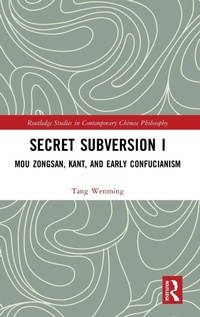
Secret Subversion I
Mou Zongsan, Kant, and Early Confucianism
1st Edition
Published on 4. August 2020
Book
Hardback
140 pages
978-0-8153-7442-8 (ISBN)
Description
Mou Zongsan (1909-1995), one of the representatives of Modern Confucianism, belongs to the most important Chinese philosophers of the twentieth century. From a more traditional Confucian perspective, this book makes a critical analysis on Mou's "moral metaphysics," mainly his thoughts about Confucian ethos.
The author observes that Mou simplifies Confucian ethos rooted in various and specific environments, making them equal to modern ethics, which is a subversion of the ethical order of life advocated by traditional Confucianism. The author believes, also, that Mou has twisted Confucian ethos systematically by introducing Kant's concept of autonomy into the interpretation of Confucian thoughts.
Scholars and students in Chinese philosophy, especially those in Confucian studies, will be attracted by this book. Also, it will appeal to readers interested in comparative philosophy.
The author observes that Mou simplifies Confucian ethos rooted in various and specific environments, making them equal to modern ethics, which is a subversion of the ethical order of life advocated by traditional Confucianism. The author believes, also, that Mou has twisted Confucian ethos systematically by introducing Kant's concept of autonomy into the interpretation of Confucian thoughts.
Scholars and students in Chinese philosophy, especially those in Confucian studies, will be attracted by this book. Also, it will appeal to readers interested in comparative philosophy.
More details
Series
Language
English
Place of publication
New York
United States
Publishing group
Taylor & Francis Inc
Target group
College/higher education
Professional and scholarly
Dimensions
Height: 240 mm
Width: 161 mm
Thickness: 13 mm
Weight
394 gr
ISBN-13
978-0-8153-7442-8 (9780815374428)
Copyright in bibliographic data and cover images is held by Nielsen Book Services Limited or by the publishers or by their respective licensors: all rights reserved.
Schweitzer Classification
Other editions
Additional editions
Book
06/2022
1st Edition
Routledge
€66.70
Shipment within 10-20 days
E-Book
08/2020
1st Edition
Routledge
€60.49
Available for download
E-Book
08/2020
1st Edition
Routledge
€60.49
Available for download
Person
Tang Wenming is a professor in the Department of Philosophy and Deputy Director of the Institute for Ethics and Religions Studies at Tsinghua University. He is also Secretary General of the Chinese Confucian Academy. His research areas are ethics, Chinese philosophy and religious studies.
Content
Part 1 The Reduction of Morality
Chapter I. Autonomy and Altruism: On the Moralistic Interpretation of Confucian Thought
Chapter II. Do the Zhou People's Concern-Consciousness and Respect for Virtue Constitute a Moral Breakthrough?
Chapter III. Is the Confucian Doctrine of Benevolence a Moralistic Doctrine?
Chapter IV. Is Mencius' Theory of Goodness of Human Nature a Moral Metaphysics?
Part 2 The Appropriation of Autonomy
Chapter I. The Spirit of Confucian Ethics and Autonomous Morality
Chapter II. Mencius on the Internality of Benevolence and Righteousness
Chapter III. "The Internality of Benevolence and Righteousness" and Autonomous Morality
Chapter IV. Confucian Ethics: Virtue-Based or Law-Based?
Chapter I. Autonomy and Altruism: On the Moralistic Interpretation of Confucian Thought
Chapter II. Do the Zhou People's Concern-Consciousness and Respect for Virtue Constitute a Moral Breakthrough?
Chapter III. Is the Confucian Doctrine of Benevolence a Moralistic Doctrine?
Chapter IV. Is Mencius' Theory of Goodness of Human Nature a Moral Metaphysics?
Part 2 The Appropriation of Autonomy
Chapter I. The Spirit of Confucian Ethics and Autonomous Morality
Chapter II. Mencius on the Internality of Benevolence and Righteousness
Chapter III. "The Internality of Benevolence and Righteousness" and Autonomous Morality
Chapter IV. Confucian Ethics: Virtue-Based or Law-Based?