

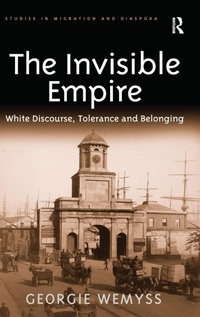
The Invisible Empire
White Discourse, Tolerance and Belonging
1st Edition
Published on 28. November 2009
Book
Hardback
214 pages
978-0-7546-7347-7 (ISBN)
Description
This book offers a significant and original contribution to critical race theory. Georgie Wemyss offers an anthropological account of the cultural hegemony of the West through investigations of the central and pivotal constituent of the dominant white discourse of Britishness - the Invisible Empire. She demonstrates how the repetitive burying of British Empire histories of violence in the retelling of Britain's past works to disguise how power operates in the present, showing how other related elements have been substantially reproduced through time to accommodate the challenges of history. The book combines ethnographic and discourse analysis with the study of connected histories to reveal how the dominant discourse maintains its dominance through its flexibility and its strategic alliances with subordinate groups.
Reviews / Votes
'Invisible Empire is a much needed antidote to the poverty of the mainstream political imagination concerning issues of racism in this country. Through a sensitivity to the political and cultural landscapes of East London, Georgina Wemyss dissects the intolerant tolerance of white liberals as well as the inability of British society to break from its imperial past and offer genuine belonging to its black and brown citizens.' - Les Back, Goldsmiths University of London, UK'This book provides a wonderfully readable analysis of the politics of multiculturalism within the framework of a particular place. The author's sustained critique of "the invisible empire" shaping the East End as a contrived tale of merchants and the spread of civilisation manages to bring to light layer upon layer of remarkable historical information along the way, right up to the present. Her methodical and innovative approach also shows those of us committed to breaking the default setting of white liberalism how to engage simultaneously with the local, the trans-local and the national. Here she demonstrates how, at each scale, public understanding of the "complex citizenship" of postcolonial settlers is diminished by careless ignorance and racism derived from decades of misinformation and hubris about Britain's past.' - Vron Ware, The Open University, UK
'Wemyss shows comprehensively that public understanding of the "complex citizenship" of postcolonial settlers is diminished by careless ignorance and racism derived from decades of misinformation about Britain's past' - BSA Network
More details
Series
Language
English
Place of publication
London
United Kingdom
Publishing group
Taylor & Francis Ltd
Target group
College/higher education
Professional and scholarly
Dimensions
Height: 240 mm
Width: 161 mm
Thickness: 16 mm
Weight
493 gr
ISBN-13
978-0-7546-7347-7 (9780754673477)
Copyright in bibliographic data and cover images is held by Nielsen Book Services Limited or by the publishers or by their respective licensors: all rights reserved.
Schweitzer Classification
Other editions
Additional editions
Book
09/2016
1st Edition
Routledge
€83.40
Shipment within 10-20 days
E-Book
03/2016
Routledge
€77.99
Available for download
E-Book
03/2016
Routledge
€77.99
Available for download
Person
Georgie Wemyss is Senior Research Fellow at the Centre for Research on Migration, Refugees and Belonging at the University of East London, U.K.
Content
Contents: Introduction; Part I: Introduction to Chapters 1 and 2; Terra nullius to the shrouding of Milligan: White histories on the Isle of Dogs; Competing colonial anniversaries in 'postcolonial' Blackwall: White memories, White belonging. Part II: Introduction to Chapters 3 and 4; Subjects of the invisible empire: 'outside extremists', 'White East Enders', 'passive Bengalis'; 'The East End' marketing strategy and the consolidation of the White East End. Part III: Introduction to Chapters 5 and 6; Tolerance, the invisible empire and the hierarchy of belonging; 'Lascars', colonial genealogies and exclusionary categories. Conclusion: exposing the invisible empire: towards commonality and metropolitan belonging; Bibliography; Index.