

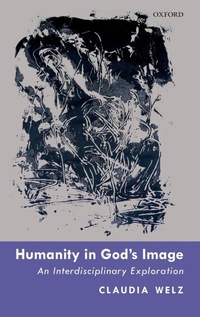
Humanity in God's Image
An Interdisciplinary Exploration
Published on 25. August 2016
Book
Hardback
352 pages
978-0-19-878498-2 (ISBN)
Description
How can we, in our times, understand the biblical concept that human beings have been created in the image of an invisible God? This is a perennial but increasingly pressing question that lies at the heart of theological anthropology. Humanity in God's Image: An Interdisciplinary Exploration clarifies the meaning of this concept, traces different Jewish and Christian interpretations of being created in God's image, and reconsiders the significance of the
imago Dei in a post-Holocaust context. As normative, counter-factual notions, human dignity and the imago Dei challenge us to see more.
Claudia Welz offers an interdisciplinary exploration of theological and ethical 'visions' of the invisible. By analysing poetry and art, Welz exemplifies human self-understanding in the interface between the visual and the linguistic. The content of the imago Dei cannot be defined apart from the image carrier: an embodied creature. Compared to verbal, visual, and mental images, how does this creature as a 'living image' refer to God-like a metaphor, a mimetic mirror, or an elusive
trace? Combining hermeneutical and phenomenological perspectives with philosophy of religion and philosophy of language, semiotics, art history, and literary studies, Welz regards the imago Dei as a complex sign that is at once iconic, indexical, and symbolical-pointing beyond itself.
imago Dei in a post-Holocaust context. As normative, counter-factual notions, human dignity and the imago Dei challenge us to see more.
Claudia Welz offers an interdisciplinary exploration of theological and ethical 'visions' of the invisible. By analysing poetry and art, Welz exemplifies human self-understanding in the interface between the visual and the linguistic. The content of the imago Dei cannot be defined apart from the image carrier: an embodied creature. Compared to verbal, visual, and mental images, how does this creature as a 'living image' refer to God-like a metaphor, a mimetic mirror, or an elusive
trace? Combining hermeneutical and phenomenological perspectives with philosophy of religion and philosophy of language, semiotics, art history, and literary studies, Welz regards the imago Dei as a complex sign that is at once iconic, indexical, and symbolical-pointing beyond itself.
Reviews / Votes
A remarkable interdisciplinary exploration of the imago Dei, every chapter of Welz's study builds upon her articles in German, Danish, and English previously published in journals and collected volumes. Each reflects careful scholarship on a range of figures, literatures, and disciplines and manifests the fruit of vetting by diverse academic audiences. An exemplary and welcome contribution to contemporary discourses about the imago Dei and human dignity, Welzventilates a conversation at times dominated by historical, political, analytic, and jurisprudential categories by foregrounding other methodologies: hermeneutical, phenomenological, post-Holocaust theology, and philosophy of religion. This monograph deserves the careful attention of all who would seek to
understand the imago Dei and its implications for human dignity today. * Matthew Puffer, Reading Religion *
More details
Other editions
Additional editions
E-Book
08/2016
1st Edition
OUP eBook
€61.99
Available for download
E-Book
08/2016
1st Edition
OUP eBook
€70.99
Available for download
Person
Claudia Welz is Professor with special responsibilities in Ethics and Philosophy of Religion at the University of Copenhagen.
Content
PART I: CREATION AND CREATIVITY; PART II: REVEALMENT AND CONCEALMENT; PART III: REORIENTATION AND REDEMPTION; PART IV: ETHICS WITH AN ESCHATOLOGICAL PROVISO