

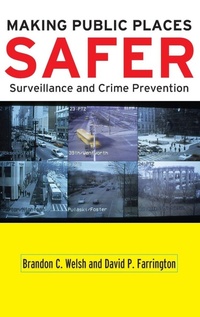
Making Public Places Safer
Surveillance and Crime Prevention
Published on 12. November 2009
Book
Hardback
176 pages
978-0-19-532621-5 (ISBN)
Description
The United Kingdom has more than 4.2 million public closed-circuit television (CCTV) cameras--one for every fourteen citizens. Across the United States, hundreds of video surveillance systems are being installed in town centers, public transportation facilities, and schools at a cost exceeding $100 million annually. And now other Western countries have begun to experiment with CCTV to prevent crime in public places. In light of this expansion and the associated public expenditure, as well as pressing concerns about privacy rights, there is an acute need for an evidence-based approach to inform policy and practice.
Drawing on the highest-quality research, criminologists Brandon C. Welsh and David P. Farrington assess the effectiveness and social costs of not only CCTV, but also of other important surveillance methods to prevent crime in public space, such as improved street lighting, security guards, place managers, and defensible space. Importantly, the book goes beyond the question of "Does it work?" and examines the specific conditions and contexts under which these surveillance methods may have an effect on crime as well as the mechanisms that bring about a reduction in crime.
At a time when cities need cost-effective methods to fight crime and the public gradually awakens to the burdens of sacrificing their privacy and civil rights for security, Welsh and Farrington provide this timely and reliable guide to the most effective and non-invasive uses of surveillance to make public places safer from crime.
Drawing on the highest-quality research, criminologists Brandon C. Welsh and David P. Farrington assess the effectiveness and social costs of not only CCTV, but also of other important surveillance methods to prevent crime in public space, such as improved street lighting, security guards, place managers, and defensible space. Importantly, the book goes beyond the question of "Does it work?" and examines the specific conditions and contexts under which these surveillance methods may have an effect on crime as well as the mechanisms that bring about a reduction in crime.
At a time when cities need cost-effective methods to fight crime and the public gradually awakens to the burdens of sacrificing their privacy and civil rights for security, Welsh and Farrington provide this timely and reliable guide to the most effective and non-invasive uses of surveillance to make public places safer from crime.
Reviews / Votes
Brandon Welsh and David Farrington make a valuable contribution to the field of criminology in their book ^iMaking Public Places Safer: Surveillance and Crime Prevention^r by providing empirical evidence to help guide the implementation of a variety of crime prevention tools. * Tasha Youstin, Crime, Law and Social Change *More details
Series
Language
English
Place of publication
New York
United States
Target group
Professional and scholarly
Illustrations
2 black and white line illustrations
Dimensions
Height: 240 mm
Width: 161 mm
Thickness: 14 mm
Weight
438 gr
ISBN-13
978-0-19-532621-5 (9780195326215)
Copyright in bibliographic data and cover images is held by Nielsen Book Services Limited or by the publishers or by their respective licensors: all rights reserved.
Schweitzer Classification
Other editions
Additional editions
E-Book
11/2009
OUP eBook
€20.99
Available for download
E-Book
11/2009
1st Edition
OUP eBook
€14.49
Available for download
Persons
Brandon C. Welsh is an Associate Professor in the College of Criminal Justice at Northeastern University and Senior Research Fellow at the Netherlands Institute for the Study of Crime and Law Enforcement. He is an author or editor of seven books, including Saving Children from a Life of Crime: Early Risk Factors and Effective Interventions (OUP, 2007), Preventing Crime: What Works for Children, Offenders, Victims, and Places, and Evidence-Based Crime Prevention.
David P. Farrington, Ph.D., is Professor of Psychological Criminology in the Institute of Criminology, Cambridge University. He is a former president of the American Society of Criminology, the British Society of Criminology, and the European Association of Psychology and Law.
David P. Farrington, Ph.D., is Professor of Psychological Criminology in the Institute of Criminology, Cambridge University. He is a former president of the American Society of Criminology, the British Society of Criminology, and the European Association of Psychology and Law.
Content
PART I: POLITICS, THEORY, AND METHOD; PART II: EVIDENCE OF EFFECTIVENESS; PART III: POLICY CHOICES AND CHALLENGES