

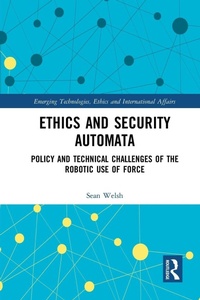
Ethics and Security Automata
Policy and Technical Challenges of the Robotic Use of Force
1st Edition
Published on 30. June 2021
Book
Paperback/Softback
230 pages
978-1-032-09611-7 (ISBN)
Description
Can security automata (robots and AIs) make moral decisions to apply force on humans correctly? If they can make such decisions, ought they be used to do so? Will security automata increase or decrease aggregate risk to humans? What regulation is appropriate? Addressing these important issues this book examines the political and technical challenges of the robotic use of force.
The book presents accessible practical examples of the 'machine ethics' technology likely to be installed in military and police robots and also in civilian robots with everyday security functions such as childcare. By examining how machines can pass 'reasonable person' tests to demonstrate measurable levels of moral competence and display the ability to determine the 'spirit' as well as the 'letter of the law', the author builds upon existing research to define conditions under which robotic force can and ought to be used to enhance human security.
The scope of the book is thus far broader than 'shoot to kill' decisions by autonomous weapons, and should attract readers from the fields of ethics, politics, and legal, military and international affairs. Researchers in artificial intelligence and robotics will also find it useful.
The book presents accessible practical examples of the 'machine ethics' technology likely to be installed in military and police robots and also in civilian robots with everyday security functions such as childcare. By examining how machines can pass 'reasonable person' tests to demonstrate measurable levels of moral competence and display the ability to determine the 'spirit' as well as the 'letter of the law', the author builds upon existing research to define conditions under which robotic force can and ought to be used to enhance human security.
The scope of the book is thus far broader than 'shoot to kill' decisions by autonomous weapons, and should attract readers from the fields of ethics, politics, and legal, military and international affairs. Researchers in artificial intelligence and robotics will also find it useful.
Reviews / Votes
"A timely and unusually readable contribution to machine ethics - the project of making moral decisions in machines - Ethics and Security Automata provides an accessible overview as to how machines might make foundational moral decisions that affect human beings in a range of situations in war and peace. It is remarkable for its clarity and its ethical even-handedness. A book that is both technically and ethically interesting. Highly recommended." - Dr. Jai Galliott, Lecturer in Cyber Security, The University of New South Wales at the Australian Defence Force Academy"This book is a "must read" for anybody responsible for programming, supplying and deploying autonomous military and security robots. It is also recommended for a general audience. With clear and comprehensible discussion and detailed case analyses, Sean Welsh presents issues that many view as impenetrable, or scary, in a practical, constructive and highly enlightening manner. As James Moor, a pioneer of robot ethics, once said, machine ethics forces us to do a better, clearer, programmable ethical theory: Ethics and Security Automata is a fine example of this project carried out in practical detail." - Dr. Peter Boltuc, Professor of Philosophy, University of Illinois Springfield
More details
Series
Language
English
Place of publication
London
United Kingdom
Publishing group
Taylor & Francis Ltd
Target group
College/higher education
Postgraduate
Illustrations
30 s/w Abbildungen
30 Illustrations, black and white
Dimensions
Height: 234 mm
Width: 156 mm
Thickness: 13 mm
Weight
360 gr
ISBN-13
978-1-032-09611-7 (9781032096117)
Copyright in bibliographic data and cover images is held by Nielsen Book Services Limited or by the publishers or by their respective licensors: all rights reserved.
Schweitzer Classification
Other editions
Additional editions
Book
11/2017
1st Edition
Routledge
€233.10
Shipment within 10-20 days
E-Book
11/2017
Routledge
€58.99
Available for download
E-Book
11/2017
Routledge
€59.49
Available for download
Person
Sean Welsh obtained his undergraduate degree in Philosophy at the University of New South Wales and underwent postgraduate study in Robot Ethics at the University of Canterbury. He has worked in extensively in software development for British Telecommunications, Telstra Australia, Volante e-business, Fitch Ratings, James Cook University, 24 Hour Communications and Lumata. He also worked for a short time as a political advisor to Warren Entsch, the Federal Member for Leichhardt in Australia. Sean's articles on robot ethics have appeared in the Conversation, CNN, the Sydney Morning Herald, the New Zealand Herald and the Australian Broadcasting Corporation.
Content
Introduction Chapter 1: Concepts Chapter 2: Method Chapter 3: Requirements Chapter 4: Solution Design Chapter 5: Development - Specific Norm Tests Chapter 6: Development - Knowledge Representation Chapter 7: Development - Basic Physical Needs Cases Chapter 8: Development - Fairness and Autonomy Cases Chapter 9: Moral Variation Chapter 10: Testing Chapter 11: Production