

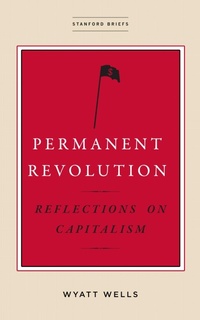
Permanent Revolution
Reflections on Capitalism
Published on 3. March 2020
Book
Paperback/Softback
192 pages
978-1-5036-1237-2 (ISBN)
Description
Permanent Revolution concisely describes the development and workings of capitalism and its influence on the broader society. In the developed world-Europe, North America, and parts of East Asia-capitalism is ubiquitous, and as such, often taken for granted. Discussion usually focuses on specific aspects of the system that individuals appreciate or dislike, ignoring the larger picture. The notion of millennials denouncing capitalism on Facebook and Twitter-products of capitalist development-is a caricature that is eerily close to reality.
In this book, Wyatt Wells examines the development of economic innovation, the role of financial markets, the business cycle, the ways markets operate, and the position of labor in capitalist economies, as well as the effects of capitalism on law, politics, religion, and even the arts. This discussion is grounded in history, though it does make use of economic theory. As a result, the book sometimes approaches topics from an unconventional direction. For instance, it notes that financial markets not only pool and allocate the resources of savers-the role ascribed to them in conventional economics textbooks-but they also discipline enterprises, punishing those unable to meet prescribed financial standards.
Permanent Revolution ranges broadly, delving into how capitalism reshapes the broader society. The system creates wealth in new and, often, unexpected places, and it constantly moves people physically and socially. The result revolutionizes society. Traditional structures based on deference and long experience gradually collapse because they no longer correspond to social reality. Capitalist societies must devise ways to accommodate perpetual change in politics, religion, and society. Much of the diversity, liberty, and flexibility we associate with modern society are the product of capitalist development.
In this book, Wyatt Wells examines the development of economic innovation, the role of financial markets, the business cycle, the ways markets operate, and the position of labor in capitalist economies, as well as the effects of capitalism on law, politics, religion, and even the arts. This discussion is grounded in history, though it does make use of economic theory. As a result, the book sometimes approaches topics from an unconventional direction. For instance, it notes that financial markets not only pool and allocate the resources of savers-the role ascribed to them in conventional economics textbooks-but they also discipline enterprises, punishing those unable to meet prescribed financial standards.
Permanent Revolution ranges broadly, delving into how capitalism reshapes the broader society. The system creates wealth in new and, often, unexpected places, and it constantly moves people physically and socially. The result revolutionizes society. Traditional structures based on deference and long experience gradually collapse because they no longer correspond to social reality. Capitalist societies must devise ways to accommodate perpetual change in politics, religion, and society. Much of the diversity, liberty, and flexibility we associate with modern society are the product of capitalist development.
Reviews / Votes
"A wonderful outline of how capitalism works and a spirited defense of its classical principles. This is a text of great use both to those who celebrate the achievements of capitalism and those who want to critique its basic tenets."-O.A. Westad, Elihu Professor of History and Global Affairs, Yale University "Wyatt Wells' Permanent Revolution is a brisk, lively, and thoroughly original anatomy of, and meditation on, capitalism. At a time when capitalism's future is increasingly being called into question, Wells offers a powerful but balanced defense of this economic system. Broadly conceived and well executed, this book constitutes an important and necessary contribution both to the scholarly literature and to contemporary debates."-Peter A. Coclanis, Albert R. Newsome Distinguished Professor of History and Director of the Global Research Institute, University of North Carolina at Chapel Hill "This is a beautifully written small book about a very big subject: the origin and worldwide spread of dynamic, ever-changing free market economies. Wells celebrates the almost unbelievable material growth achieved by the role-governed competition of risk-taking, profit-seeking entrepreneurs. He evaluates the claims of anticapitalist critics, and explores the often conflicted interaction of economic systems and the broader social realm, including even religion and the arts."-Paul K. Conkin, Distinguished Professor of History, Vanderbilt University "Permanent Revolutionis a superb integrative discussion of capitalism that unites history and economics with its political, cultural, and sociological foundations. When academics typically confine themselves to an in-depth 'silo' of knowledge cut off from other domains, this form of integration is rare and welcome."-Raymond C. Niles, EH.netMore details
Edition
New edition
Language
English
Place of publication
United States
Publishing group
Stanford University Press
Target group
Professional and scholarly
Edition type
New edition
Product notice
Paperback (trade)
Dimensions
Height: 201 mm
Width: 124 mm
Thickness: 13 mm
Weight
227 gr
ISBN-13
978-1-5036-1237-2 (9781503612372)
Copyright in bibliographic data and cover images is held by Nielsen Book Services Limited or by the publishers or by their respective licensors: all rights reserved.
Schweitzer Classification
Other editions
Additional editions
Book
09/2017
Stanford University Press
€18.50
Shipment within 15-20 days
Person
Wyatt Wells is Professor of History at Auburn University at Montgomery.