

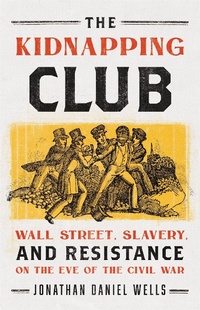
The Kidnapping Club
Wall Street, Slavery, and Resistance on the Eve of the Civil War
Published on 5. November 2020
Book
Hardback
368 pages
978-1-56858-752-3 (ISBN)
Description
Although slavery was outlawed in the northern states in 1827, the illegal slave trade continued in the one place modern readers would least expect, the streets and ports of America's great northern metropolis: New York City.
In The Kidnapping Club, historian Jonathan Daniel Wells takes readers to a rapidly changing city rife with contradiction, where social hierarchy clashed with a rising middle class, Black citizens jostled for an equal voice in politics and culture, and women of all races eagerly sought roles outside the home. It is during this time that the city witnessed an alarming trend: a number of free and fugitive Black men, women, and children were being kidnapped into slavery.
The group responsible, known as the Kidnapping Club, was a frighteningly effective network of judges, lawyers, police officers, and bankers who circumvented northern anti-slavery laws by sanctioning the kidnapping of free Black Americans-selling them into markets in the South, South America, and the Caribbean, for vast sums of wealth. David Ruggles, a Black journalist and abolitionist, worked tirelessly to bring their injustices to light-risking his own freedom in the process and ultimately exposing the vast system of corruption that made New York City rich.
A searing and dramatic history, The Kidnapping Club upends the myth of an abolitionist North at odds with a slavery-loving South. It is a powerful and resonant account of the ties between slavery and capitalism, the deeply corrupt roots of policing in America, and the strength of Black activism.
In The Kidnapping Club, historian Jonathan Daniel Wells takes readers to a rapidly changing city rife with contradiction, where social hierarchy clashed with a rising middle class, Black citizens jostled for an equal voice in politics and culture, and women of all races eagerly sought roles outside the home. It is during this time that the city witnessed an alarming trend: a number of free and fugitive Black men, women, and children were being kidnapped into slavery.
The group responsible, known as the Kidnapping Club, was a frighteningly effective network of judges, lawyers, police officers, and bankers who circumvented northern anti-slavery laws by sanctioning the kidnapping of free Black Americans-selling them into markets in the South, South America, and the Caribbean, for vast sums of wealth. David Ruggles, a Black journalist and abolitionist, worked tirelessly to bring their injustices to light-risking his own freedom in the process and ultimately exposing the vast system of corruption that made New York City rich.
A searing and dramatic history, The Kidnapping Club upends the myth of an abolitionist North at odds with a slavery-loving South. It is a powerful and resonant account of the ties between slavery and capitalism, the deeply corrupt roots of policing in America, and the strength of Black activism.
More details
Language
English
Place of publication
United States
Dimensions
Height: 234 mm
Width: 160 mm
Thickness: 35 mm
Weight
590 gr
ISBN-13
978-1-56858-752-3 (9781568587523)
Copyright in bibliographic data and cover images is held by Nielsen Book Services Limited or by the publishers or by their respective licensors: all rights reserved.
Schweitzer Classification
Other editions
Additional editions
Jonathan Daniel Wells
The Kidnapping Club
Wall Street, Slavery, and Resistance on the Eve of the Civil War
E-Book
10/2020
PublicAffairs
€11.99
Available for download
Person
Jonathan Daniel Wells is a social, cultural, and intellectual historian and a Professor of History in the Departments of Afroamerican and African Studies at the University of Michigan. He is currently a Visiting Scholar at Gonville & Caius College at the University of Cambridge. His published works include The Origins of the Southern Middle Class, Women Writers and Journalists in the Nineteenth-Century South, and A House Divided: The Civil War and Nineteenth-Century America. He lives in Ann Arbor, Michigan.