

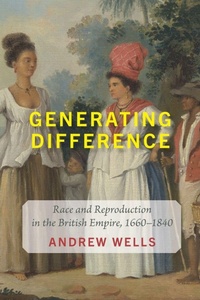
Generating Difference
Race and Reproduction in the British Empire, 1660-1840
Will be published approx. on 13. January 2026
Book
Paperback/Softback
392 pages
978-1-4214-5360-6 (ISBN)
Description
Explores the intersection of racial thought and reproductive science and policy across the British Empire.
In Generating Difference, Andrew Wells traces the entwined histories of race, sex, and reproduction in Britain and its empire during the long eighteenth century. Challenging the assumption that the concept of race evolved in the modern era solely through new forms of biological science, Wells argues that older ideas of lineage, sexual reproduction, and bodily difference remained central to how race was understood, categorized, and enforced well into the nineteenth century.
From the pages of Enlightenment science to colonial policy in the Caribbean, South Asia, and the Pacific, Wells shows how reproductive sex served as a primary framework for defining human differences. Concepts of identity were written onto bodies-especially those marked as non-white or non-male-through perceived differences in anatomy, fertility, and sexuality, albeit never unproblematically. Whether in debates about slavery, interracial relationships, embryology, or population policy, the reproductive body became the crucible in which ideas about race and sex were forged and maintained.
Offering a global scope beyond the Atlantic, including South Asia and the Pacific, and drawing from a wide range of sources-from satire to scientific treatises-Generating Difference brings the scholarship of race and sexuality into direct and compelling conversation. Wells uncovers how deeply reproduction structured imperial ideologies and how the policing of bodies helped naturalize hierarchy, control, and exclusion. At its core, the book reconsiders what made difference "visible" in a period before the dominance of the idea of racial biology.
In Generating Difference, Andrew Wells traces the entwined histories of race, sex, and reproduction in Britain and its empire during the long eighteenth century. Challenging the assumption that the concept of race evolved in the modern era solely through new forms of biological science, Wells argues that older ideas of lineage, sexual reproduction, and bodily difference remained central to how race was understood, categorized, and enforced well into the nineteenth century.
From the pages of Enlightenment science to colonial policy in the Caribbean, South Asia, and the Pacific, Wells shows how reproductive sex served as a primary framework for defining human differences. Concepts of identity were written onto bodies-especially those marked as non-white or non-male-through perceived differences in anatomy, fertility, and sexuality, albeit never unproblematically. Whether in debates about slavery, interracial relationships, embryology, or population policy, the reproductive body became the crucible in which ideas about race and sex were forged and maintained.
Offering a global scope beyond the Atlantic, including South Asia and the Pacific, and drawing from a wide range of sources-from satire to scientific treatises-Generating Difference brings the scholarship of race and sexuality into direct and compelling conversation. Wells uncovers how deeply reproduction structured imperial ideologies and how the policing of bodies helped naturalize hierarchy, control, and exclusion. At its core, the book reconsiders what made difference "visible" in a period before the dominance of the idea of racial biology.
More details
Language
English
Place of publication
Baltimore, MD
United States
Target group
Professional and scholarly
Product notice
Paperback (trade)
Illustrations
21 s/w Abbildungen
21 Illustrations, black and white
Dimensions
Height: 152 mm
Width: 229 mm
Thickness: 25 mm
Weight
606 gr
ISBN-13
978-1-4214-5360-6 (9781421453606)
DOI
10.56021/9781421453606
Copyright in bibliographic data and cover images is held by Nielsen Book Services Limited or by the publishers or by their respective licensors: all rights reserved.
Schweitzer Classification
Person
Andrew Wells is a senior lecturer in early modern history at the Christian-Albrechts-Universitaet zu Kiel in Germany. He is a coeditor of The "Second World" in Contemporary British Writing.
Content
Table of Contents
Acknowledgements
Introduction: (Re)producing Bodies and Identities
1. "The King's Honor": Population and Pronatalism in Greater Britain
2. The Limits of Pronatalism: Slavery and Population in the British Caribbean
3. Gentes and Genitals: Sex in Enlightenment Racial Theory
4. Ex Ovo Omnia: Embryology, Sex, and Race
5. "This race benign": Race and Reproduction in the Pacific, 1760-1820
6. Colonial Ethnogenesis and the Sexual Making of Race
7. Conclusion
Acknowledgements
Introduction: (Re)producing Bodies and Identities
1. "The King's Honor": Population and Pronatalism in Greater Britain
2. The Limits of Pronatalism: Slavery and Population in the British Caribbean
3. Gentes and Genitals: Sex in Enlightenment Racial Theory
4. Ex Ovo Omnia: Embryology, Sex, and Race
5. "This race benign": Race and Reproduction in the Pacific, 1760-1820
6. Colonial Ethnogenesis and the Sexual Making of Race
7. Conclusion