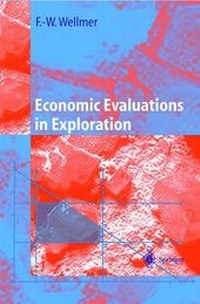
This textbook is a translation of the German textbook "Rechnen fUr Lagerstattenkundler und Rohstoffwirtschaftler, Teil 1" published by the Ellen Pilger Publishing Company. Those passages in the German edition which were especially written for the German readership were transform ed for English speaking readers. Compared with the German edition many chapters have been slightly amended. The main new additions in this English version are the chapter on linear optimization in Chapter 10.2 and Chapter 12 on the comparison of ore deposits. The textbook is intended for the economic geologist who deals with the evaluation of deposits at an early stage of development. Once an ex ploration project has reached the feasibility stage, the exact calculations of the deposit, the technical and economic assessment will be performed by a team of geologists, mining engineers, metallurgists, and economists. In the early stages of exploration, however, any evaluator of deposits has to be able to cover the whole spectrum himself. Since only order of magnitude parameters are available at this stage, the calculations can only yield order of magnitude results. Precise calculations would even be misleading, since the evaluation does not yet aim at accurate economic assessment but at making the right decision: should the investigation be abandoned or should it be continued at higher costs and with more detailed methods.
Reviews / Votes
From the reviews of the second edition:
"This textbook is designed for economic geologists who deal with the evaluation of deposits at an early stage of development. . the book contains a useful list of references and a number of appendices, including tables, graphs, mathematical formulae, and internet addresses. . is a handy reference for practitioners and a useful textbook for students." (Jean-Michel Rendu, Economic Geology, Vol. 103, 2008)
"The textbook is intended for the economic geologist who deals with the evaluation of deposits at an early stage of development. . It provides both the student and the geologist in the field with a complete set of rules and methods enabling them to perform a quick initial evaluation of the deposit without the support of specialists or computers . . The case histories, exercises, metal prices and terminology, especially concerning 'reserves and resources', have been fully updated in this second edition." (Glückauf, Vol. 145 (6), July, 2009)
Edition
1st ed. 1989. Corr. 2nd printing
Language
Place of publication
Publishing group
Target group
College/higher education
Professional and scholarly
Illustrations
10 s/w Tabellen
33 figures, 10 diagrams
Dimensions
Height: 23.5 cm
Width: 15.5 cm
Weight
ISBN-13
978-3-540-50924-0 (9783540509240)
DOI
10.1007/978-3-662-02578-9
Schweitzer Classification
1 Conversions.- 2 Metal Prices.- 3 Calculation of Volume and Tonnage of Ore Deposit.- 4 Weighting and Grade Determination.- 5 Dealing with Data for Multi-Element Deposits.- 6 Conversion of Geological Data into Mining Data for Ore Deposits.- 7 Calculation of the Net Smelter Return (NSR) of a Mine.- 8 Production Lifetime.- 9 Calculation of Cost Data.- 10 Additional Economic Planning Methods.- 11 Economic Evaluations.- 12 Comparison of Deposits.- 13 Calculating Growth Rates.- 14 Equity Calculations.- Annex: Problems Created by the Application of Geometrical Series.- References.- Appendix A: Diagrams for Conversion Between Imperial and Metric Units.- Appendix B: Diagrams to Determine the Thickness Reduction Factors for Drilling Oblique to Strike and Dip at Different Angles of Inclination and Diagram to Determine the Optimal Angle of Inclination of Drill Holes for Drilling Oblique to Strike.- Appendix C: Tables.- Important Abbreviations and Notations.- Conversion Table.- Appendix D: Scales.