

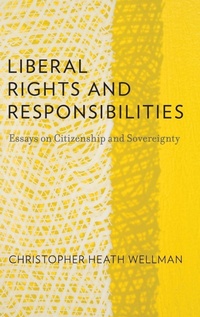
Liberal Rights and Responsibilities
Essays on Citizenship and Sovereignty
Published on 14. November 2013
Book
Hardback
272 pages
978-0-19-998218-9 (ISBN)
Description
The twin questions at the heart of political philosophy are "Why may the state forcibly impose itself on its constituents? " and "Why must citizens obey the state's commands? " In Liberal Rights and Responsibilities, Christopher Heath Wellman offers original responses to these fundamental questions and then, building upon these answers, defends a number of distinctive positions concerning the rights and responsibilities individual citizens, separatist groups, and political states have regarding one another. The first four chapters combine to critically discuss standard theories of political obligation and then to introduce Wellman's samaritan explanation of our duty to obey the law. The next three papers challenge the traditional approaches to group autonomy en route to advancing Wellman's functional account of political self-determination. Next Wellman reviews group responsibility and argues that, in addition to discharging our individual moral duties, each of us must do our share to ensure that the groups to which we belong do not perpetrate injustice. In the ninth chapter, Wellman invokes freedom of association to provide a defense of a legitimate state's right to unilaterally design and enforce an exclusionary immigration policy. The last two essays are on punishment; the first defends the rights forfeiture justification of punishment, and the second combines this rights forfeiture theory with the samaritan account of political legitimacy to explain why legitimate states may permissibly assume exclusive control over the enforcement of criminal law.
Taken as a group, these eleven essays - one new and ten previously published - aim to vindicate a liberal political philosopher's capacity to begin with relatively modest moral principles and still arrive at robust conclusions in favor of the moral standing of legitimate states.
Taken as a group, these eleven essays - one new and ten previously published - aim to vindicate a liberal political philosopher's capacity to begin with relatively modest moral principles and still arrive at robust conclusions in favor of the moral standing of legitimate states.
Reviews / Votes
These essays will engage anyone interested in issues of political obligation to the state and justice beyond borders. It is a collection I warmly recommend. * Thom Brooks, Political Studies Review *More details
Language
English
Place of publication
New York
United States
Target group
College/higher education
Professional and scholarly
Dimensions
Height: 240 mm
Width: 161 mm
Thickness: 21 mm
Weight
625 gr
ISBN-13
978-0-19-998218-9 (9780199982189)
Copyright in bibliographic data and cover images is held by Nielsen Book Services Limited or by the publishers or by their respective licensors: all rights reserved.
Schweitzer Classification
Other editions
Additional editions
E-Book
09/2013
1st Edition
OUP eBook
€46.99
Available for download
Person
Christopher Heath Wellman is Professor of Philosophy at Washington University in St. Louis. He works in ethics, specializing in political and legal philosophy. His previous books include A Theory of Secession (2005); (with John Simmons) Is There a Duty to Obey the Law? (2005); (with Andrew Altman) A Liberal Theory of International Justice (OUP, 2009); and (with Phillip Cole) Debating the Ethics of Immigration: Is There a Right to Exclude? (OUP, 2011).
Content
Acknowledgements ; Introduction ; Chapter One: Associative Allegiances and Political Obligations ; Chapter Two: Relational Facts in Liberal Theory: Is There Magic in the Pronoun "My"? ; Chapter Three: Toward a Liberal Theory of Political Obligation ; Chapter Four: Political Obligation and the Particularity Requirement ; Chapter Five: A Defense of Secession and Political Self-Determination ; Chapter Six: The Truth in the Nationalist Principle ; Chapter Seven: Group Autonomy and State Sovereignty ; Chapter Eight: Responsibility: Personal, Corporate, Collective ; Chapter Nine: Immigration and Freedom of Association ; Chapter Ten: The Rights Forfeiture Theory of Punishment ; Chapter Eleven: Rights and State Punishment ; Index