

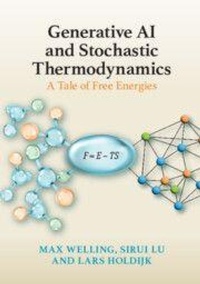
Generative AI and Stochastic Thermodynamics
A Tale of Free Energies
Will be published approx. on 31. July 2026
Book
Hardback
307 pages
978-1-009-70906-4 (ISBN)
Description
Originating from lectures delivered at the African Institute of Mathematical Sciences, this book presents a unifying perspective on traditional and modern methods in generative AI and stochastic thermodynamics. By relating the core topics in machine learning to the notion of (variational) free-energy, a bridge is built between methods such as latent variable models, variational auto-encoders, optimal control, optimal transport, normalizing flows and diffusion models and concepts such as entropy production and fluctuation theorems in stochastic thermodynamics. Structured into three main parts, the book commences by setting up the required mathematical and statistical physics preliminaries needed to make it broadly accessible. The largest part of the book then focuses on building intuition of major advances in generative AI by considering discrete time processes and their relationship to topics in stochastic thermodynamics. Finally, the authors take a short excursion to the continuous time domain for the more advanced learner.
Reviews / Votes
'Just as thermodynamics proved key to understanding the age of steam, stochastic thermodynamics will prove key to understanding the age of AI. This book is the first comprehensive guide to the principles of stochastic thermodynamics and how they relate to modern AI. It is much needed and will be widely read.' Neil Lawrence, University of Cambridge 'Generative AI now shapes science and industry, but its conceptual underpinnings are often opaque even to those who use it daily. This text develops an elegant unifying perspective grounded in the physics of stochastic thermodynamics - an angle no other book has explored at this depth. An inspiring resource for researchers in both fields.' Miranda Cheng, Academia Sinica 'In Generative AI and Stochastic Thermodynamics, Max Welling achieves something rare and thrilling: a beautiful marriage of two deep and historically separate fields, weaving together the principles of modern AI with the elegant formalism of statistical physics. Complex ideas are presented with remarkable clarity and care, never sacrificing mathematical rigor for the sake of accessibility, yet remaining wonderfully approachable throughout. This book is an essential read for anyone working at the intersection of AI and the physical sciences, and I have no doubt it will inspire a new generation of cross-disciplinary thinking.' Rose Yu, UC San Diego 'Generative AI and statistical physics keep rediscovering each other's ideas under different names. This book presents both fields in the same framework and is the most interesting textbook I have read this year. It taught me new things about areas I thought I knew well. I strongly recommend it for anyone interested in AI and physics.' Jascha Sohl-Dickstein, AnthropicMore details
Language
English
Place of publication
Cambridge
United Kingdom
Target group
College/higher education
Illustrations
Worked examples or Exercises
ISBN-13
978-1-009-70906-4 (9781009709064)
Copyright in bibliographic data and cover images is held by Nielsen Book Services Limited or by the publishers or by their respective licensors: all rights reserved.
Schweitzer Classification
Other editions
Additional editions
Lars Holdijk | Max Welling | Sirui Lu
Generative AI and Stochastic Thermodynamics
A Tale of Free Energies
Book
approx. 07/2026
Cambridge University Press
€35.00
Not yet published
Persons
Max Welling is Full Professor in Machine Learning at the University of Amsterdam. He is co-founder and CTO of the startup CuspAI. Professor Welling is a member of the Dutch Royal Academy of Sciences and was the recipient of the ECCV Koenderink Prize in 2010 and the ICML Test of Time award in 2021. Sirui Lu is Doctoral Researcher at the Max Planck Institute of Quantum Optics, Germany. His research directions are the deep integration between (quantum) physics and artificial intelligence. Previously, he obtained his bachelor's degree from the Department of Physics at Tsinghua University, Beijing. Lars Holdijk is Ph.D. student at the University of Oxford. His research focusses on the intersection of Generative Artificial Intelligence, Computational Biochemistry and Statistical Physics.
Content
Preface; Acknowledgement; Why stochastic thermodynamics of machine learning?; Part I. Preliminaries: 1. Mathematical preliminaries; 2. Neural network preliminaries; 3. Physics preliminaries; Part II. Discrete-time Stochastic Dynamics:4. Latent variable models and graphical models; 5. Thermodynamics of probabilistic machine learning; 6. Belief propagation; 7. The variational autoencoder; 8. Normalizing flows; 9. Markov processes and time reversal; 10. Stochastic thermodynamics; 11. Markov chain Monte Carlo; 12. Sequential importance sampling; 13. Variational di?usion models; 14. Schro? dinger bridges; 15. Optimal control; 16. Generative flow networks; 17. Fluctuation theorems; 18. Free energy estimation; 19. Escorted free energy estimations and fluctuation theorems; 20. Hybrid stochastic flows and surjective flows; Part III. Continuous-time Probabilistic Dynamics: 21. Stochastic thermodynamics from the Fokker-Planck equation; 22. Optimal transport and Schro? dinger bridge; 23. Continuous normalizing flows and flow matching; Part IV. Epilogue: 24. Uni?cation: free energy is all you need; Bibliography; Index.