

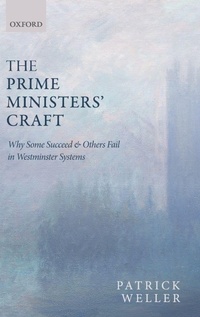
The Prime Ministers' Craft
Why Some Succeed and Others Fail in Westminster Systems
Published on 30. May 2018
Book
Hardback
282 pages
978-0-19-964620-3 (ISBN)
Description
Prime ministers are presented as ever-more powerful figures; at the same time they seem to fail more regularly. How can the public image be so different from the apparent experience? This book seeks to answer this conundrum. It examines the myth that prime ministers are growing more powerful or that prime ministerial government has replaced cabinet government, and explores the way that prime ministers work and how they use the available levers of power to build support across the political system. Prime ministers have the potential to exercise extensive power; to do so they need to exercise the skills and opportunities available: that is, they need to develop the prime ministers' craft.
Using evidence from four countries with similar Westminster systems, Australia, Britain, Canada and New Zealand, the analysis starts at the centre by examining how prime ministers reach office and how they understand their new job -- those who win elections see it differently from those who replace leaders from the same party. The book then analyses the support prime ministers have from their Prime Ministers Offices and the Cabinet Offices, exploring their relations with ministers and the way they run and use their cabinet, and explains how governments work and why prime ministers are so central to their success. The book then explores their role as public figures selling the government to the parliament and the electorate and to the international community beyond.
The Prime Ministers' Craft concludes by assessing how success can be judged and identifies how the different institutional arrangements have an impact on the way prime ministers work and the degree to which they are accountable.
Using evidence from four countries with similar Westminster systems, Australia, Britain, Canada and New Zealand, the analysis starts at the centre by examining how prime ministers reach office and how they understand their new job -- those who win elections see it differently from those who replace leaders from the same party. The book then analyses the support prime ministers have from their Prime Ministers Offices and the Cabinet Offices, exploring their relations with ministers and the way they run and use their cabinet, and explains how governments work and why prime ministers are so central to their success. The book then explores their role as public figures selling the government to the parliament and the electorate and to the international community beyond.
The Prime Ministers' Craft concludes by assessing how success can be judged and identifies how the different institutional arrangements have an impact on the way prime ministers work and the degree to which they are accountable.
Reviews / Votes
Weller compares the experience of the modern PM's role across the "Westminster systems" of New Zealand, the UK, Canada and Australia, producing some (much-needed) fresh insights into the rather claustrophobic world of British politics. * Times Literary Supplement *More details
Language
English
Place of publication
Oxford
United Kingdom
Target group
College/higher education
Dimensions
Height: 240 mm
Width: 161 mm
Thickness: 20 mm
Weight
590 gr
ISBN-13
978-0-19-964620-3 (9780199646203)
Copyright in bibliographic data and cover images is held by Nielsen Book Services Limited or by the publishers or by their respective licensors: all rights reserved.
Schweitzer Classification
Other editions
Additional editions
E-Book
05/2018
1st Edition
OUP eBook
€44.99
Available for download
E-Book
05/2018
1st Edition
OUP eBook
€54.49
Available for download
Person
Patrick Weller is Professor Emeritus, Centre for Governance and Public Policy, School of Government and International Relations, Griffith University. He is the author or co-author of some 20 books on Australian politics, comparative politics, and international organization, including First among Equals (Allen and Unwin,1985), Malcolm Fraser: Prime Minister (Penguin, 1989) Cabinet Government in Australia 1900 to 2006 ( 2007), Westminster Compared (co-authored with R.A.W. Rhodes and John Wanna, 2009), and Kevin Rudd: Twice Prime Minister (Melbourne, University Press, 2014).
Content
1: Prime Ministers: Conundrums and Dilemmas
2: Getting There, Staying There
3: The Job: Assumptions, Visions, and Workloads
4: The Inner Circle: Prime Ministers and Their Advisers
5: Prime Ministers and Their Ministers
6: Prime Ministers and Cabinet Government
7: Prime Ministers, Party, and Parliament
8: Prime Ministers and the Public
9: Prime Ministers as National Leaders
10: Conclusion: Why Prime Ministers Succeed (Or Not)
2: Getting There, Staying There
3: The Job: Assumptions, Visions, and Workloads
4: The Inner Circle: Prime Ministers and Their Advisers
5: Prime Ministers and Their Ministers
6: Prime Ministers and Cabinet Government
7: Prime Ministers, Party, and Parliament
8: Prime Ministers and the Public
9: Prime Ministers as National Leaders
10: Conclusion: Why Prime Ministers Succeed (Or Not)