

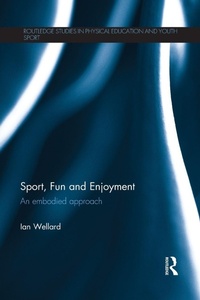
Sport, Fun and Enjoyment
An Embodied Approach
1st Edition
Published on 22. May 2015
Book
Paperback/Softback
148 pages
978-1-138-86040-7 (ISBN)
Description
Sport, Fun and Enjoyment explores the pleasurable aspects of sport within the context of everyday recreational and competitive physical activities. While much recent work has focused on the relationships between physical activity, health and wellbeing, much less attention has been paid to pleasure and fun, key aspects of our engagement with sport but not so easy to measure in terms of specific outcomes. By offering a critical exploration of what can be constituted as 'fun' in a sporting context, this book reveals the complex ways in which individuals approach sport and engage with it throughout the life course.
The book considers the importance of pleasure and fun as a factor in our initial, formative experiences of sport activity, and as a factor in participation and continued participation. It explores the nature of fun as an embodied experience which incorporates a multitude of social, psychological and physiological components, and as a subjective experience which cannot be fully explained through simplistic binary formulations of pleasure and pain. Drawing on a wide research literature and original empirical research with children and adults, the book outlines a new theoretical framework for thinking about pleasure and fun in sport, highlighting the contrasting ways in which sport and physical activity is experienced and the interplay between individual and social contexts.
Sport, Fun and Enjoyment is important reading for anybody with an interest in physical education, youth sport, the sociology of sport, physical activity and health, sport development or sport policy.
The book considers the importance of pleasure and fun as a factor in our initial, formative experiences of sport activity, and as a factor in participation and continued participation. It explores the nature of fun as an embodied experience which incorporates a multitude of social, psychological and physiological components, and as a subjective experience which cannot be fully explained through simplistic binary formulations of pleasure and pain. Drawing on a wide research literature and original empirical research with children and adults, the book outlines a new theoretical framework for thinking about pleasure and fun in sport, highlighting the contrasting ways in which sport and physical activity is experienced and the interplay between individual and social contexts.
Sport, Fun and Enjoyment is important reading for anybody with an interest in physical education, youth sport, the sociology of sport, physical activity and health, sport development or sport policy.
More details
Series
Language
English
Place of publication
London
United Kingdom
Publishing group
Taylor & Francis Ltd
Target group
College/higher education
Illustrations
1 s/w Tabelle
1 Tables, black and white
Dimensions
Height: 234 mm
Width: 156 mm
Thickness: 9 mm
Weight
254 gr
ISBN-13
978-1-138-86040-7 (9781138860407)
Copyright in bibliographic data and cover images is held by Nielsen Book Services Limited or by the publishers or by their respective licensors: all rights reserved.
Schweitzer Classification
Other editions
Additional editions
Book
09/2013
1st Edition
Routledge
€231.10
Shipment within 15-20 days
E-Book
09/2013
1st Edition
Routledge
€64.49
Available for download
E-Book
09/2013
1st Edition
Routledge
€64.49
Available for download
Person
Ian Wellard is a Reader in the Sociology of Sport and Physical Education. His main research interests relate to body practices, masculinities, and sport. Recent books include Sport, Masculinities and the Body and Re-thinking Gender and Youth Sport, both for Routledge.
Content
1. Introduction: Sport and embodied pleasures 2. Theorising sport and body-reflexive pleasures 3. Fun and enjoyment in childhood sports and physical activity 4. Sport, fun and enjoyment for the 'non-sporty' 5. Sporting fun outside the margins 6. Personal reflections and shared stories 7. Conclusions