

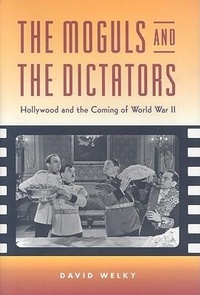
The Moguls and the Dictators
Hollywood and the Coming of World War II
Published on 9. March 2009
Book
Hardback
448 pages
978-0-8018-9044-4 (ISBN)
Description
In this fresh look at moviemaking during the Great Depression, David Welky examines Hollywood's response to the rise of fascism and the beginning of the Second World War. Through innovative analysis of hundreds of movies-including The Dawn Patrol, Goodbye, Mr. Chips, and Sergeant York-Welky traces the shifting motivations and arguments of the film industry, politicians, and the public as they negotiated how-or whether-the silver screen should portray Nazism, depict conflict overseas, promote Americanism, and support President Roosevelt's rearmament efforts. Hollywood, Welky argues, was a primary player in the debate between interventionists and isolationists. These competing groups vied for influence and control over the message Hollywood offered the public-either scorning it for being too timid or attacking it for being too aggressive. The national debate reached a fever pitch in September 1941, when isolationists in the U.S. Senate staged widely publicized hearings, accusing the movie industry of warmongering. While prewar Hollywood often reflected the principles of the Roosevelt administration, it also sometimes outpaced the cautious and politically astute president.
Providing Americans with the psychological preparation they needed to enter World War II, popular movies familiarized audiences with the wartime experience, offered definitions of patriotism and Americanism, and established the fundamental distinctions between democracy and dictatorship. Welky's depth of research and focused, analytical approach will be appreciated by historians as well as film buffs.
Providing Americans with the psychological preparation they needed to enter World War II, popular movies familiarized audiences with the wartime experience, offered definitions of patriotism and Americanism, and established the fundamental distinctions between democracy and dictatorship. Welky's depth of research and focused, analytical approach will be appreciated by historians as well as film buffs.
Reviews / Votes
The research is impeccable and the footnotes are copious, and, despite the number of players involved, the story that Welky tells is nothing less than riveting. His rich anecdotal material transcends any potentially scholastic tone, and as a reference source it is worthy of being 'Kindled.' -- Charles L. Hoyt Internet Review of Books 2008 Well-written and absorbing new history. -- J. Hoberman Film Comment 2009 A superbly researched account of the Depression/pre-War years in Hollywood. Empire 2009 To his credit, Welky's 'Essay on Sources' alone makes the book worthwhile. But there is another approach-that of a historian, not a cinema studies scholar or humanist from a related discipline-that enables him to mine the studio archives and discover material that might elude another's eye. -- Bernard F. Dick Journal of American History 2010 Lively study... What makes The Moguls and the Dictators engrossing is its ability to bring the period, its events and its main protagonists vividly to life. -- Andre Kaenel Cercles 2010 The Moguls and the Dictators is an abundantly detailed, highly informative book that serves both as a useful reference text and as an engaging story, and it is an original and valuable addition to interwar film scholarship. -- Hannah Durkin SCOPE 2010 A fascinating and convincing portrait... Thoroughly researched and engagingly written, The Moguls and the Dictators not only adds to our understanding of Hollywood in the 1930s and 1940s but also provides a valuable model for thinking about the interaction of business and cultural history. -- Benjamin L. Alpers American Historical Review 2010More details
Language
English
Place of publication
Baltimore, MD
United States
Product notice
sewn/stitched
Cloth over boards
With dust jacket
Illustrations
18 s/w Photographien bzw. Rasterbilder
18 Halftones, black and white
Dimensions
Height: 233 mm
Width: 161 mm
Thickness: 38 mm
Weight
751 gr
ISBN-13
978-0-8018-9044-4 (9780801890444)
DOI
10.56021/9780801890444
Copyright in bibliographic data and cover images is held by Nielsen Book Services Limited or by the publishers or by their respective licensors: all rights reserved.
Schweitzer Classification
Person
David Welky is an assistant professor of history at the University of Central Arkansas, the author of Everything Was Better in America: Print Culture and the Great Depression, and coauthor of Charles A. Lindbergh: The Power and Peril of Celebrity. He has also published articles in Film & History and Film Quarterly.
Content
Acknowledgments
Introduction
1. A Wonderful Place
2. Fires at Home, Fires Abroad
3. Fingers in the Dike
4. Misfires
5. New Directions
6. Good Neighbors
7. Serving America
8. The Widening Campaign
9. A Fine Pickle
10. A Winter of Discontent
11. Leading the Way
12. The Pivotal Month
13. Zanuck Makes His Stand
14. Searching for a Voice
15. Closing the Ring
16. Weapons of Inspiration
17. Three Continents-Spring 1941
18. Marching to War
19. Hollywood Triumphant
20. The End of Peace
Conclusion
Notes
Essay on Sources
Index
Introduction
1. A Wonderful Place
2. Fires at Home, Fires Abroad
3. Fingers in the Dike
4. Misfires
5. New Directions
6. Good Neighbors
7. Serving America
8. The Widening Campaign
9. A Fine Pickle
10. A Winter of Discontent
11. Leading the Way
12. The Pivotal Month
13. Zanuck Makes His Stand
14. Searching for a Voice
15. Closing the Ring
16. Weapons of Inspiration
17. Three Continents-Spring 1941
18. Marching to War
19. Hollywood Triumphant
20. The End of Peace
Conclusion
Notes
Essay on Sources
Index