

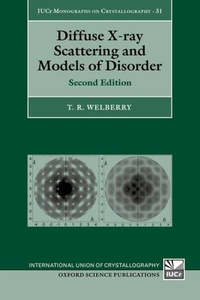
Diffuse X-ray Scattering and Models of Disorder
2nd Edition
Published on 1. May 2022
Book
Hardback
424 pages
978-0-19-886248-2 (ISBN)
Description
Diffuse X-ray scattering is a rich source of local structural information over and above that obtained by conventional crystal structure determination. The main aim of the book is to show how computer simulation of a model crystal provides a general method by which diffuse scattering of all kinds and from all types of materials can be interpreted and analysed.
Since the first edition was published in 2004 there have been major improvements both in the experimental methods for recording diffuse scattering and in our ability to analyse it. The advent of new and better detectors means that fully 3-dimensional diffuse scattering data can be collected routinely for even quite small samples and computational power that is now available has continued its upward trend, meaning modelling calculations inconceivable in 2004 are now routine. The final part of the book traces these recent developments and outlines their future potential in the field.
Since the first edition was published in 2004 there have been major improvements both in the experimental methods for recording diffuse scattering and in our ability to analyse it. The advent of new and better detectors means that fully 3-dimensional diffuse scattering data can be collected routinely for even quite small samples and computational power that is now available has continued its upward trend, meaning modelling calculations inconceivable in 2004 are now routine. The final part of the book traces these recent developments and outlines their future potential in the field.
Reviews / Votes
Diffuse X-ray Scattering and Models of Disorder remains essential reading for anyone interested in diffuse scattering methods -- novice and expert alike. For the novice, there is the helpful background one needs to enter the field, and the advantage of learning from the experience of one of the field's true pioneers. For the expert, the text is rich with nuggets of profound insight into the structures of disordered systems and the relationship between disorder and the scattering function. * A. L. Goodwin, Crystallography News *More details
Series
Edition
2nd Revised edition
Language
English
Place of publication
Oxford
United Kingdom
Target group
Professional and scholarly
Edition type
Revised edition
Product notice
sewn/stitched
Cloth over boards
Illustrations
206 line drawings and photographs
Dimensions
Height: 239 mm
Width: 164 mm
Thickness: 25 mm
Weight
912 gr
ISBN-13
978-0-19-886248-2 (9780198862482)
Copyright in bibliographic data and cover images is held by Nielsen Book Services Limited or by the publishers or by their respective licensors: all rights reserved.
Schweitzer Classification
Other editions
Additional editions
T. R. Welberry
Diffuse X-ray Scattering and Models of Disorder
E-Book
04/2022
1st Edition
OUP Oxford
€192.99
Available for download
Person
Following his PhD degree (1968-1970) in Kathleen Lonsdale's Chemical Crystallography Laboratory at University College, London and a Postdoctoral Fellowship at University College Cardiff, T. R. Welberry was appointed to the Research School of Chemistry at ANU in 1975 and subsequently became full Professor and is now an Emeritus Professor. He was Co-editor of two IUCr Journals over a period of 15 years and is now Editor of International Tables for Crystallography Vol. C.
Content
I EXPERIMENT
1: Measurement of diffuse scattering
II DISORDER MODELS
2: Disorder in one dimension
3: Particular disorder models
4: Displacements in one dimension
5: Disorder in higher dimensions
6: Displacements in two or three dimensions
7: Interactions between occupancies and displacements
III EXAMPLES OF REAL DISORDERED SYSTEMS I
8: 1,3-dibromo-2,5-diethyl-4,6-dimethylbenzene (Bemb2)
9: p-chloro-N-(p-methyl-benzylidene)aniline (MeCl)
10: Urea inclusion compounds
11: Mullite
12: Wuestite
13: Cubic stabilised zirconias
14: Automatic refinement of 1 a Monte Carlo model
15: Further applications of the automatic Monte Carlo 16 method
16: Disorder involving multi-site interactions
17: Strain effects in disordered 1 crystals
18: Miscellaneous examples
IV EXAMPLES OF REAL DISORDERED SYSTEMS II
19: Pentachloronitrobenzene, C6Cl5NO2
20: Polymorphs of Benzocaine, C9H11O2N
21: A new refinement strategy
22: Polymorphism in Aspirin
23: Lead perovskite relaxors, PZN and PMN
24: Pair Distribution Functions (PDF, 3D-PDF and 3D-*DPDF)
1: Measurement of diffuse scattering
II DISORDER MODELS
2: Disorder in one dimension
3: Particular disorder models
4: Displacements in one dimension
5: Disorder in higher dimensions
6: Displacements in two or three dimensions
7: Interactions between occupancies and displacements
III EXAMPLES OF REAL DISORDERED SYSTEMS I
8: 1,3-dibromo-2,5-diethyl-4,6-dimethylbenzene (Bemb2)
9: p-chloro-N-(p-methyl-benzylidene)aniline (MeCl)
10: Urea inclusion compounds
11: Mullite
12: Wuestite
13: Cubic stabilised zirconias
14: Automatic refinement of 1 a Monte Carlo model
15: Further applications of the automatic Monte Carlo 16 method
16: Disorder involving multi-site interactions
17: Strain effects in disordered 1 crystals
18: Miscellaneous examples
IV EXAMPLES OF REAL DISORDERED SYSTEMS II
19: Pentachloronitrobenzene, C6Cl5NO2
20: Polymorphs of Benzocaine, C9H11O2N
21: A new refinement strategy
22: Polymorphism in Aspirin
23: Lead perovskite relaxors, PZN and PMN
24: Pair Distribution Functions (PDF, 3D-PDF and 3D-*DPDF)