

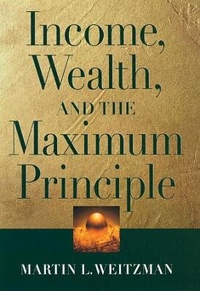
Income, Wealth, and the Maximum Principle
Published on 1. September 2007
Book
Paperback/Softback
358 pages
978-0-674-02576-9 (ISBN)
Description
This compact and original exposition of optimal control theory and applications is designed for graduate and advanced undergraduate students in economics. It presents a new elementary yet rigorous proof of the maximum principle and a new way of applying the principle that will enable students to solve any one-dimensional problem routinely. Its unified framework illuminates many famous economic examples and models.
This work also emphasizes the connection between optimal control theory and the classical themes of capital theory. It offers a fresh approach to fundamental questions such as: What is income? How should it be measured? What is its relation to wealth?
The book will be valuable to students who want to formulate and solve dynamic allocation problems. It will also be of interest to any economist who wants to understand results of the latest research on the relationship between comprehensive income accounting and wealth or welfare.
This work also emphasizes the connection between optimal control theory and the classical themes of capital theory. It offers a fresh approach to fundamental questions such as: What is income? How should it be measured? What is its relation to wealth?
The book will be valuable to students who want to formulate and solve dynamic allocation problems. It will also be of interest to any economist who wants to understand results of the latest research on the relationship between comprehensive income accounting and wealth or welfare.
Reviews / Votes
Martin Weitzman has written an innovative and important new book on dynamic optimization--in particular, the Maximum Principle of optimal control theory--and its application to economics. It is an excellent textbook on optimal control theory, but it is much more than that. It explains how much of capital theory can be formulated in terms of a prototype optimal control problem, and it shows how, in the context of a multisector growth model, the Maximum Principle can be used to obtain a comprehensive measure of national income. Thus, this book will appeal to several different audiences: graduate students in economics, practicing economists with an interest in capital theory, and environmental economists...Weitzman deserves considerable applause for this clear and elegant book. -- Robert S. Pindyck * Journal of Economic Literature *More details
Language
English
Place of publication
Cambridge, Mass
United States
Target group
Professional and scholarly
US School Grade: College Graduate Student
Illustrations
4 line illustrations
Dimensions
Height: 225 mm
Width: 144 mm
ISBN-13
978-0-674-02576-9 (9780674025769)
Copyright in bibliographic data and cover images is held by Nielsen Book Services Limited or by the publishers or by their respective licensors: all rights reserved.
Schweitzer Classification
Other editions
Additional editions
Martin L. Weitzman
Income, Wealth, and the Maximum Principle
E-Book
07/2009
Harvard University Press
€34.79
Available for download
Person
Martin L. Weitzman is Professor of Economics, Harvard University.
Content
Preface Introduction Part I. Introduction to the Maximum Principle 1. The Calculus of Variations and the Stationary Rate of Return on Capital 2. The Prototype-Economic Control Problem 3. The Maximum Principle in One Dimension 4. Applications of the Maximum Principle in One Dimension Part II. Comprehensive Accounting and the Maximum Principle 5. Optimal Multisector Growth and Dynamic Competitive Equilibrium 6. The Pure Theory of Perfectly Complete National Income Accounting 7. The Stochastic Wealth and Income Version of the Maximum Principle References Index