

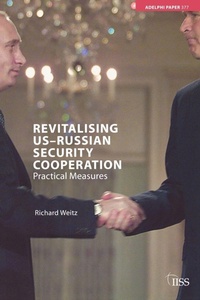
Revitalising US-Russian Security Cooperation
Practical Measures
1st Edition
Published on 7. December 2005
Book
Paperback/Softback
104 pages
978-0-415-39864-0 (ISBN)
Description
Russia and the United States are the most important countries for many vital security issues. They possess the world's largest nuclear weapons arsenals, are involved in the principal regional conflicts, and have lead roles in opposing international terrorism and weapons proliferation. Despite persistent differences on many questions, mutual interests consistently drive Russians and Americans to work together to overcome these impediments.
This Adelphi paper argues that opportunities for improving further security cooperation between Russia and the United States exist but are limited. Near-term results in the areas of formal arms control or ballistic missile defences are unlikely. The two governments should focus on improving and expanding their joint threat reduction and nonproliferation programmes, enhancing their military-to-military dialogue regarding Central Asia and defence industrial cooperation, and deepening their antiterrorist cooperation, both bilaterally and through NATO. Using more market incentives, expanding reciprocity and equal treatment, and limiting the adverse repercussions from disputes over Iran would facilitate progress.
Russia and the United States will not soon become close allies, but they should be able to achieve better security ties given that, on most issues, their shared interests outweigh those that divide them.
This Adelphi paper argues that opportunities for improving further security cooperation between Russia and the United States exist but are limited. Near-term results in the areas of formal arms control or ballistic missile defences are unlikely. The two governments should focus on improving and expanding their joint threat reduction and nonproliferation programmes, enhancing their military-to-military dialogue regarding Central Asia and defence industrial cooperation, and deepening their antiterrorist cooperation, both bilaterally and through NATO. Using more market incentives, expanding reciprocity and equal treatment, and limiting the adverse repercussions from disputes over Iran would facilitate progress.
Russia and the United States will not soon become close allies, but they should be able to achieve better security ties given that, on most issues, their shared interests outweigh those that divide them.
More details
Series
Language
English
Place of publication
London
United Kingdom
Publishing group
Taylor & Francis Ltd
Target group
College/higher education
Professional and scholarly
Dimensions
Height: 234 mm
Width: 156 mm
Thickness: 6 mm
Weight
175 gr
ISBN-13
978-0-415-39864-0 (9780415398640)
Copyright in bibliographic data and cover images is held by Nielsen Book Services Limited or by the publishers or by their respective licensors: all rights reserved.
Schweitzer Classification
Other editions
Additional editions
E-Book
11/2020
1st Edition
Routledge
€39.49
Available for download
E-Book
11/2020
1st Edition
Routledge
€39.49
Available for download
Book
06/2017
1st Edition
Routledge
€252.55
Shipment within 10-20 days
Person
Richard Weitz is a Senior Fellow and Associate Director of Hudson Institute's Center for Future Security Strategies. His special interests include scenario-based planning, European and Asian security issues, terrorism, and defense transformation. He has published articles on these and other topics in The Washington Quarterly , JFQ: Joint Forces Quarterly , The Journal of Strategic Studies , Security Studies , and Political Science Quarterly . Before joining Hudson, Dr. Weitz worked for the Institute for Foreign Policy Analysis, DFI International, Inc., the Center for Naval Analyses, the Office of the Secretary of Defense, the Commission on the Roles and Missions of the Armed Forces of the United States, and as a Lecturer in Social Studies at Harvard University.
Content
Introduction, US-Russian threat-reduction programmes, Futhering Russian-US defence cooperation, Strengtening NATO-Russian ties, Towards better Russia-US security relations.