

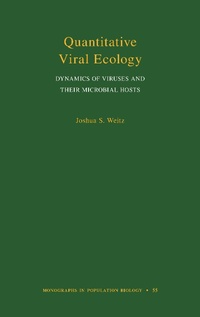
Quantitative Viral Ecology
Dynamics of Viruses and Their Microbial Hosts
Will be published approx. on 5. January 2016
Book
Hardback
360 pages
978-0-691-16154-9 (ISBN)
Description
When we think about viruses we tend to consider ones that afflict humans--such as those that cause influenza, HIV, and Ebola. Yet, vastly more viruses infect single-celled microbes. Diverse and abundant, microbes and the viruses that infect them are found in oceans, lakes, plants, soil, and animal-associated microbiomes. Taking a vital look at the "microscopic" mode of disease dynamics, Quantitative Viral Ecology establishes a theoretical foundation from which to model and predict the ecological and evolutionary dynamics that result from the interaction between viruses and their microbial hosts. Joshua Weitz addresses three major questions: What are viruses of microbes and what do they do to their hosts? How do interactions of a single virus-host pair affect the number and traits of hosts and virus populations? How do virus-host dynamics emerge in natural environments when interactions take place between many viruses and many hosts? Emphasizing how theory and models can provide answers, Weitz offers a cohesive framework for tackling new challenges in the study of viruses and microbes and how they are connected to ecological processes--from the laboratory to the Earth system.
Quantitative Viral Ecology is an innovative exploration of the influence of viruses in our complex natural world.
Quantitative Viral Ecology is an innovative exploration of the influence of viruses in our complex natural world.
Reviews / Votes
Winner of the 2016 Postgraduate Textbook Prize, Royal Society of BiologyMore details
Series
Language
English
Place of publication
New Jersey
United States
Target group
College/higher education
Professional and scholarly
Product notice
Trade binding
Illustrations
4 halftones. 73 line illus.
Dimensions
Height: 236 mm
Width: 157 mm
Thickness: 28 mm
Weight
726 gr
ISBN-13
978-0-691-16154-9 (9780691161549)
Copyright in bibliographic data and cover images is held by Nielsen Book Services Limited or by the publishers or by their respective licensors: all rights reserved.
Schweitzer Classification
Other editions
Additional editions
E-Book
07/2016
1st Edition
Princeton University Press
from
€160.95
Available for download
Person
Joshua S. Weitz is associate professor of biology at the Georgia Institute of Technology.
Content
Acknowledgments xi Preface xiii I VIROLOGY: AN ECOLOGICAL PERSPECTIVE 1 1. What Is a Virus? 3 1.1. What Is a Virus? 3 1.2. Dimensions of Viral Biodiversity 7 1.3. Summary 22 2. Viral Life History Traits 24 2.1. Life History Traits in Ecology 24 2.2. Viral Life Cycle 25 2.3. Traits Associated with Lysis 28 2.4. Traits Associated with Lysogeny 39 2.5. Extracellular Traits 46 2.6. Summary 52 II POPULATION AND EVOLUTIONARY DYNAMICS OF VIRUSES AND THEIR MICROBIAL HOSTS 55 3. Population Dynamics of Viruses and Microbes 57 3.1. On Measurements and Models 57 3.2. Viruses and the "Control" of Microbial Populations 58 3.3. Viruses and Oscillatory Dynamics 74 3.4. Linking Microscopic Details with Dynamics 84 3.5. Summary 88 4. Evolutionary Dynamics of Viruses or Microbes, but Not Both 89 4.1. Viruses and the Nature of Mutation 89 4.2. The Effects of Viruses on Host Evolution 98 4.3. The Effects of Hosts on Viral Evolution 110 4.4. Summary 123 5. Coevolutionary Dynamics of Viruses and Microbes 125 5.1. From Sensitivity Relations to Coevolution 125 5.2. Toward "Novel" Coevolution: On the Probability of Compensating Mutations 129 5.3. The Effect of Coevolution on Host and Viral Population Dynamics 137 5.4. Ecological Effects on the Coevolutionary Dynamics of Types and Traits 146 5.5. Summary 159 III VIRAL ECOLOGY IN THE OCEANS: A MODEL SYSTEM FOR MEASUREMENT AND INFERENCE 161 6. Ocean Viruses: On Their Abundance, Diversity, and Target Hosts 163 6.1. Ways of Seeing 163 6.2. Counting Viruses in the Environment 165 6.3. Estimating Viral Diversity 175 6.4. Virus-Microbe Infection Networks 186 6.5. Summary 199 7. Virus-Host Dynamics in a Complex Milieu 201 7.1. Rosenblueth and Wiener's Cat 201 7.2. Many Viruses and Many Hosts 203 7.3. Nutrients and the Viral "Shunt" 213 7.4. Viruses and Grazers 219 7.5. Summary 235 8. The Future of Quantitative Viral Ecology 236 8.1. Current Challenges, in Theory 236 8.2. On the Future of Quantitative Viral Ecology 239 TECHNICAL APPENDIXES 245 A. Viral Life History Traits 247 A.1. Measuring Viral Life History Traits: A Quantitative Perspective 247 A.2. A Core Technique: The Plaque Assay 248 A.3. Protocols for Life History Trait Estimation 254 B. Population Dynamics of Viruses and Microbes 258 B.1. Host-Associated Life History Traits 258 B.2. Linear Stability Analysis of a Nonlinear Dynamical System 259 B.3. Implicit Resource Dynamics as a Limit of Explicit Resource Dynamics 269 B.4. On Poisson Processes and Mean Field Models 270 B.5. A Note on Simulating Dynamical Systems 272 B.6. Analysis of a Population Dynamics Model with Reinfection of Infected Hosts 276 C. Evolutionary Dynamics of Viruses or Microbes, but Not Both 278 C.1. Models of Independent Mutations Arising in the Growth of Populations 278 C.2. Invasion Criterion for Mutant Viruses with Distinct Life History Traits 280 C.3. Deriving the Canonical Equation of Adaptive Dynamics 281 C.4. Simulating Evolutionary Dynamics 283 D. Ocean Viruses: On Their Abundance, Diversity, and Target Hosts 286 D.1. Protocol for Automatic Estimation of Virus-Like Particles from Digital Images Derived from Epifluorescence Microscopy 286 E. Virus-Host Dynamics in a Complex Milieu 288 E.1. A Multitrophic Model to Quantify the Effects of Marine Viruses on Microbial Food Webs and Ecosystem Processes 288 Bibliography 293 Index 319