

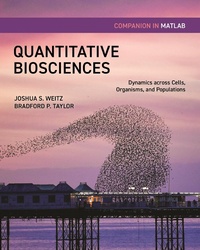
Quantitative Biosciences Companion in MATLAB
Dynamics across Cells, Organisms, and Populations
Published on 5. March 2024
Book
Paperback/Softback
256 pages
978-0-691-25568-2 (ISBN)
Description
A hands-on lab guide in the MATLAB programming language that enables students in the life sciences to reason quantitatively about living systems across scales
This lab guide accompanies the textbook Quantitative Biosciences, providing students with the skills they need to translate biological principles and mathematical concepts into computational models of living systems. This hands-on guide uses a case study approach organized around central questions in the life sciences, introducing landmark advances in the field while teaching students-whether from the life sciences, physics, computational sciences, engineering, or mathematics-how to reason quantitatively in the face of uncertainty.
Draws on real-world case studies in molecular and cellular biosciences, organismal behavior and physiology, and populations and ecological communities
Encourages good coding practices, clear and understandable modeling, and accessible presentation of results
Helps students to develop a diverse repertoire of simulation approaches, enabling them to model at the appropriate scale
Builds practical expertise in a range of methods, including sampling from probability distributions, stochastic branching processes, continuous time modeling, Markov chains, bifurcation analysis, partial differential equations, and agent-based simulations
Bridges the gap between the classroom and research discovery, helping students to think independently, troubleshoot and resolve problems, and embark on research of their own
Stand-alone computational lab guides for Quantitative Biosciences also available in Python and R
This lab guide accompanies the textbook Quantitative Biosciences, providing students with the skills they need to translate biological principles and mathematical concepts into computational models of living systems. This hands-on guide uses a case study approach organized around central questions in the life sciences, introducing landmark advances in the field while teaching students-whether from the life sciences, physics, computational sciences, engineering, or mathematics-how to reason quantitatively in the face of uncertainty.
Draws on real-world case studies in molecular and cellular biosciences, organismal behavior and physiology, and populations and ecological communities
Encourages good coding practices, clear and understandable modeling, and accessible presentation of results
Helps students to develop a diverse repertoire of simulation approaches, enabling them to model at the appropriate scale
Builds practical expertise in a range of methods, including sampling from probability distributions, stochastic branching processes, continuous time modeling, Markov chains, bifurcation analysis, partial differential equations, and agent-based simulations
Bridges the gap between the classroom and research discovery, helping students to think independently, troubleshoot and resolve problems, and embark on research of their own
Stand-alone computational lab guides for Quantitative Biosciences also available in Python and R
More details
Language
English
Place of publication
New Jersey
United States
Target group
Professional and scholarly
Product notice
Paperback (trade)
Illustrations
124 b/w illus.
Dimensions
Height: 254 mm
Width: 203 mm
Thickness: 14 mm
Weight
517 gr
ISBN-13
978-0-691-25568-2 (9780691255682)
Copyright in bibliographic data and cover images is held by Nielsen Book Services Limited or by the publishers or by their respective licensors: all rights reserved.
Schweitzer Classification
Other editions
Additional editions
Joshua S. Weitz | Bradford Taylor
Quantitative Biosciences Companion in MATLAB
Dynamics across Cells, Organisms, and Populations
E-Book
01/2024
University of Pennsylvania Press, Inc.
€24.49
Available for download
Persons
Joshua S. Weitz is professor and the Clark Leadership Chair in Data Analytics in the Department of Biology at the University of Maryland. Previously, he held the Tom and Marie Patton Chair in Biological Sciences at the Georgia Institute of Technology, where he founded the Interdisciplinary Graduate Program in Quantitative Biosciences. He is the author of Quantitative Viral Ecology (Princeton). Bradford P. Taylor is a research associate in the T. H. Chan School of Public Health at Harvard University.