

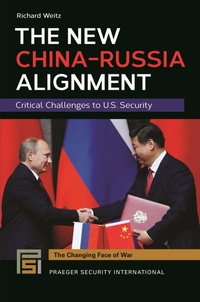
The New China-Russia Alignment
Critical Challenges to U.S. Security
Published on 13. September 2022
Book
Hardback
280 pages
978-1-4408-4736-3 (ISBN)
Description
This volume identifies the main drivers of the current Sino-Russian relationship, assesses whether-and under what conditions-China and Russia would cooperate more extensively and effectively against American interests, and recommends U.S. policies that could prevent such an outcome.
Most experts argue that economic interdependence, nuclear weapons, and the U.S. contribution to maintaining the global commons mean that China and Russia will generally accept U.S. military superiority and U.S. political supremacy in managing global affairs. An agreement between these two powerful countries to work against the United States, however, would greatly increase its vulnerabilities. Relations between the governments of China and Russia with the U.S. have worsened in past years. Identifying the various pathways, events, and political, economic, and military drivers that could shape the dynamics of the China-Russia relationship is of critical importance to U.S. security.
This book examines the sources, nuances, and manifestations of the ongoing Sino-Russian relationship in order to recommend strategy and policy that could work to U.S. advantage. Written by an author who traveled extensively in both countries in order to conduct research and expert interviews for the work, the book covers the latest developments to include the major changes in Chinese foreign policy under President Xi Jinping and ongoing relations with Russian President Vladimir Putin.
Most experts argue that economic interdependence, nuclear weapons, and the U.S. contribution to maintaining the global commons mean that China and Russia will generally accept U.S. military superiority and U.S. political supremacy in managing global affairs. An agreement between these two powerful countries to work against the United States, however, would greatly increase its vulnerabilities. Relations between the governments of China and Russia with the U.S. have worsened in past years. Identifying the various pathways, events, and political, economic, and military drivers that could shape the dynamics of the China-Russia relationship is of critical importance to U.S. security.
This book examines the sources, nuances, and manifestations of the ongoing Sino-Russian relationship in order to recommend strategy and policy that could work to U.S. advantage. Written by an author who traveled extensively in both countries in order to conduct research and expert interviews for the work, the book covers the latest developments to include the major changes in Chinese foreign policy under President Xi Jinping and ongoing relations with Russian President Vladimir Putin.
Reviews / Votes
Miller's book is political history at its best. It paints vivid portraits of the personalities who have shaped Russian policy towards East Asia. * Pacific Affairs * Recommended. Advanced undergraduates through faculty; professionals. * Choice *More details
Series
Language
English
Place of publication
United States
Publishing group
Bloomsbury Publishing Plc
Target group
College/higher education
Professional and scholarly
Illustrations
10 bw illus
Dimensions
Height: 240 mm
Width: 161 mm
Thickness: 20 mm
Weight
590 gr
ISBN-13
978-1-4408-4736-3 (9781440847363)
Copyright in bibliographic data and cover images is held by Nielsen Book Services Limited or by the publishers or by their respective licensors: all rights reserved.
Schweitzer Classification
Other editions
Additional editions
E-Book
09/2022
1st Edition
Praeger Publishers Inc
€33.49
Available for download
E-Book
09/2022
1st Edition
Praeger Publishers Inc
€33.49
Available for download
Person
Richard Weitz is senior fellow and director of the Center for Political-Military Analysis at Hudson Institute, Washington, DC, USA.
Content
Preface
Introduction Trilateral Great Power Politics in Theory and History
Part I Regional Alignments
Chapter 1 Korea
Chapter 2 Japan
Chapter 3 South Asia
Chapter 4 Eurasia
Chapter 5 The Arctic
Part II Functional Interaction
Chapter 6 Security Ties
Chapter 7 Arms Sales
Chapter 8 Arms Control
Chapter 9 The Cyber Domain
Chapter 10 Economics and Energy
Chapter 11 Outer Space
Conclusion Implications and Recommendations
Appendices
Notes
Index
Introduction Trilateral Great Power Politics in Theory and History
Part I Regional Alignments
Chapter 1 Korea
Chapter 2 Japan
Chapter 3 South Asia
Chapter 4 Eurasia
Chapter 5 The Arctic
Part II Functional Interaction
Chapter 6 Security Ties
Chapter 7 Arms Sales
Chapter 8 Arms Control
Chapter 9 The Cyber Domain
Chapter 10 Economics and Energy
Chapter 11 Outer Space
Conclusion Implications and Recommendations
Appendices
Notes
Index