

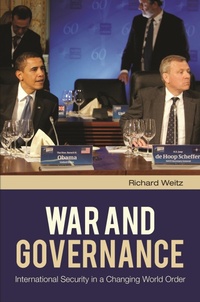
War and Governance
International Security in a Changing World Order
Published on 5. October 2011
Book
Hardback
232 pages
978-0-313-34735-1 (ISBN)
Description
An insightful and expert assessment examines how best to end-and avert-wars.
How do we avoid war? To arrive at an answer, master analyst Richard Weitz explores the ways nations, international organizations, and individuals have sought to bring order to an inherently disorderly phenomenon-potential and actual violent conflict among organized political entities.
Specifically, War and Governance: International Security in a Changing World Order analyzes a number of critical issues such as whether regional security institutions have distinct advantages and liabilities in promoting international security, as compared with universal organizations like the United Nations. Other important questions are addressed, as well. How will international organizations, such as the UN, EU, and NATO, change the nature of war in the 21st century-and be changed by it? What role might less formal institutions and nongovernmental organizations play in peacemaking? Will the nation-state remain the most important international security actor? The book ends with a gap analysis that identifies incongruities between international needs and capabilities-and suggests ways to overcome them.
How do we avoid war? To arrive at an answer, master analyst Richard Weitz explores the ways nations, international organizations, and individuals have sought to bring order to an inherently disorderly phenomenon-potential and actual violent conflict among organized political entities.
Specifically, War and Governance: International Security in a Changing World Order analyzes a number of critical issues such as whether regional security institutions have distinct advantages and liabilities in promoting international security, as compared with universal organizations like the United Nations. Other important questions are addressed, as well. How will international organizations, such as the UN, EU, and NATO, change the nature of war in the 21st century-and be changed by it? What role might less formal institutions and nongovernmental organizations play in peacemaking? Will the nation-state remain the most important international security actor? The book ends with a gap analysis that identifies incongruities between international needs and capabilities-and suggests ways to overcome them.
More details
Series
Language
English
Place of publication
United States
Publishing group
Bloomsbury Publishing Plc
Target group
Interest Age: From 7 to 17 years
Dimensions
Height: 240 mm
Width: 161 mm
Thickness: 17 mm
Weight
517 gr
ISBN-13
978-0-313-34735-1 (9780313347351)
Copyright in bibliographic data and cover images is held by Nielsen Book Services Limited or by the publishers or by their respective licensors: all rights reserved.
Schweitzer Classification
Other editions
Additional editions
E-Book
10/2011
1st Edition
Praeger Publishers Inc
€49.49
Available for download
E-Book
10/2011
1st Edition
Praeger Publishers Inc
€49.49
Available for download
Person
Richard Weitz, PhD, is director of the Center for Political-Military Analysis at the Hudson Institute and the author of Revitalising US-Russian Security Cooperation: Practical Measures.
Content
Chapter 1 Introduction
Chapter 2 The United Nations
Chapter 3 The Group of Eight
Chapter 4 The African Union
Chapter 5 Case Study: Kosovo
Chapter 6 Case Study: Somali Pirates
Chapter 7 Concluding Observations
Notes
Index
Chapter 2 The United Nations
Chapter 3 The Group of Eight
Chapter 4 The African Union
Chapter 5 Case Study: Kosovo
Chapter 6 Case Study: Somali Pirates
Chapter 7 Concluding Observations
Notes
Index