

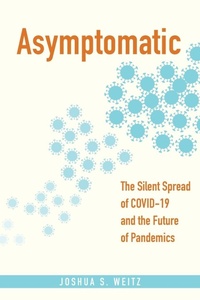
Asymptomatic
The Silent Spread of COVID-19 and the Future of Pandemics
Published on 22. October 2024
Book
Paperback/Softback
272 pages
978-1-4214-5048-3 (ISBN)
Description
The riveting account of how asymptomatic transmission drove COVID-19's global spread and catalyzed interventions to control it.
Why was COVID-19 so difficult to contain and so devastating to people and economies worldwide? In Asymptomatic, author Joshua S. Weitz explains how silent transmission enabled COVID-19's massive and tragic global impact.
Weaving the science of viral infections together with an insider's look at response efforts, Weitz guides readers through the shockwaves of successive epidemic waves as public health officials and academic research teams confronted the rise and risk of what was then a burgeoning global pandemic. The discovery of asymptomatic spread also fueled competing narratives: either COVID-19 was about to dissipate as quickly as it had emerged or completely disrupt life as we knew it.
Weitz, a physicist-turned-biologist who directs a quantitative viral dynamics research group and has been immersed in COVID-19 response efforts, explains both why and how scientists tried to wade through competing narratives and warn the public of COVID-19's profound risk. As explored through a careful analysis of local outbreaks, accessible descriptions of virus dynamics, and the use of predictive models to guide response efforts, Asymptomatic provides readers a unique look into the secret ingredient that allowed COVID-19 to spread across borders and the high-impact interventions needed to fight it and future pandemics.
Why was COVID-19 so difficult to contain and so devastating to people and economies worldwide? In Asymptomatic, author Joshua S. Weitz explains how silent transmission enabled COVID-19's massive and tragic global impact.
Weaving the science of viral infections together with an insider's look at response efforts, Weitz guides readers through the shockwaves of successive epidemic waves as public health officials and academic research teams confronted the rise and risk of what was then a burgeoning global pandemic. The discovery of asymptomatic spread also fueled competing narratives: either COVID-19 was about to dissipate as quickly as it had emerged or completely disrupt life as we knew it.
Weitz, a physicist-turned-biologist who directs a quantitative viral dynamics research group and has been immersed in COVID-19 response efforts, explains both why and how scientists tried to wade through competing narratives and warn the public of COVID-19's profound risk. As explored through a careful analysis of local outbreaks, accessible descriptions of virus dynamics, and the use of predictive models to guide response efforts, Asymptomatic provides readers a unique look into the secret ingredient that allowed COVID-19 to spread across borders and the high-impact interventions needed to fight it and future pandemics.
Reviews / Votes
Weitz gives us a work that will surely be remembered as a modern classic on topics related to epidemics, and a shining example of how one need not sacrifice technical rigor for social relevance.-C Brandon Ogbunugafor, Virus Evolution [Asymptomatic] is a satisfying read...This book helps readers understand the complexity of the problem, situational awareness, and the dangers of relying solely on complex computer modeling and simulations alone.
- (c) Doody's Review Service, 2025
More details
Language
English
Place of publication
Baltimore, MD
United States
Target group
Professional and scholarly
Product notice
Paperback (trade)
Illustrations
34 s/w Abbildungen
34 Illustrations, black and white
Dimensions
Height: 229 mm
Width: 152 mm
Thickness: 17 mm
Weight
449 gr
ISBN-13
978-1-4214-5048-3 (9781421450483)
DOI
10.56021/9781421450483
Copyright in bibliographic data and cover images is held by Nielsen Book Services Limited or by the publishers or by their respective licensors: all rights reserved.
Schweitzer Classification
Person
Joshua S. Weitz (ROCKVILLE, MD) is a professor of biology and the Clark Leadership Chair in Data Analytics at the University of Maryland. He is a fellow of the American Association for the Advancement of Science, a fellow of the American Academy of Microbiology, a Simons Foundation Investigator in the Theoretical Physics of Living Systems, and the author of Quantitative Viral Ecology: Dynamics of Viruses and Their Microbial Hosts and Quantitative Biosciences: Dynamics across Cells, Organisms, and Populations.