

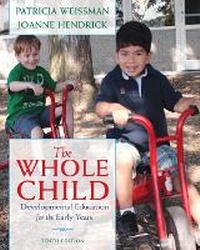
Whole Child, The
Developmental Education for the Early Years
10th Edition
Published on 29. May 2013
Book
Hardback
496 pages
978-0-13-285342-2 (ISBN)
Description
The Whole Child, 10/e, written in a warm and engaging style by Patricia Weissman and Joanne Hendrick,is a complete, practical, and hands-on book that uses a developmental domain approach to educate readers about young children from infancy through age 8. The authors believe that physical and emotional health are fundamental to the well-being of children and provide practical methods and materials that address the entire individual, not just curriculum topics. This text focuses on the "whole child" and what he/she needs from the learning environment in order to thrive. It pictures the child as being made up of "selves" - emotional, social, physical, creative, and cognitive...examines each of those selves in turn in separate chapters...and recommends methods and materials for enhancing growth in each area. This popular text is unique in that it combines a practical, realistic approach with a firm foundation in pertinent research topics. With an emphasis on emergent curriculum, intentional teaching, and the Reggio approach, students learn about quality teaching in a way that is accessible and encouraging to the novice teacher and presented to the reader in such a way that encourages linkage between theory and practice.
More details
Other editions
Previous edition
Book
05/2009
9th Edition
Pearson
€97.79
Article exhausted; check for reprint
Persons
Patricia Weissman, Ph.D., is co-author with Joanne Hendrick of two renowned early childhood college textbooks: The Whole Child: Developmental Education for the First Early Years (Pearson, 2010) and Total Learning: Developmental Curriculum for the Young Child (Pearson, 2011). Dr. Weissman began her early childhood career as a family care provider for two infants. Having found her calling, she studied early childhood education and received a doctorate of education from the University of San Francisco. During the past 35 years, she has worked as an infant caregiver, pre-primary teacher, center director, Child Development Associate (CDA) and Head Start advisor, professor of early childhood education, and research associate at the Merrill-Palmer Institute of Wayne State University. She attended two study tours of the early childhood program in Reggio Emilia, Italy and was the founding editor of the journal Innovations in Early Education: The International Reggio Exchange. Dr. Weissman also designed and consulted on the production of the Public Broadcasting Service video series title The Whole Child: A Caregiver's Guide to the First Five Years. Most recently she has returned to her first love of caring for infants and has served as a consultant to the International Nanny Association.
Joanne Hendrick is professor emerita of early childhood education from the University of Oklahoma. In addition to raising four children of her own, her practical experience includes working with children at the Stanford Speech and Hearing Clinic, directing a parent-child workshop, working in Head Start, and chairing the early childhood areas at Santa Barbara City College and the University of Oklahoma. She holds an undergraduate degree from Stanford University in disorders of speech and hearing, and graduate degrees from the University of California in counseling and early childhood education. She is past-president of the California Association for the Education of Young Children. Her current interests include gardening, photography, traveling to exotic places, writing about young children, and enjoying her ten grandchildren.
Joanne Hendrick is professor emerita of early childhood education from the University of Oklahoma. In addition to raising four children of her own, her practical experience includes working with children at the Stanford Speech and Hearing Clinic, directing a parent-child workshop, working in Head Start, and chairing the early childhood areas at Santa Barbara City College and the University of Oklahoma. She holds an undergraduate degree from Stanford University in disorders of speech and hearing, and graduate degrees from the University of California in counseling and early childhood education. She is past-president of the California Association for the Education of Young Children. Her current interests include gardening, photography, traveling to exotic places, writing about young children, and enjoying her ten grandchildren.
Content
Part I The Basics of Good Early Childhood Education
Chapter 1 What Is Good Education for Young Children?
Chapter 2 Collaborating with Families
Chapter 3 Fostering Creativity in Play
Chapter 4 Providing Cross-Cultural, Nonsexist Education
Chapter 5 Welcoming Children Who Have Special Education Requirements
Chatper 6 Using Standards and Assessment in Early Childhood Education
Chapter 7 Arranging a Good Day for Young Children: Daily Routines and a Supportive Classroom Environment
Part II Supporting the Development of the Whole Child
Chapter 8 Promoting the Development of the Physical Self
Chapter 9 Strengthening the Development of the Emotional Self
Chapter 10 The Social Self: Encouraging Social Competence in Young Children
Chapter 11 The Social Self: Fostering Self-Discipline and Conflict Resolution Skills
Chatper 12 Fostering the Development of Language Skills
Chapter 13 Fostering the Emergence of Literacy
Chapter 14 Supporting the Development of the Cognitive Self
Chapter 15 Nurturing the Development of the Creative Self
Chapter 16 Developing the Whole Child; Becoming the Whole Teacher
Chapter 1 What Is Good Education for Young Children?
Chapter 2 Collaborating with Families
Chapter 3 Fostering Creativity in Play
Chapter 4 Providing Cross-Cultural, Nonsexist Education
Chapter 5 Welcoming Children Who Have Special Education Requirements
Chatper 6 Using Standards and Assessment in Early Childhood Education
Chapter 7 Arranging a Good Day for Young Children: Daily Routines and a Supportive Classroom Environment
Part II Supporting the Development of the Whole Child
Chapter 8 Promoting the Development of the Physical Self
Chapter 9 Strengthening the Development of the Emotional Self
Chapter 10 The Social Self: Encouraging Social Competence in Young Children
Chapter 11 The Social Self: Fostering Self-Discipline and Conflict Resolution Skills
Chatper 12 Fostering the Development of Language Skills
Chapter 13 Fostering the Emergence of Literacy
Chapter 14 Supporting the Development of the Cognitive Self
Chapter 15 Nurturing the Development of the Creative Self
Chapter 16 Developing the Whole Child; Becoming the Whole Teacher