

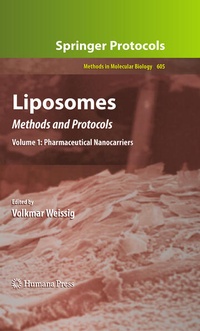
Liposomes
Methods and Protocols, Volume 1: Pharmaceutical Nanocarriers
1st Edition
Published on 18. December 2009
Book
Hardback
XIV, 564 pages
978-1-60327-359-6 (ISBN)
Description
Efforts to describe and model the molecular structure of biological membranes go back to the beginning of the last century. In 1917, Langmuir described membranes as a layer of lipids one molecule thick [1]. Eight years later, Gorter and Grendel concluded from their studies that "the phospholipid molecules that formed the cell membrane were arranged in two layers to form a lipid bilayer" [2]. Danielli and Robertson proposed, in 1935, a model in which the bilayer of lipids is sequestered between two monolayers of unfolded proteins [3], and the currently still accepted fuid mosaic model was proposed by Singer and Nicolson in 1972 [4]. Among those landmarks of biomembrane history, a serendipitous observation made by Alex Bangham during the early 1960s deserves undoubtedly a special place. His fnding that exposure of dry phospholipids to an excess of water gives rise to lamellar structures [5] has opened versatile experimental access to studying the biophysics and biochemistry of biological phospholipid membranes. Although during the following 4 decades biological membrane models have grown in complexity and functionality [6], liposomes are, besides supported bilayers, membrane nanodiscs, and hybrid membranes, still an indisputably important tool for membrane b- physicists and biochemists. In vol. II of this book, the reader will fnd detailed methods for the use of liposomes in studying a variety of biochemical and biophysical membrane phenomena concomitant with chapters describing a great palette of state-of-the-art analytical technologies.
Reviews / Votes
From the reviews:
"The book provides in-depth descriptions of tumor and gene therapies, focusing on cationic liposomes. . The book presents the most seminal studies on the application of liposomes in the pharmaceutical area published over the past two decades. . the content provides the reader with a comprehensive overview of the topic and constitutes essential reading for those working or intending to work in the development of drug nanocarriers." (Nádia Araci Bou Chacra, Brazilian Journal of Pharmaceutical Sciences, Vol. 46 (4), October-December, 2010)
"Provide a comprehensive guide to the preparation, characterisation, and potential use of currently known types of liposomes. They are written using an interdisciplinary approach, and so provide essential knowledge of liposomes, for not only researchers in this particular field, but also scientists in wider pharmaceutical and biological areas. . very inspiring - the potential for liposomes is immense - and these well-written chapters ignited notions of further applications - this is clearly a very exciting field." (Trudy L. Knight, BTS Newsletter, Issue 37, Winter, 2010)More details
Series
Language
English
Place of publication
Totowa
United States
Target group
Professional and scholarly
Professional/practitioner
Illustrations
XIV, 564 p.
Dimensions
Height: 260 mm
Width: 183 mm
Thickness: 40 mm
Weight
1405 gr
ISBN-13
978-1-60327-359-6 (9781603273596)
DOI
10.1007/978-1-60327-360-2
Schweitzer Classification
Other editions
Additional editions
Book
08/2016
Humana Press Inc.
€117.69
Shipment within 15-20 days
Content
Current Trends in Liposome Research.- Nanoliposomes: Preparation and Analysis.- Preparation of DRV Liposomes.- Elastic Liposomes for Topical and Transdermal Drug Delivery.- Archaebacterial Tetraetherlipid Liposomes.- Cationic Magnetoliposomes.- Ultrasound-Responsive Liposomes.- Liposome Formulations of Hydrophobic Drugs.- Remote Loading of Anthracyclines into Liposomes.- Arsonoliposomes: Preparation and Physicochemical Characterization.- Liposome-Based Vaccines.- Mannosylated Liposomes for Targeted Vaccines Delivery.- Liposomes for Specific Depletion of Macrophages from Organs and Tissues.- Vesicular Phospholipid Gels.- Environment-Responsive Multifunctional Liposomes.- Functional Liposomal Membranes for Triggered Release.- A "Dock and Lock" Approach to Preparation of Targeted Liposomes.- Conjugation of Ligands to the Surface of Preformed Liposomes by Click Chemistry.- Targeted Magnetic Liposomes Loaded with Doxorubicin.- Liposomes for Drug Delivery to Mitochondria.- Cytoskeletal-Antigen Specific Immunoliposomes: Preservation of Myocardial Viability.- Gadolinium-Loaded Polychelating Polymer-Containing Tumor-Targeted Liposomes.- Angiogenic Vessel-Targeting DDS by Liposomalized Oligopeptides.- TAT-Peptide Modified Liposomes: Preparation, Characterization, and Cellular Interaction.- ATP-Loaded Liposomes for Targeted Treatment in Models of Myocardial Ischemia.- Intracellular ATP Delivery Using Highly Fusogenic Liposomes.- Lipoplex Formation Using Liposomes Prepared by Ethanol Injection.- Acid-Labile Liposome/pDNA Complexes.- Serum-Resistant Lipoplexes in the Presence of Asialofetuin.- Anionic pH Sensitive Lipoplexes.- Liposomal siRNA Delivery.- Complexation of siRNA and pDNA with Cationic Liposomes: The Important Aspects in Lipoplex Preparation.- Effective In Vitro andIn Vivo Gene Delivery by the Combination of Liposomal Bubbles (Bubble Liposomes) and Ultrasound Exposure.- Liposomal Magnetofection.- Long-Circulating, pH-Sensitive Liposomes.- Serum-Stable, Long-Circulating, pH-Sensitive PEGylated Liposomes.