

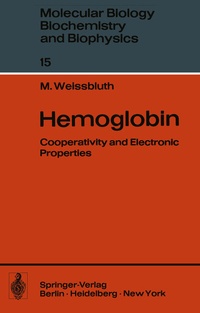
Hemoglobin
Cooperativity and Electronic Properties
Published on 15. December 2011
Book
Paperback/Softback
VIII, 176 pages
978-3-642-80803-6 (ISBN)
Description
Approximately one third of the mass of a mammalian red blood cell is hemo globin. Its major function is to bind oxygen at the partial pressure prevailing in the lungs and to release it to the tissues where the partial pressure is lower. The process whereby hemoglobin performs this essential physiological role is characterized by a cooperative interaction among its constituent subunits. A great deal of research effort has been devoted to this interaction, going back at least as far as the fitst decade of this century. Moreover, cooperativity in hemo globin is probably not unique; it may well be one instance of a general class of interactions that occur in biological molecules. Certain enzymes with a variety of regulatory and catalytic functions, for example, contain several sites which interact in a highly specific manner such that the affinity of a given site for the substrate is markedly influenced by the state of binding at the other sites. But whereas we know very little of the structure of most enzymes of this type, hemo globin is one of a very small number of biological molecules whose immensely intricate machinery has been revealed to us. We owe this insight to the group under the leadership of M. F. PERUTZ in Cambridge, England, whose research over a period of several decades culminated in a detailed description of the three dimensional structure.
More details
Series
Edition
Softcover reprint of the original 1st ed. 1974
Language
English
Place of publication
Berlin
Germany
Publishing group
Springer Berlin
Target group
Professional and scholarly
Research
Illustrations
1 s/w Abbildung
VIII, 176 p. 1 illus.
Dimensions
Height: 244 mm
Width: 156 mm
Thickness: 11 mm
Weight
314 gr
ISBN-13
978-3-642-80803-6 (9783642808036)
DOI
10.1007/978-3-642-80801-2
Schweitzer Classification
Other editions
Additional editions
E-Book
12/2012
Springer
€96.29
Available for download
Book
06/1974
1st Edition
Springer
€139.09
Article exhausted; check different version
Content
I Amino Acids, Peptides and Proteins.- 1.1 Amino Acids.- 1.2 Peptides.- 1.3 Proteins.- II Hemoglobin.- 2.1 Primary Structure.- 2.2 Spin States.- 2.3 Heme.- 2.4 Secondary and Tertiary Structure.- 2.5 Quaternary Structure.- 2.6 Dissociated Hemoglobin.- III Oxygenation Characteristics.- 3.1 Equilibrium Curves.- 3.2 Quantitative Description.- 3.3 The Bohr Effect.- 3.4 Thermodynamic and Kinetic Properties.- IV Approaches to Cooperativity.- 4.1 The Monod-Wyman-Changeux (MWC) Model.- 4.2 The Koshland-Nemethy-Filmer (KNF) Model.- 4.3 Stereochemical Theory.- 4.4 Magnetic Resonance.- 4.5 Discussion.- V Electronic States of Iron.- 5.1 Free Ions.- 5.2 Cubic Symmetry.- 5.3 Tetragonal and Rhombic Symmetries.- 5.4 One-Electron Energies.- 5.5 Multielectron Configurations.- 5.6 Kramers Theorem.- 5.7 The Jahn-Teller Effect.- 5.8 Molecular Orbitals.- VI Magnetic Properties.- 6.1 General Features.- 6.2 Electron Spin Resonance of Low-Spin Ferrihemoglobin.- 6.3 Electron Spin Resonance of High-Spin Ferrihemoglobin.- 6.4 Paramagnetic Susceptibility.- 6.5 Discussion.- VII Molecular Orbitals and Optical Spectra.- 7.1 Computational Method.- 7.2 Results of Molecular Orbital Calculations.- 7.3 Optical Spectra.- VIII Mossbauer Spectroscopy.- 8.1 General Features.- 8.2 Mossbauer Spectra of Hemoglobin.- 8.3 Theoretical Interpretation and Discussion.- IX Further Aspects.- 9.1 Diamagnetism of Oxyhemoglobin.- 9.2 The Jahn-Teller Effect and Cooperativity in Hemoglobin.- References.