

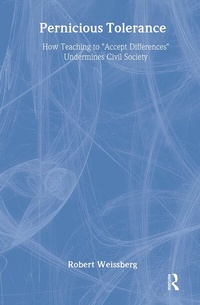
Pernicious Tolerance
How Teaching to Accept Differences Undermines Civil Society
1st Edition
Will be published approx. on 15. March 2008
Book
Hardback
183 pages
978-1-4128-0695-4 (ISBN)
Description
Recent decades have seen a consistent effort by the American educational establishment to instruct schoolchildren about the importance of "appreciating differences," all in the name of "tolerance," so as to quell burgeoning "hate." In Pernicious Tolerance, Robert Weissberg argues that educators' endless obsession with homophobia, sexism, racism, and other alleged hateful disorders is part of a much larger ongoing radical ideological quest to transform America, by first capturing education.
In pursuing their objectives, radical pedagogues have abandoned the idea of tolerance of what some find objectionable. In its place they have adopted a fantasy-that tolerance can be replaced with a blank-check appreciation of diversity. Weissberg argues that this approach is guaranteed to promote civil strife. In rejecting a more workable version of tolerance, today's professional educators risk civic disaster in an effort to achieve legitimacy for those they believe are unfairly marginalized, stigmatized, underappreciated, and otherwise disdained.
Weissberg also addresses the issue of an ever-expanding welfare state not only concerned with our material being, but, critically, also with our "mental health," defined as beliefs about the vulnerable or victims in waiting-women, ethnic and racial minorities, homosexuals, and others. He shows that this therapeutic state does not stop at imploring good thinking; it goes much further and criminalizes evil thoughts, as if thinking poorly of those at risk is tantamount to inflicting bodily harm. There is substantial collateral damage in this quest for tolerance; it facilitates intellectual sloth while raising anti-intellectualism to an honored professional norm.
In pursuing their objectives, radical pedagogues have abandoned the idea of tolerance of what some find objectionable. In its place they have adopted a fantasy-that tolerance can be replaced with a blank-check appreciation of diversity. Weissberg argues that this approach is guaranteed to promote civil strife. In rejecting a more workable version of tolerance, today's professional educators risk civic disaster in an effort to achieve legitimacy for those they believe are unfairly marginalized, stigmatized, underappreciated, and otherwise disdained.
Weissberg also addresses the issue of an ever-expanding welfare state not only concerned with our material being, but, critically, also with our "mental health," defined as beliefs about the vulnerable or victims in waiting-women, ethnic and racial minorities, homosexuals, and others. He shows that this therapeutic state does not stop at imploring good thinking; it goes much further and criminalizes evil thoughts, as if thinking poorly of those at risk is tantamount to inflicting bodily harm. There is substantial collateral damage in this quest for tolerance; it facilitates intellectual sloth while raising anti-intellectualism to an honored professional norm.
More details
Language
English
Place of publication
New York
United States
Publishing group
Taylor & Francis Inc
Target group
Professional and scholarly
Dimensions
Height: 229 mm
Width: 152 mm
Weight
362 gr
ISBN-13
978-1-4128-0695-4 (9781412806954)
Copyright in bibliographic data and cover images is held by Nielsen Book Services Limited or by the publishers or by their respective licensors: all rights reserved.
Schweitzer Classification
Other editions
Additional editions
E-Book
07/2017
1st Edition
Routledge
€64.49
Available for download
E-Book
07/2017
Routledge
€64.49
Available for download
Book
11/2011
1st Edition
Routledge
€64.00
Shipment within 10-15 days
Person
Robert Weissberg is professor of political science emeritus, University of Illinois-Urbana. He is the author of Polling Policy and Public Opinion, The Politics of Empowerment, Political Tolerance, Political Learning, Political Choice, and Democratic Citizenship, and The Limits of Civic Activism (available from Transaction).
Content
1: Two Tolerance Visions: From John Locke to PBS; 2: Some Arduous Choices on the Road to Social Harmony; 3: Preaching the Tolerance Gospel; 4: Empirical Foundations; 5: Bringing Tolerance by Criminalizing Hate; 6: Summing Up and a Disconcerting Alert