

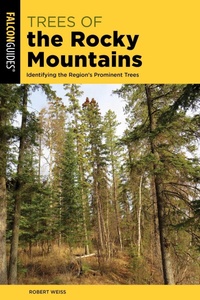
Trees of the Rocky Mountains
Identifying the Region's Prominent Trees
Published on 17. August 2025
Book
Paperback/Softback
200 pages
978-1-4930-8652-8 (ISBN)
Description
Trees of the Rocky Mountains will fill a gap in Falcon's nature category by providing readers with a dedicated guidebook to identifying the most prominent tree species occurring in the Rocky Mountain region of North America. This guide will cover a selection of the most prominent native and naturalized tree species of the iconic Rocky Mountain region spanning Colorado, Wyoming, Montana, Utah, and Idaho.
Each species will get a full description detailing shape and form, physical characteristics, habitat, wildlife uses, and information on identifying potential signs of disease and damage. Each species entry will include multiple photographs, detailing the tree's bark, needles/leaves, seeds/pinecones, and overall appearance.
Each species will get a full description detailing shape and form, physical characteristics, habitat, wildlife uses, and information on identifying potential signs of disease and damage. Each species entry will include multiple photographs, detailing the tree's bark, needles/leaves, seeds/pinecones, and overall appearance.
More details
Language
English
Place of publication
United States
Publishing group
Rowman & Littlefield
Product notice
Paperback (trade)
Illustrations
317 Color Photos, 61 Maps, 6 Tables
Dimensions
Height: 222 mm
Width: 152 mm
Thickness: 15 mm
Weight
366 gr
ISBN-13
978-1-4930-8652-8 (9781493086528)
Copyright in bibliographic data and cover images is held by Nielsen Book Services Limited or by the publishers or by their respective licensors: all rights reserved.
Schweitzer Classification
Person
Robert Weiss has been a botanist for 20 years and more recently an arborist, focusing on vascular and non-vascular plant surveys, noxious weed management, and seed collections. He has performed wetland delineations and tree hazard assessments. He has experience with vegetation surveys along utility lines and technical report writing. Most of his work as a botanist and arborist has been on the West Coast of the United States in Washington, Oregon, and California.