

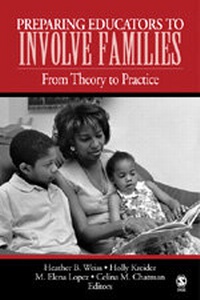
Preparing Educators to Involve Families
From Theory to Practice
1st Edition
Published on 3. June 2005
Book
Hardback
216 pages
978-1-4129-0909-9 (ISBN)
Description
'This book is a valuable resource for my course because I want students to think deeply about issues affecting children and families and to be advocates for them. Without serious reflection about systems theory, students are not able to move beyond simplistic solutions. The author does a superb job in conveying the book's usefulness' - Leo R. Sandy, Plymouth State University
'The authors frame the issues well, integrate the literature, and place the cases in theoretical perspective. The cases have the virtue of being grounded in experience. It is jargon free. The sections are crisp. It's very readable. It's a good starting point for further research' - Helen M. Marks, Ohio State University
'This is a thought-provoking and dynamic text that brings to light many key issues facing today's educators' - Amy J. Malkus, East Tennessee State University
'This book is guaranteed to engage the reader in thoughtful consideration of their role in family involvement and the important role played by parents and children themselves' - Ithel Jones, Florida State University
The goal of Preparing Educators to Involve Families: From Theory to Practice is to help prepare teachers and other professionals to partner effectively with the families of children in elementary school. The book pairs perspectives on child development with teaching cases that reflect critical dilemmas of practice in family-school-community relations, especially among families for whom poverty and cultural differences are daily realities.
Readers are encouraged to link theory and practice, honing their analytic and problem-solving skills through the application of theory to the real-life situations of school children and the key individuals and contexts in their lives and learning.
'The authors frame the issues well, integrate the literature, and place the cases in theoretical perspective. The cases have the virtue of being grounded in experience. It is jargon free. The sections are crisp. It's very readable. It's a good starting point for further research' - Helen M. Marks, Ohio State University
'This is a thought-provoking and dynamic text that brings to light many key issues facing today's educators' - Amy J. Malkus, East Tennessee State University
'This book is guaranteed to engage the reader in thoughtful consideration of their role in family involvement and the important role played by parents and children themselves' - Ithel Jones, Florida State University
The goal of Preparing Educators to Involve Families: From Theory to Practice is to help prepare teachers and other professionals to partner effectively with the families of children in elementary school. The book pairs perspectives on child development with teaching cases that reflect critical dilemmas of practice in family-school-community relations, especially among families for whom poverty and cultural differences are daily realities.
Readers are encouraged to link theory and practice, honing their analytic and problem-solving skills through the application of theory to the real-life situations of school children and the key individuals and contexts in their lives and learning.
Reviews / Votes
This book is a valuable resource for my course because I want students to think deeply about issues affecting children and families and to be advocates for them. Without serious reflection about systems theory, students are not able to move beyond simplistic solutions. The author does a superb job in conveying the book's usefulness. -- Leo R. Sandy The authors frame the issues well, integrate the literature, and place the cases in theoretical perspective. The cases have the virtue of being grounded in experience. It is jargon free. The sections are crisp. It's very readable. It's a good starting point for further research. -- Helen M. Marks This is a thought-provoking and dynamic text that brings to light many key issues facing today's educators. -- Amy J. Malkus This book is guaranteed to engage the reader in thoughtful consideration of their role in family involvement and the important role played by parents and children themselves. -- Ithel Jones "This thought-provoking and powerful book is right on the mark-addressing the obstacles to positive communication and relationships between families and schools, and proposing solutions. Preparing Educators to Involve Parents: From Theory to Practice offers realistic and problematic case studies involving families and schools-scenarios familiar to all educators and administrators. The accompanying theories, research, analysis, and discussion questions make this book a catalyst for reflection and action towards improving relationships between families and schools-and ultimately towards healthy child development and academic and life success."-- James P. Comer, M.D. "While this text focuses on middle childhood development, academic advisors can gain an enriched perspective into the contexts and the individual and collective constituents that impact student thought, feelings, behaviors, and values as they pertain to education from the onset of formal education to the present day." -- Nikki Allen Dyer "Preparing Educators is superb in using cases to make theory come alive, and in applying theory to make sense of family beliefs and practices. Excellent discussion questions encourage readers to imagine alternative scenarios, relate cases to their own experiences, and explore the big questions of who has responsibility for children's learning and well-being. The scenarios lend themselves to collective problem-solving and role-playing that will animate graduate classes. For those who want more closure and practical tips, the HFRP website (www.gse.harvard.edu/hfrp/) offers expert commentary and instructors' notes on half the cases, plus additional cases and resources. All educators could benefit from exposure to these rich cases, with their strong theoretical base and problematization of family involvement issues." -- Susan Auerbach "Super Coverage of all types of diverse family structures." -- Lois Christensen
More details
Language
English
Place of publication
Thousand Oaks
United States
Target group
College/higher education
Product notice
Cloth over boards
Dimensions
Height: 229 mm
Width: 152 mm
Weight
422 gr
ISBN-13
978-1-4129-0909-9 (9781412909099)
Copyright in bibliographic data and cover images is held by Nielsen Book Services Limited or by the publishers or by their respective licensors: all rights reserved.
Schweitzer Classification
Persons
Heather B. Weiss is founder and director of the Harvard Family Research Project (HFRP; www.hfrp.org) and senior research associate/instructor at the Harvard Graduate School of Education. Founded in 1983, HFRP's mission is to improve practice, intervention, and policy to support children's successful development from birth to adulthood. Dr. Weiss and her HFRP colleagues conduct, synthesize, and disseminate research and evaluation information and develop professional and organizational learning tools that support evaluation, continuous improvement, and accountability and that spark innovation. A cornerstone of HFRP's work is the promotion, documentation, and assessment of complementary learning: strategies that support children's learning and development in family and community settings as well as school contexts. Under Dr. Weiss's leadership, HFRP created the national Family Involvement Network of Educators (FINE); informed policy development in the areas of children, youth and families; and significantly expanded its complementary learning resources to include early childhood education, afterschool and expanded learning time opportunities, and digital media and learning. Dr. Weiss writes, speaks, and advises on programs and policies for children and families and is a consultant and advisor to numerous foundations on strategic grant making and evaluation. Her recent publications focus on reframing research and evaluation to support continuous improvement and results-based decision making, examining the case for complementary learning from a research and policy perspective, and assessing new ways of providing and evaluating professional development. Dr. Weiss received her EdD in education and social policy from Harvard University.
Holly Kreider is program officer in family engagement at the Heising-Simons Foundation in Los Altos, California. Dr. Kreider leads family engagement grant making for the Foundation, including direct service grants in local counties, as well as state- and national-level research, evaluation, and policy grants. Previously, Dr. Kreider served as director of programs for Raising A Reader National Office, overseeing training, evaluation, and affiliate relations with 165 agencies across the United States. She also previously served as vice president at Sociometrics, leading federally funded and private sector research and evaluation projects focused on children's mental health, adolescent pregnancy prevention, HIV/STI prevention, and family strengthening. Finally, Dr. Kreider was a research associate at the Harvard Family Research Project (HFRP) and an instructor at the Harvard Graduate School of Education for more than a decade. At HFRP, she managed research projects and developed best practice resources in areas of family engagement, out-of-school time, teacher professional development, and program evaluation. At HFRP, she also cofounded the Family Involvement Network of Educators-a national network of more than 12,000 educators and other professionals committed to engaging families in their children's education. She is author/editor of four books and dozens of publications, including Promising Practices for Family Engagement in Out-of-School Time (IAP, 2011) and Promising Practices for Engaging Families in Literacy (IAP, 2013). Dr. Kreider received her EdD in human development and psychology from Harvard University.
M. Elena Lopez is associate director at the Harvard Family Research Project. Her research interests focus on the relationships of families, schools, and communities in children's development and education. She has co-led evaluations of public and philanthropic initiatives to promote children's well-being, created tools to facilitate family engagement for high school success and college and career readiness, and provided technical assistance to states and communities in order support quality programs for young children and families. As a cofounder of the Family Involvement Network of Educators, a national network of more than 12,000 preK-12 educators, Dr. Lopez seeks to facilitate the usability of research in practice, policy, and professional development. Her other professional experiences include lecturing at the Harvard Graduate School of Education, working as a program officer for a philanthropic foundation, and serving on national advisory and governing boards. She is author/coauthor of numerous articles about family engagement in education. Dr. Lopez received her PhD in anthropology from Harvard University.
Celina Chatman-Nelson (Ph.D, Rutgers University) is a Visiting Program Associate in the College of Education at the University of Illinois at Chicago, where she directs a project aiming to identify challenges and solutions in preparing early childhood teachers to work with all young children and their families. She was formerly associate director for the Herr Research Center for Children and Social Policy at Erikson Institute, and prior to that she was associate director for the Center for Human Potential and Public Policy at the University of Chicago's Harris Graduate School of Public Policy Studies. Chatman-Nelson also worked as a Senior Research Associate at the University of Michigan's Institute for Social Research and Institute for Research on Women and Gender, where she led analyses on adolescent identity and achievement motivation in the context of race and ethnicity. Other edited volumes include Developmental Pathways Through Middle Childhood (Lawrence Erlbaum, 2005, with Catherine Cooper, Cynthia Garcia Coll, W. Todd Bartko and Helen Davis) and Navigating the Future: Social Identity, Coping, and Life Tasks (Russell Sage Foundation, 2005, with Geraldine Downey and Jacquelynne S. Eccles). Dr. Chatman-Nelson received her PhD in social psychology from Rutgers University.
Holly Kreider is program officer in family engagement at the Heising-Simons Foundation in Los Altos, California. Dr. Kreider leads family engagement grant making for the Foundation, including direct service grants in local counties, as well as state- and national-level research, evaluation, and policy grants. Previously, Dr. Kreider served as director of programs for Raising A Reader National Office, overseeing training, evaluation, and affiliate relations with 165 agencies across the United States. She also previously served as vice president at Sociometrics, leading federally funded and private sector research and evaluation projects focused on children's mental health, adolescent pregnancy prevention, HIV/STI prevention, and family strengthening. Finally, Dr. Kreider was a research associate at the Harvard Family Research Project (HFRP) and an instructor at the Harvard Graduate School of Education for more than a decade. At HFRP, she managed research projects and developed best practice resources in areas of family engagement, out-of-school time, teacher professional development, and program evaluation. At HFRP, she also cofounded the Family Involvement Network of Educators-a national network of more than 12,000 educators and other professionals committed to engaging families in their children's education. She is author/editor of four books and dozens of publications, including Promising Practices for Family Engagement in Out-of-School Time (IAP, 2011) and Promising Practices for Engaging Families in Literacy (IAP, 2013). Dr. Kreider received her EdD in human development and psychology from Harvard University.
M. Elena Lopez is associate director at the Harvard Family Research Project. Her research interests focus on the relationships of families, schools, and communities in children's development and education. She has co-led evaluations of public and philanthropic initiatives to promote children's well-being, created tools to facilitate family engagement for high school success and college and career readiness, and provided technical assistance to states and communities in order support quality programs for young children and families. As a cofounder of the Family Involvement Network of Educators, a national network of more than 12,000 preK-12 educators, Dr. Lopez seeks to facilitate the usability of research in practice, policy, and professional development. Her other professional experiences include lecturing at the Harvard Graduate School of Education, working as a program officer for a philanthropic foundation, and serving on national advisory and governing boards. She is author/coauthor of numerous articles about family engagement in education. Dr. Lopez received her PhD in anthropology from Harvard University.
Celina Chatman-Nelson (Ph.D, Rutgers University) is a Visiting Program Associate in the College of Education at the University of Illinois at Chicago, where she directs a project aiming to identify challenges and solutions in preparing early childhood teachers to work with all young children and their families. She was formerly associate director for the Herr Research Center for Children and Social Policy at Erikson Institute, and prior to that she was associate director for the Center for Human Potential and Public Policy at the University of Chicago's Harris Graduate School of Public Policy Studies. Chatman-Nelson also worked as a Senior Research Associate at the University of Michigan's Institute for Social Research and Institute for Research on Women and Gender, where she led analyses on adolescent identity and achievement motivation in the context of race and ethnicity. Other edited volumes include Developmental Pathways Through Middle Childhood (Lawrence Erlbaum, 2005, with Catherine Cooper, Cynthia Garcia Coll, W. Todd Bartko and Helen Davis) and Navigating the Future: Social Identity, Coping, and Life Tasks (Russell Sage Foundation, 2005, with Geraldine Downey and Jacquelynne S. Eccles). Dr. Chatman-Nelson received her PhD in social psychology from Rutgers University.
Content
Foreword - Heather B. Weiss, Holly Kreider, M. Elena Lopez, Celina M. Chatman
Introduction - Heather B. Weiss, Holly Kreider, M. Elena Lopez, Celina M. Chatman
Section 1: The Microsystem - Heather B. Weiss, Holly Kreider, M. Elena Lopez, Celina M. Chatman
Chapter 1: Theoretical Perspectives on the Microsystem - Deborah Stipek, Penny Hauser-Cram, Marji Erickson Warfield, Jack P. Shonkoff, Marty Wyngaarden Krauss, Aline Sayer, and Carole Christofk Upshur
Chapter 2: The Cases - Ellen Mayer, Margaret A. Vaughan, and Phyllis Blumenfeld
Section 2: The Mesosystem - Heather B. Weiss, Holly Kreider, M. Elena Lopez, Celina M. Chatman
Chapter 3: Theoretical Perspectives on the Mesosystem - Pamela Davis-Kean, Jacquelynne S. Eccles, Heather B. Weiss, and M. Elena Lopez
Chapter 4: The Cases - Barrie Thorne, Margaret Caspe, Holly Kreider, Catherine R. Cooper, Elizabeth Dominguez, Margarita Azmitia, Erica Holt, Dolores Mena, and Gabriela Chavira
Section 3: The Exosystem - Heather B. Weiss, Holly Kreider, M. Elena Lopez, Celina M. Chatman
Chapter 5: Theoretical Perspectives on the Exosystem - Heather B. Weiss and Holly Kreider
Chapter 6: The Cases - Ellen Mayer, Jennifer Romich, and Jennifer Simmelink
Section 4: The Macrosystem - Heather B. Weiss, Holly Kreider, M. Elena Lopez, Celina M. Chatman
Chapter 7: Theoretical Perspectives on the Macrosystem - Thomas S. Weisner, Cynthia Garcia Coll, and Celina Chatman
Chapter 8: The Cases - Ann Barger Hannum, Eboni C. Howard, and Cynthia Garcia Coll
Contributor Biographies
Index
Introduction - Heather B. Weiss, Holly Kreider, M. Elena Lopez, Celina M. Chatman
Section 1: The Microsystem - Heather B. Weiss, Holly Kreider, M. Elena Lopez, Celina M. Chatman
Chapter 1: Theoretical Perspectives on the Microsystem - Deborah Stipek, Penny Hauser-Cram, Marji Erickson Warfield, Jack P. Shonkoff, Marty Wyngaarden Krauss, Aline Sayer, and Carole Christofk Upshur
Chapter 2: The Cases - Ellen Mayer, Margaret A. Vaughan, and Phyllis Blumenfeld
Section 2: The Mesosystem - Heather B. Weiss, Holly Kreider, M. Elena Lopez, Celina M. Chatman
Chapter 3: Theoretical Perspectives on the Mesosystem - Pamela Davis-Kean, Jacquelynne S. Eccles, Heather B. Weiss, and M. Elena Lopez
Chapter 4: The Cases - Barrie Thorne, Margaret Caspe, Holly Kreider, Catherine R. Cooper, Elizabeth Dominguez, Margarita Azmitia, Erica Holt, Dolores Mena, and Gabriela Chavira
Section 3: The Exosystem - Heather B. Weiss, Holly Kreider, M. Elena Lopez, Celina M. Chatman
Chapter 5: Theoretical Perspectives on the Exosystem - Heather B. Weiss and Holly Kreider
Chapter 6: The Cases - Ellen Mayer, Jennifer Romich, and Jennifer Simmelink
Section 4: The Macrosystem - Heather B. Weiss, Holly Kreider, M. Elena Lopez, Celina M. Chatman
Chapter 7: Theoretical Perspectives on the Macrosystem - Thomas S. Weisner, Cynthia Garcia Coll, and Celina Chatman
Chapter 8: The Cases - Ann Barger Hannum, Eboni C. Howard, and Cynthia Garcia Coll
Contributor Biographies
Index