

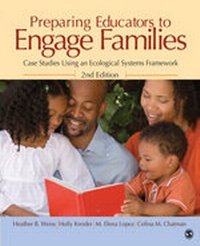
Preparing Educators to Engage Families
Case Studies Using an Ecological Systems Framework
2nd Edition
Published on 19. January 2010
Book
Paperback/Softback
200 pages
978-1-4129-7437-0 (ISBN)
Description
Preparing Educators to Engage Families: Case Studies Using an Ecological Systems Framework, Second Edition encourages readers to hone their analytic and problem-solving skills for use in real-world situations with students and their families. Organized according to Ecological Systems Theory (of the micro, meso, exo, macro, and chrono systems), the text presents research-based teaching cases that reflect critical dilemmas in family-school-community relations, especially among families for whom poverty and cultural differences are daily realities.
Reviews / Votes
"Professors, in particular, seeking a compelling and interesting text regarding family engagement should consider Preparing Educators to Engage Families. It can enhance existing courses or serve as a stand alone text for a specific course on family engagement. Students will find the text invaluable in terms of how they will learn to respect all families and better understand other points of view, and they will learn to view families from a strength perspective as opposed to a deficit perspective." -- Michelle H. Abrego and Jesus "Chuey" AbregoMore details
Edition
2nd Revised edition
Language
English
Place of publication
Thousand Oaks
United States
Target group
College/higher education
Edition type
Revised edition
Dimensions
Height: 232 mm
Width: 187 mm
Weight
340 gr
ISBN-13
978-1-4129-7437-0 (9781412974370)
Copyright in bibliographic data and cover images is held by Nielsen Book Services Limited or by the publishers or by their respective licensors: all rights reserved.
Schweitzer Classification
Other editions
New editions
Heather B. Weiss | M. Elena Lopez | Holly M. Kreider
Preparing Educators to Engage Families
Case Studies Using an Ecological Systems Framework
Book
12/2013
3rd Edition
SAGE Publications Inc
€117.10
Shipment within 15-20 days
Previous edition
Heather B. Weiss | Holly M. Kreider | M. Elena Lopez
Preparing Educators to Involve Families
From Theory to Practice
Book
05/2005
1st Edition
SAGE Publications Inc
€55.95
Article exhausted; check for reprint
Persons
Heather B. Weiss is founder and director of the Harvard Family Research Project (HFRP; www.hfrp.org) and senior research associate/instructor at the Harvard Graduate School of Education. Founded in 1983, HFRP's mission is to improve practice, intervention, and policy to support children's successful development from birth to adulthood. Dr. Weiss and her HFRP colleagues conduct, synthesize, and disseminate research and evaluation information and develop professional and organizational learning tools that support evaluation, continuous improvement, and accountability and that spark innovation. A cornerstone of HFRP's work is the promotion, documentation, and assessment of complementary learning: strategies that support children's learning and development in family and community settings as well as school contexts. Under Dr. Weiss's leadership, HFRP created the national Family Involvement Network of Educators (FINE); informed policy development in the areas of children, youth and families; and significantly expanded its complementary learning resources to include early childhood education, afterschool and expanded learning time opportunities, and digital media and learning. Dr. Weiss writes, speaks, and advises on programs and policies for children and families and is a consultant and advisor to numerous foundations on strategic grant making and evaluation. Her recent publications focus on reframing research and evaluation to support continuous improvement and results-based decision making, examining the case for complementary learning from a research and policy perspective, and assessing new ways of providing and evaluating professional development. Dr. Weiss received her EdD in education and social policy from Harvard University.
Holly Kreider is program officer in family engagement at the Heising-Simons Foundation in Los Altos, California. Dr. Kreider leads family engagement grant making for the Foundation, including direct service grants in local counties, as well as state- and national-level research, evaluation, and policy grants. Previously, Dr. Kreider served as director of programs for Raising A Reader National Office, overseeing training, evaluation, and affiliate relations with 165 agencies across the United States. She also previously served as vice president at Sociometrics, leading federally funded and private sector research and evaluation projects focused on children's mental health, adolescent pregnancy prevention, HIV/STI prevention, and family strengthening. Finally, Dr. Kreider was a research associate at the Harvard Family Research Project (HFRP) and an instructor at the Harvard Graduate School of Education for more than a decade. At HFRP, she managed research projects and developed best practice resources in areas of family engagement, out-of-school time, teacher professional development, and program evaluation. At HFRP, she also cofounded the Family Involvement Network of Educators-a national network of more than 12,000 educators and other professionals committed to engaging families in their children's education. She is author/editor of four books and dozens of publications, including Promising Practices for Family Engagement in Out-of-School Time (IAP, 2011) and Promising Practices for Engaging Families in Literacy (IAP, 2013). Dr. Kreider received her EdD in human development and psychology from Harvard University.
M. Elena Lopez is associate director at the Harvard Family Research Project. Her research interests focus on the relationships of families, schools, and communities in children's development and education. She has co-led evaluations of public and philanthropic initiatives to promote children's well-being, created tools to facilitate family engagement for high school success and college and career readiness, and provided technical assistance to states and communities in order support quality programs for young children and families. As a cofounder of the Family Involvement Network of Educators, a national network of more than 12,000 preK-12 educators, Dr. Lopez seeks to facilitate the usability of research in practice, policy, and professional development. Her other professional experiences include lecturing at the Harvard Graduate School of Education, working as a program officer for a philanthropic foundation, and serving on national advisory and governing boards. She is author/coauthor of numerous articles about family engagement in education. Dr. Lopez received her PhD in anthropology from Harvard University.
Celina Chatman-Nelson (Ph.D, Rutgers University) is a Visiting Program Associate in the College of Education at the University of Illinois at Chicago, where she directs a project aiming to identify challenges and solutions in preparing early childhood teachers to work with all young children and their families. She was formerly associate director for the Herr Research Center for Children and Social Policy at Erikson Institute, and prior to that she was associate director for the Center for Human Potential and Public Policy at the University of Chicago's Harris Graduate School of Public Policy Studies. Chatman-Nelson also worked as a Senior Research Associate at the University of Michigan's Institute for Social Research and Institute for Research on Women and Gender, where she led analyses on adolescent identity and achievement motivation in the context of race and ethnicity. Other edited volumes include Developmental Pathways Through Middle Childhood (Lawrence Erlbaum, 2005, with Catherine Cooper, Cynthia Garcia Coll, W. Todd Bartko and Helen Davis) and Navigating the Future: Social Identity, Coping, and Life Tasks (Russell Sage Foundation, 2005, with Geraldine Downey and Jacquelynne S. Eccles). Dr. Chatman-Nelson received her PhD in social psychology from Rutgers University.
Holly Kreider is program officer in family engagement at the Heising-Simons Foundation in Los Altos, California. Dr. Kreider leads family engagement grant making for the Foundation, including direct service grants in local counties, as well as state- and national-level research, evaluation, and policy grants. Previously, Dr. Kreider served as director of programs for Raising A Reader National Office, overseeing training, evaluation, and affiliate relations with 165 agencies across the United States. She also previously served as vice president at Sociometrics, leading federally funded and private sector research and evaluation projects focused on children's mental health, adolescent pregnancy prevention, HIV/STI prevention, and family strengthening. Finally, Dr. Kreider was a research associate at the Harvard Family Research Project (HFRP) and an instructor at the Harvard Graduate School of Education for more than a decade. At HFRP, she managed research projects and developed best practice resources in areas of family engagement, out-of-school time, teacher professional development, and program evaluation. At HFRP, she also cofounded the Family Involvement Network of Educators-a national network of more than 12,000 educators and other professionals committed to engaging families in their children's education. She is author/editor of four books and dozens of publications, including Promising Practices for Family Engagement in Out-of-School Time (IAP, 2011) and Promising Practices for Engaging Families in Literacy (IAP, 2013). Dr. Kreider received her EdD in human development and psychology from Harvard University.
M. Elena Lopez is associate director at the Harvard Family Research Project. Her research interests focus on the relationships of families, schools, and communities in children's development and education. She has co-led evaluations of public and philanthropic initiatives to promote children's well-being, created tools to facilitate family engagement for high school success and college and career readiness, and provided technical assistance to states and communities in order support quality programs for young children and families. As a cofounder of the Family Involvement Network of Educators, a national network of more than 12,000 preK-12 educators, Dr. Lopez seeks to facilitate the usability of research in practice, policy, and professional development. Her other professional experiences include lecturing at the Harvard Graduate School of Education, working as a program officer for a philanthropic foundation, and serving on national advisory and governing boards. She is author/coauthor of numerous articles about family engagement in education. Dr. Lopez received her PhD in anthropology from Harvard University.
Celina Chatman-Nelson (Ph.D, Rutgers University) is a Visiting Program Associate in the College of Education at the University of Illinois at Chicago, where she directs a project aiming to identify challenges and solutions in preparing early childhood teachers to work with all young children and their families. She was formerly associate director for the Herr Research Center for Children and Social Policy at Erikson Institute, and prior to that she was associate director for the Center for Human Potential and Public Policy at the University of Chicago's Harris Graduate School of Public Policy Studies. Chatman-Nelson also worked as a Senior Research Associate at the University of Michigan's Institute for Social Research and Institute for Research on Women and Gender, where she led analyses on adolescent identity and achievement motivation in the context of race and ethnicity. Other edited volumes include Developmental Pathways Through Middle Childhood (Lawrence Erlbaum, 2005, with Catherine Cooper, Cynthia Garcia Coll, W. Todd Bartko and Helen Davis) and Navigating the Future: Social Identity, Coping, and Life Tasks (Russell Sage Foundation, 2005, with Geraldine Downey and Jacquelynne S. Eccles). Dr. Chatman-Nelson received her PhD in social psychology from Rutgers University.
Content
Preface
Acknowledgments
Introduction: Preparing Educators in Family Engagement
About Family Engagement in Education
How to Use the Casebook
PART I. THE MICROSYSTEM
1. Theoretical Perspectives on the Microsystem
Motivation to Learn
A Developmental-Contextual Perspective
2. The Microsystem Cases
Case 1. A Special Education Plan for Anabela: Does Supporting Her Needs Mean Holding Her Back?
Case 2. My Favorite Subject Is Lunch: Motivating a Disengaged Student
PART II. THE MESOSYSTEM
3. Theoretical Perspectives on the Mesosystem
Social Executive Functioning
Community Support for Family Engagement in Children's Learning
4. The Mesosystem Cases
Case 3. Lunchtime at Sunnydale Elementary School: What Do First Graders Need?
Case 4. Defining "Fine": Communicating Academic Progress to Parents
Case 5. Bilingual Voices and Parent Classroom Choices: Family Engagement in Language and Literacy
PART III. THE EXOSYSTEM
5. Theoretical Perspectives on the Exosystem
School-Based Family Support
6. The Exosystem Cases
Case 6. Afterschool for Cindy: Family, School, and Community Roles in Out-of-School Time
Case 7. Piecing It Together: Linking Systems to Support a Student and Family
PART IV. THE MACROSYSTEM
7. Theoretical Perspectives on the Macrosystem
Ecocultural Understanding
Ethnic and Racial Diversity
8. The Macrosystem Cases
Case 8. What Words Don't Say: Talking About Racism
Case 9. Raising Children Alone: Poverty, Welfare Reform, and Family Involvement
Case 10. Learning in the Shadow of Violence: Community, Culture, and Family Engagement
PART V. THE CHRONOSYSTEM
9. Theoretical Perspectives on the Chronosystem
Families, Time, and Learning
10. The Chronosystem Cases
Case 11. Tomasito Is Too Big to Hold Hands: The Developing Child and the Home-School Relationship
Case 12. Staying on the Path Toward College: One Boy at the Crossroads
Glossary
References
Index
About the Authors
About the Contributors
Acknowledgments
Introduction: Preparing Educators in Family Engagement
About Family Engagement in Education
How to Use the Casebook
PART I. THE MICROSYSTEM
1. Theoretical Perspectives on the Microsystem
Motivation to Learn
A Developmental-Contextual Perspective
2. The Microsystem Cases
Case 1. A Special Education Plan for Anabela: Does Supporting Her Needs Mean Holding Her Back?
Case 2. My Favorite Subject Is Lunch: Motivating a Disengaged Student
PART II. THE MESOSYSTEM
3. Theoretical Perspectives on the Mesosystem
Social Executive Functioning
Community Support for Family Engagement in Children's Learning
4. The Mesosystem Cases
Case 3. Lunchtime at Sunnydale Elementary School: What Do First Graders Need?
Case 4. Defining "Fine": Communicating Academic Progress to Parents
Case 5. Bilingual Voices and Parent Classroom Choices: Family Engagement in Language and Literacy
PART III. THE EXOSYSTEM
5. Theoretical Perspectives on the Exosystem
School-Based Family Support
6. The Exosystem Cases
Case 6. Afterschool for Cindy: Family, School, and Community Roles in Out-of-School Time
Case 7. Piecing It Together: Linking Systems to Support a Student and Family
PART IV. THE MACROSYSTEM
7. Theoretical Perspectives on the Macrosystem
Ecocultural Understanding
Ethnic and Racial Diversity
8. The Macrosystem Cases
Case 8. What Words Don't Say: Talking About Racism
Case 9. Raising Children Alone: Poverty, Welfare Reform, and Family Involvement
Case 10. Learning in the Shadow of Violence: Community, Culture, and Family Engagement
PART V. THE CHRONOSYSTEM
9. Theoretical Perspectives on the Chronosystem
Families, Time, and Learning
10. The Chronosystem Cases
Case 11. Tomasito Is Too Big to Hold Hands: The Developing Child and the Home-School Relationship
Case 12. Staying on the Path Toward College: One Boy at the Crossroads
Glossary
References
Index
About the Authors
About the Contributors