

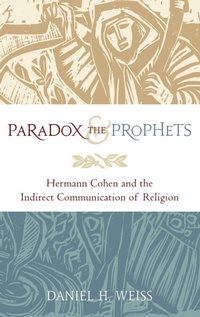
Paradox and the Prophets
Hermann Cohen and the Indirect Communication of Religion
Published on 21. June 2012
Book
Hardback
352 pages
978-0-19-989590-8 (ISBN)
Description
Hermann Cohen (1842-1918) is widely regarded as the most influential representative of twentieth-century Jewish philosophy, and his Religion of Reason is often described as one of the most significant attempts to wrestle with the competing claims of philosophy and the Jewish religious tradition since Maimonides' Guide of the Perplexed. Nevertheless, Cohen has often been treated merely as an historical precursor to later Jewish thinkers like Buber, Rosenzweig, and Levinas.
Daniel H. Weiss offers an insightful new reading of Religion of Reason, arguing that the style and method of Cohen's final work have long been fundamentally misunderstood. Previous readers, puzzled by the seemingly incompatible perspectives within Religion of Reason, have tended either to uphold one or another of the text's 'voices' or to criticize the text for intellectual incoherence. Weiss demonstrates that the multiplicity of Cohen's text is an essential element of its rational and communicative purposes. Drawing upon Kierkegaard as a theorist of indirect communication, he shows how Cohen combines the 'incompatible voices' of philosophy and of Scripture in order to convey religious and ethical ideas-such as the unique God, the other as You, and the messianic future-that would be distorted in a fully consistent, single-voiced mode of thought and communication.
While focusing on the details and style of Cohen's text, Paradox and the Prophets also explores the broader philosophical claim that Religion of Reason, far from representing an outdated mode of thought, serves as a model for contemporary efforts to reason about religion and ethics.
Daniel H. Weiss offers an insightful new reading of Religion of Reason, arguing that the style and method of Cohen's final work have long been fundamentally misunderstood. Previous readers, puzzled by the seemingly incompatible perspectives within Religion of Reason, have tended either to uphold one or another of the text's 'voices' or to criticize the text for intellectual incoherence. Weiss demonstrates that the multiplicity of Cohen's text is an essential element of its rational and communicative purposes. Drawing upon Kierkegaard as a theorist of indirect communication, he shows how Cohen combines the 'incompatible voices' of philosophy and of Scripture in order to convey religious and ethical ideas-such as the unique God, the other as You, and the messianic future-that would be distorted in a fully consistent, single-voiced mode of thought and communication.
While focusing on the details and style of Cohen's text, Paradox and the Prophets also explores the broader philosophical claim that Religion of Reason, far from representing an outdated mode of thought, serves as a model for contemporary efforts to reason about religion and ethics.
More details
Language
English
Place of publication
New York
United States
Target group
Professional and scholarly
College/higher education
Dimensions
Height: 240 mm
Width: 161 mm
Thickness: 23 mm
Weight
690 gr
ISBN-13
978-0-19-989590-8 (9780199895908)
Copyright in bibliographic data and cover images is held by Nielsen Book Services Limited or by the publishers or by their respective licensors: all rights reserved.
Schweitzer Classification
Other editions
Additional editions
E-Book
09/2012
1st Edition
OUP eBook
€37.99
Available for download
Person
Polonsky-Coexist Lecturer in Jewish Studies, Cambridge University
Content
Abbreviations ; Introduction ; A Note on Terminology: Warding off some common connotations ; Chapter 1: Hermann Cohen's"The Style of the Prophets" ; Chapter 2: The Sources of Multiplicity: Cohen's Project in its Own Terms ; Chapter 3: Resisting Auflosung: A Single-voiced Attempt ; Chapter 4: Making Cohen's Style Explicit: A Kierkegaardian Interlude ; Chapter 5: Communicating through Contradiction: Cohen's Performance of Religious Concepts ; Chapter 6: The Task, the Moment, and the Messianic Future ; Conclusion ; Bibliography