

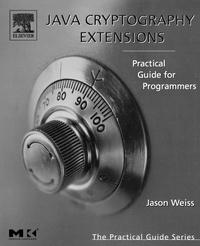
Java Cryptography Extensions
Practical Guide for Programmers
Published on 18. May 2004
Book
Paperback/Softback
176 pages
978-0-12-742751-5 (ISBN)
Description
For a long time, there has been a need for a practical, down-to-earth developers book for the Java Cryptography Extension. I am very happy to see there is now a book that can answer many of the technical questions that developers, managers, and researchers have about such a critical topic. I am sure that this book will contribute greatly to the success of securing Java applications and deployments for e-business. --Anthony Nadalin, Java Security Lead Architect, IBM
For many Java developers and software engineers, cryptography is an "on-demand" programming exercise, where cryptographic concepts are shelved until the next project requires renewed focus. But considerations for cryptography must be made early on in the design process and it's imperative that developers know what kinds of solutions exist.
One of Java's solutions to help bridge the gap between academic research and real-world problem solving comes in the form of a well-defined architecture for implementing cryptographic solutions. However, to use the architecture and its extensions, it is important to recognize the pros and cons of different cryptographic algorithms and to know how to implement various devices like key agreements, digital signatures, and message digests, to name a few.
In Java Cryptography Extensions (JCE), cryptography is discussed at the level that developers need to know to work with the JCE and with their own applications but that doesn't overwhelm by packing in details unimportant to the busy professional. The JCE is explored using numerous code examples and instructional detail, with clearly presented sections on each aspect of the Java library. An online open-source cryptography toolkit and the code for all of the examples further reinforces the concepts covered within the book. No other resource presents so concisely or effectively the exact material needed to begin utilizing the JCE.
For many Java developers and software engineers, cryptography is an "on-demand" programming exercise, where cryptographic concepts are shelved until the next project requires renewed focus. But considerations for cryptography must be made early on in the design process and it's imperative that developers know what kinds of solutions exist.
One of Java's solutions to help bridge the gap between academic research and real-world problem solving comes in the form of a well-defined architecture for implementing cryptographic solutions. However, to use the architecture and its extensions, it is important to recognize the pros and cons of different cryptographic algorithms and to know how to implement various devices like key agreements, digital signatures, and message digests, to name a few.
In Java Cryptography Extensions (JCE), cryptography is discussed at the level that developers need to know to work with the JCE and with their own applications but that doesn't overwhelm by packing in details unimportant to the busy professional. The JCE is explored using numerous code examples and instructional detail, with clearly presented sections on each aspect of the Java library. An online open-source cryptography toolkit and the code for all of the examples further reinforces the concepts covered within the book. No other resource presents so concisely or effectively the exact material needed to begin utilizing the JCE.
Reviews / Votes
"For a long time, there has been a need for a practical, down-to-earth developers book for the Java Cryptography Extension. I am very happy to see there is now a book that can answer many of the technical questions that developers, managers, and researchers have about such a critical topic. I am sure that this book will contribute greatly to the success of securing Java applications and deployments for e-business." --Anthony Nadalin, Java Security Lead Architect, IBM"I think it's worth having a copy of this book in the company library." - Dr Dobb's Journal, November 2004
"No other resource presents so concisely or effectively the exact material needed to begin utilizing the JCE." Stefan Meyer (Berlin) Zentralblatt MATH 1060, November 2005
More details
Series
Language
English
Place of publication
San Francisco
United States
Publishing group
Elsevier Science & Technology
Target group
Professional and scholarly
Java developers, programmers, and analysts. Students in undergrad security courses and Java programming courses
Product notice
Paperback (trade)
Dimensions
Height: 235 mm
Width: 190 mm
Thickness: 17 mm
Weight
375 gr
ISBN-13
978-0-12-742751-5 (9780127427515)
Copyright in bibliographic data and cover images is held by Nielsen Book Services Limited or by the publishers or by their respective licensors: all rights reserved.
Schweitzer Classification
Other editions
Additional editions
E-Book
05/2004
Morgan Kaufmann
€24.95
Available for download
Person
Content
Chapter 1: Understanding Java's Cryptographic Architecture * Chapter 2: Working with Symmetric Ciphers * Chapter 3: Working with Asymmetric Ciphers and Key Agreement Protocols * Chapter 4: Message Digests, Message Authentication Codes, and Digital Signatures * Chapter 5: Managing Keys and Certificates * Bibliography