

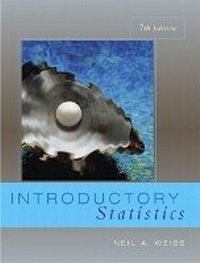
Introductory Statistics
International Edition
7th Edition
Published on 10. June 2004
Book
Mixed media product
960 pages
978-0-321-26340-7 (ISBN)
Description
Introductory Statistics is the longer of the two texts (Elementary Statistics is the shorter one) and is appropriate for a one- or two-semester course. IS includes more detailed (but still flexible) coverage of probability and later coverage of Correlation and Regression. It also covers more advanced topics covered in the second semester course.
IS has a reputation for being thorough and precise, and for using real data extensively. Students find the book readable and clear, and the math level is right for the diverse population that takes the introductory statistics course. The text thoroughly explains and illustrates concepts through an abundance of worked out examples.
IS has a reputation for being thorough and precise, and for using real data extensively. Students find the book readable and clear, and the math level is right for the diverse population that takes the introductory statistics course. The text thoroughly explains and illustrates concepts through an abundance of worked out examples.
More details
Edition
7th edition
Language
English
Place of publication
United States
Publishing group
Pearson Education (US)
Target group
Professional and scholarly
Dimensions
Height: 251 mm
Width: 220 mm
Thickness: 31 mm
Weight
1882 gr
ISBN-13
978-0-321-26340-7 (9780321263407)
Copyright in bibliographic data and cover images is held by Nielsen Book Services Limited or by the publishers or by their respective licensors: all rights reserved.
Schweitzer Classification
Other editions
New editions
Book
01/2007
8th Edition
Pearson
€69.49
Article exhausted; check for reprint
Person
About the Author
Neil A. Weiss received his Ph.D. from UCLA in 1970 and subsequently accepted an Assistant-Professor position at Arizona State University, where he was ultimately promoted to therank of Full Professor. Dr. Weiss has taught statistics, probability, andmathematics-from the freshman level to the advanced graduate level-for morethan 30 years. In recognition of his excellence in teaching, Dr. Weiss received the Dean's Quality Teaching Award from the ASU College of Liberal Arts and Sciences. This comprehensive knowledge andexperience ensures that Weiss's texts are mathematically and statistically accurate as well as pedagogically sound.
In addition to his numerous research publications, Dr. Weiss has authored or co-authored books in finite mathematics, statistics, and real analysis, and is currently working on two new books: one in probability theory and the other in applied regression analysis and analysisof variance. Weiss's texts-well known for their precision, readability, and pedagogical excellence-are used worldwide.
Dr. Weiss is a pioneer of the integration of statistical software into textbooks and the classroom, first providing such integration over 20 years ago in the book Introductory Statistics (Addison-Wesley, 1982). Weiss and Addison-Wesley continue this pioneering spirit to this day with the inclusion of some of the most comprehensive Web sites in the field.
In his spare time, Dr. Weiss enjoys walking, studying and practicing meditation, and playing hold 'em poker. He has two sons.
Neil A. Weiss received his Ph.D. from UCLA in 1970 and subsequently accepted an Assistant-Professor position at Arizona State University, where he was ultimately promoted to therank of Full Professor. Dr. Weiss has taught statistics, probability, andmathematics-from the freshman level to the advanced graduate level-for morethan 30 years. In recognition of his excellence in teaching, Dr. Weiss received the Dean's Quality Teaching Award from the ASU College of Liberal Arts and Sciences. This comprehensive knowledge andexperience ensures that Weiss's texts are mathematically and statistically accurate as well as pedagogically sound.
In addition to his numerous research publications, Dr. Weiss has authored or co-authored books in finite mathematics, statistics, and real analysis, and is currently working on two new books: one in probability theory and the other in applied regression analysis and analysisof variance. Weiss's texts-well known for their precision, readability, and pedagogical excellence-are used worldwide.
Dr. Weiss is a pioneer of the integration of statistical software into textbooks and the classroom, first providing such integration over 20 years ago in the book Introductory Statistics (Addison-Wesley, 1982). Weiss and Addison-Wesley continue this pioneering spirit to this day with the inclusion of some of the most comprehensive Web sites in the field.
In his spare time, Dr. Weiss enjoys walking, studying and practicing meditation, and playing hold 'em poker. He has two sons.
Content
1. The Nature of Statistics
2. Organizing Data
3. Descriptive Measures
4. Probability Concepts
5. Discrete Random Variables
6. The Normal Distribution
7. The Sampling Distribution of the Sample Mean
8. Confidence Intervals for One Population Mean
9. Hypothesis Tests for One Population Mean
10. Inferences for Two Population Means
11. Inferences for Population Standard Deviations
12. Inferences for Population Proportions
13. Chi-Square Procedures
14. Descriptive Methods in Regression and Correlation
15. Inferential Methods in Regression and Correlation
16. Analysis of Variance (ANOVA)
Module A: Multiple Regression Analysis (on CD)
Module B: Model Building in Regression (on CD)
Module C: Design of Experiments and Analysis of Variance (on CD)
2. Organizing Data
3. Descriptive Measures
4. Probability Concepts
5. Discrete Random Variables
6. The Normal Distribution
7. The Sampling Distribution of the Sample Mean
8. Confidence Intervals for One Population Mean
9. Hypothesis Tests for One Population Mean
10. Inferences for Two Population Means
11. Inferences for Population Standard Deviations
12. Inferences for Population Proportions
13. Chi-Square Procedures
14. Descriptive Methods in Regression and Correlation
15. Inferential Methods in Regression and Correlation
16. Analysis of Variance (ANOVA)
Module A: Multiple Regression Analysis (on CD)
Module B: Model Building in Regression (on CD)
Module C: Design of Experiments and Analysis of Variance (on CD)