

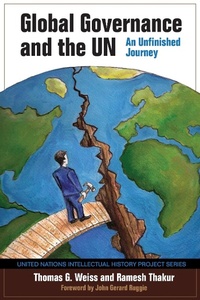
Global Governance and the UN
An Unfinished Journey
Published on 23. April 2010
Book
Paperback/Softback
448 pages
978-0-253-22167-4 (ISBN)
Description
In the 21st century, the world is faced with threats of global scale that cannot be confronted without collective action. Although global government as such does not exist, formal and informal institutions, practices, and initiatives-together forming "global governance"-bring a greater measure of predictability, stability, and order to trans-border issues than might be expected. Yet, there are significant gaps between many current global problems and available solutions. Thomas G. Weiss and Ramesh Thakur analyze the UN's role in addressing such knowledge, normative, policy, institutional, and compliance lapses. The UN's relationship to these five global governance gaps is explored through case studies of some of the most burning problems of our age, including terrorism, nuclear proliferation, humanitarian crises, development aid, climate change, human rights, and HIV/AIDS.
Reviews / Votes
Global Governance and the UN will satisfy those who seek a serious grappling with the ethical aspects of international action to address the world's most pressing challenges. The book argues that the UN's evolution is an "unfinished journey": . . . global governance will continue to evolve, with the UN at the center, in the wake of each global crisis. dec 2011(Ethics and International Affairs) Weiss and Thakur have managed to perform the difficult trick of producing a work that can function as textbook, scholarly reference, policy guide, and popular reading. . . . Recommended.
(Choice)
More details
Language
English
Place of publication
Bloomington, IN
United States
Target group
Professional and scholarly
Product notice
Paperback (trade)
Dimensions
Height: 234 mm
Width: 156 mm
Thickness: 26 mm
Weight
332 gr
ISBN-13
978-0-253-22167-4 (9780253221674)
Copyright in bibliographic data and cover images is held by Nielsen Book Services Limited or by the publishers or by their respective licensors: all rights reserved.
Schweitzer Classification
Other editions
Additional editions
E-Book
04/2010
1st Edition
Indiana University Press
from
€44.99
Available for download
Previous edition

Book
04/2010
Indiana University Press
€69.44
No shipping information available
Persons
Thomas G. Weiss is Presidential Professor of Political Science at The Graduate Center of the City University of New York and Director of the Ralph Bunche Institute for International Studies.
Ramesh Thakur is the Inaugural Director of the Balsillie School of International Affairs, Distinguished Fellow of the Centre for International Governance Innovation, and Professor of Political Science at the University of Waterloo, Ontario.
Ramesh Thakur is the Inaugural Director of the Balsillie School of International Affairs, Distinguished Fellow of the Centre for International Governance Innovation, and Professor of Political Science at the University of Waterloo, Ontario.
Content
Contents
List of Boxes, Tables, and Figures
Series Editors' Foreword Louis Emmerij, Richard Jolly, and Thomas G. Weiss
Foreword John Gerard Ruggie
Acknowledgments
Abbreviations
Introduction: The Problematique of Global Governance
1. Tracing the Origins of an Idea and the UN's Contribution
Part 1. International Security
2. The Use of Force: War, Collective Security, and Peace Operations
3. Arms Control and Disarmament
4. Terrorism
Part 2. Development
5. Trade, Aid, and Finance
6. Sustainable Development
7. Saving the Environment: The Ozone Layer and Climate Change
Part 3. Human Rights
8. Generations of Rights
9. Protecting against Pandemics
10. The Responsibility to Protect
Notes
Index
About the Authors
About the United Nations Intellectual History Project
List of Boxes, Tables, and Figures
Series Editors' Foreword Louis Emmerij, Richard Jolly, and Thomas G. Weiss
Foreword John Gerard Ruggie
Acknowledgments
Abbreviations
Introduction: The Problematique of Global Governance
1. Tracing the Origins of an Idea and the UN's Contribution
Part 1. International Security
2. The Use of Force: War, Collective Security, and Peace Operations
3. Arms Control and Disarmament
4. Terrorism
Part 2. Development
5. Trade, Aid, and Finance
6. Sustainable Development
7. Saving the Environment: The Ozone Layer and Climate Change
Part 3. Human Rights
8. Generations of Rights
9. Protecting against Pandemics
10. The Responsibility to Protect
Notes
Index
About the Authors
About the United Nations Intellectual History Project