

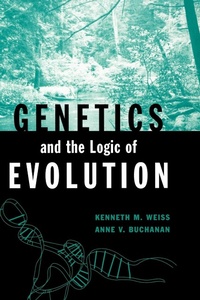
Genetics and the Logic of Evolution
1st Edition
Published on 17. February 2004
Book
Hardback
560 pages
978-0-471-23805-8 (ISBN)
Description
In this book the authors draw on what is known, largely from recent research, about the nature of genes and cells, the genetics of development and animal and plant body plans, intra- and interorganismal communication, sensation and perception, to propose that a few basic generalizations, along with the modified application of the classical evolutionary theory, can provide a broader theoretical understanding of genes, evolution, and the diverse and complex nature of living organisms.
Reviews / Votes
"...the book is indeed recommendable..." (The QuarterlyReview of Biology, December 2004)"for anyone who wishes to know more about genes and evolutionand go beyond the classic, classroom theory--this is the book foryou...[will] take you on a ride you won't regret."(Heredity, February 2005)
"For anyone who wishes to know more about genes andevolution and go beyond the classic, classroom theory - this is foryou..." (Heredity, Vol. 94, 2005)
"This book is well written and would probably be mainly ofinterest to students of evolution who have a more philosophicalperspective or to philosophy students interested inevolution." (American Journal of Human Genetics,September 2004)
"This book is highly suited to students and scientists in arange of fields who want to understand how evolution works throughgenetics." (E-STREAMS, August 2004)
"This book represents a valiant effort in expanding evolutionarythinking in many biological specialties." (Choice, June2004, Vol. 41 No. 10)
More details
Language
English
Place of publication
New York
United States
Publishing group
John Wiley & Sons Inc
Target group
Professional and scholarly
Product notice
sewn/stitched
Cloth over boards
Illustrations
Drawings: 120 B&W, 0 Color; Tables: 12 B&W, 0 Color
Dimensions
Height: 260 mm
Width: 183 mm
Thickness: 34 mm
Weight
1230 gr
ISBN-13
978-0-471-23805-8 (9780471238058)
Copyright in bibliographic data and cover images is held by Nielsen Book Services Limited or by the publishers or by their respective licensors: all rights reserved.
Schweitzer Classification
Persons
Kenneth M Weiss is Evan Pugh Professor of Anthropology and Genetics at Penn State University. After majoring in mathematics at Oberlin College, he received graduate training in Biological Anthropology and genetics at the University of Michigan, where he received his PhD in 1972. He has written widely on evolutionary principlesand biology, human genetics and the complexities of therelationships between genes and traits like human disease or developmental patterns. He writes a regular column onproblems and issues in evolution and genetics for the journal Evolutionary Anthropology, and is the author of Genetic Variation and Human Disease: Principles and Evolutionary Approaches. He has also been a professional meteorologist.
Anne Buchanan is Senior Research Scientist in the Department of Anthropology at Penn State University. She has a BA in Anthropology from the University of Massachusetts and a DrPH in Population Studies from the University of Texas School of Public Health. She has worked on population-scale problems in relation to health and genetics, and on molecular and developmental genetics, and has published in a diversity of areas, including anthropology, demography, epidemiology, genetic epidemiology, and developmental genetics.
Anne Buchanan is Senior Research Scientist in the Department of Anthropology at Penn State University. She has a BA in Anthropology from the University of Massachusetts and a DrPH in Population Studies from the University of Texas School of Public Health. She has worked on population-scale problems in relation to health and genetics, and on molecular and developmental genetics, and has published in a diversity of areas, including anthropology, demography, epidemiology, genetic epidemiology, and developmental genetics.
Content
Preface.
Acknowledgments.
I. UNDERSTANDING BIOLOGICAL COMPLEXITY: Basic Concepts andPrinciples.
1. Prospect: The Basic Postulates of Life.
2. Conceptual and Analytic Approaches to Evolution.
3. Evolution By Phenotype: How Change Happens in Life.
II. BUILDING BLOCKS OF LIFE: A Genetic Repertoire for EvolvingComplexity.
4. The Storage and Flow of Biological Information.
5. Genotypes and Phenotypes.
6. A Cell is Born.
7. A Repertoire of Basic Genetic Mechanisms.
III. AN INTERNAL AWARENESS OF SELF: Communication withinOrganisms.
8. Making More of Life: The Many Aspects of Reproduction.
9. Scaling Up: How Cells Build an Organism.
10. Communicating Between Cells.
11. Detecting and Destroying Internal Invaders.
IV. EXTERNAL AWARENESS: Information Transfer between Environmentto Organism.
12. Detecting Physical Variability in the Environment.
13. Chemical Signaling and Sensation from the Outside World.
14. Detecting Light.
15. The Development and Structure of Nervous Systems.
16. Perceiving: Integrating Signals from the Environment.
V. FINALE: Evolutionary Order and Disorder between Phenotypesand Genotypes.
17. A Great Chain of Beings.
References.
Index.
Acknowledgments.
I. UNDERSTANDING BIOLOGICAL COMPLEXITY: Basic Concepts andPrinciples.
1. Prospect: The Basic Postulates of Life.
2. Conceptual and Analytic Approaches to Evolution.
3. Evolution By Phenotype: How Change Happens in Life.
II. BUILDING BLOCKS OF LIFE: A Genetic Repertoire for EvolvingComplexity.
4. The Storage and Flow of Biological Information.
5. Genotypes and Phenotypes.
6. A Cell is Born.
7. A Repertoire of Basic Genetic Mechanisms.
III. AN INTERNAL AWARENESS OF SELF: Communication withinOrganisms.
8. Making More of Life: The Many Aspects of Reproduction.
9. Scaling Up: How Cells Build an Organism.
10. Communicating Between Cells.
11. Detecting and Destroying Internal Invaders.
IV. EXTERNAL AWARENESS: Information Transfer between Environmentto Organism.
12. Detecting Physical Variability in the Environment.
13. Chemical Signaling and Sensation from the Outside World.
14. Detecting Light.
15. The Development and Structure of Nervous Systems.
16. Perceiving: Integrating Signals from the Environment.
V. FINALE: Evolutionary Order and Disorder between Phenotypesand Genotypes.
17. A Great Chain of Beings.
References.
Index.