

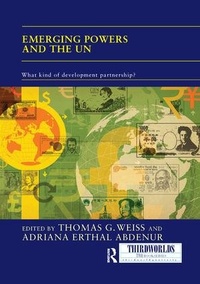
Emerging Powers and the UN
What Kind of Development Partnership?
1st Edition
Published on 7. June 2017
Book
Paperback/Softback
188 pages
978-1-138-08654-8 (ISBN)
Description
The post-2015 sustainable development goals and the changing environment for development cooperation requires a renewed and transformed UN system. In line with their increasing significance as economic powers, a growing number of emerging countries will play an expanded role in the UN system, which could take the form of growing financial contributions, greater presence in governance, higher staff representation, a stronger voice in development deliberations, and a greater overall influence on the development agenda.
Emerging Powers and the UN explores in depth the relationship of these countries on the world stage and their role in the future UN development system. Formally, the relationship is through representation as member states (first UN) and also UN staff (second UN). However, the importance of civil society and market actors (third UN) in emerging countries is also growing.
This book was originally published as a special issue of Third World Quarterly.
Emerging Powers and the UN explores in depth the relationship of these countries on the world stage and their role in the future UN development system. Formally, the relationship is through representation as member states (first UN) and also UN staff (second UN). However, the importance of civil society and market actors (third UN) in emerging countries is also growing.
This book was originally published as a special issue of Third World Quarterly.
More details
Series
Language
English
Place of publication
London
United Kingdom
Publishing group
Taylor & Francis Ltd
Target group
College/higher education
Dimensions
Height: 246 mm
Width: 174 mm
Weight
370 gr
ISBN-13
978-1-138-08654-8 (9781138086548)
Copyright in bibliographic data and cover images is held by Nielsen Book Services Limited or by the publishers or by their respective licensors: all rights reserved.
Schweitzer Classification
Other editions
Additional editions
E-Book
11/2018
1st Edition
Routledge
€47.49
Available for download
E-Book
11/2018
Routledge
€47.49
Available for download
Book
07/2015
1st Edition
Routledge
€222.84
Shipment within 10-20 days
Persons
Thomas G. Weiss is Presidential Professor of Political Science, and Director Emeritus of the Ralph Bunche Institute for International Studies, at The City University of New York's Graduate Center, CUNY, New York City, USA.
Adriana Erthal Abdenur is Professor of International Relations at the Pontifical Catholic University in Rio de Janeiro, Brazil, and General Coordinator of the BRICS Policy Center.
Adriana Erthal Abdenur is Professor of International Relations at the Pontifical Catholic University in Rio de Janeiro, Brazil, and General Coordinator of the BRICS Policy Center.
Content
Introduction: emerging powers and the UN - what kind of development partnership? Part I - Inequalities And Multilateralism: Revisiting The North-South Axis 1. Assessing the G77: 50 years after UNCTAD and 40 years after the NIEO 2. South-South cooperation and the international development battlefield: between the OECD and the UN 3. How representative are BRICS? Part II - The Changing Development Cooperation Landscape 4. Financing the UN development system and the future of multilateralism 5. Emerging powers at the UN: ducking for cover? 6. A changing world: is the UN development system ready? 7. South-South cooperation and the future of development assistance: mapping actors and options 8. Emerging powers as normative agents: Brazil and China within the UN development system 9. Emerging powers and the UN development system: canvassing global views 10. War-torn countries, natural resources, emerging-power investors and the UN development system