

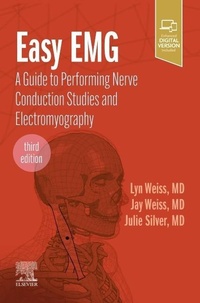
Easy EMG
A Guide to Performing Nerve Conduction Studies and Electromyography
3rd Edition
Published on 9. March 2022
Book
Paperback/Softback
304 pages
978-0-323-79686-6 (ISBN)
Description
Ideal for on-the-go reference and review, Easy EMG, 3rd Edition, covers fundamental principles, how to perform, and how to interpret electromyography (EMG) and nerve conduction studies (NCS)-all in an easy-to-read, well-organized resource. This unique, pocket-sized manual offers expert guidance on the most common conditions encountered in daily practice, with clear illustrations showing the correct needle placement for each condition.
Presents "just the facts? of EMG and NCS in a compact format-perfect for on-the-go learning or review.
Features at-a-glance tables of complex information for quick and easy reference and a new, all-inclusive chart that includes electrodiagnostic findings in specific disorders.
Depicts precise needle placement through clear, computer-generated illustrations.
Includes new and updated videos, including clips on motor and sensory nerve conduction studies and H-reflex.
Reflects the latest changes to EMG billing codes to ensure accurate, up-to-date application.
Enhanced eBook version included with purchase. Your enhanced eBook allows you to access all of the text, figures, and references from the book on a variety of devices.
Presents "just the facts? of EMG and NCS in a compact format-perfect for on-the-go learning or review.
Features at-a-glance tables of complex information for quick and easy reference and a new, all-inclusive chart that includes electrodiagnostic findings in specific disorders.
Depicts precise needle placement through clear, computer-generated illustrations.
Includes new and updated videos, including clips on motor and sensory nerve conduction studies and H-reflex.
Reflects the latest changes to EMG billing codes to ensure accurate, up-to-date application.
Enhanced eBook version included with purchase. Your enhanced eBook allows you to access all of the text, figures, and references from the book on a variety of devices.
Reviews / Votes
"This book is an introduction to electromyography (EMG) designed for trainees. It covers the purpose of the test, how to perform different elements of the test, and various diagnoses encountered. It also includes a section on billing and coding. It is available as an ebook that can be downloaded as a reference, which includes video clips for enhanced learning. This third edition book is an update to the second edition, which was published in 2015." (c)Doody's Review Service, 2023, Vivian C Roy, MD (Shirley Ryan AbilityLab) Doody's Score: 5 Stars!More details
Edition
3rd edition
Language
English
Place of publication
Philadelphia
United States
Target group
Professional and scholarly
Product notice
Paperback (trade)
Unsewn / adhesive bound
Dimensions
Height: 226 mm
Width: 148 mm
Thickness: 12 mm
Weight
392 gr
ISBN-13
978-0-323-79686-6 (9780323796866)
Copyright in bibliographic data and cover images is held by Nielsen Book Services Limited or by the publishers or by their respective licensors: all rights reserved.
Schweitzer Classification
Other editions
Previous edition
Lyn D. Weiss | Jay M. Weiss | Julie K. Silver
Easy EMG
A Guide to Performing Nerve Conduction Studies and Electromyography
Book
05/2015
2nd Edition
Elsevier
€64.36
Article exhausted; check for reprint
Persons
Author
Chairman and Director of Residency Training, Professor of Clinical Physical Medicine and Rehabilitation, Director of Electrodiagnostic Services, Department of Physical Medicine and Rehabilitation, Nassau University Medical Center, East Meadow, NY, USA
Long Island Physical Medicine and Rehabilitation, Jericho, NY; Associate Professor of Clinical Physical Medicine and Rehabilitation, Stony Brook College of Medicine Stony Brook, NY, USA
Associate Professor, Department of Physical Medicine and Rehabilitation, Harvard Medical School, Cambridge, Massachusetts
Content
Preface
Acknowledgments
Dedication
Video Table of Contents
1.What is an EMG?
2.Why Perform Electrodiagnostic Studies?
3.About the Machine
4.Nerve Conduction Studies
5.Electromyography
6.Injuries to Peripheral Nerves
7.How to Plan Out the Examination
8.Pitfalls
9.Carpal Tunnel Syndrome
10.Ulnar Neuropathy
11.Radial Neuropathy
12.Radiculopathy
13.Spinal Stenosis
14.Fibular (Peroneal) Neuropathy
15.Tarsal Tunnel Syndrome
16.Peripheral Polyneuropathy
17.Myopathy
18.Brachial Plexopathies
19.Lumbosacral Plexopathies
20.Motor Neuron Diseases
21.Critical Illness Neuropathy and Myopathy
22.Inflammatory Neuropathies
23.Neuromuscular Junction Disorders
24.How to Write a Report
25.Tables of Normals
26.Reimbursement
Appendix:
1.Figures for Table 4.3 (Nerve Conduction Studies Setup)
2.Figures for Table 5.4 (Common Muscles - Innervation, Location, and Needle Placement)
Acknowledgments
Dedication
Video Table of Contents
1.What is an EMG?
2.Why Perform Electrodiagnostic Studies?
3.About the Machine
4.Nerve Conduction Studies
5.Electromyography
6.Injuries to Peripheral Nerves
7.How to Plan Out the Examination
8.Pitfalls
9.Carpal Tunnel Syndrome
10.Ulnar Neuropathy
11.Radial Neuropathy
12.Radiculopathy
13.Spinal Stenosis
14.Fibular (Peroneal) Neuropathy
15.Tarsal Tunnel Syndrome
16.Peripheral Polyneuropathy
17.Myopathy
18.Brachial Plexopathies
19.Lumbosacral Plexopathies
20.Motor Neuron Diseases
21.Critical Illness Neuropathy and Myopathy
22.Inflammatory Neuropathies
23.Neuromuscular Junction Disorders
24.How to Write a Report
25.Tables of Normals
26.Reimbursement
Appendix:
1.Figures for Table 4.3 (Nerve Conduction Studies Setup)
2.Figures for Table 5.4 (Common Muscles - Innervation, Location, and Needle Placement)