

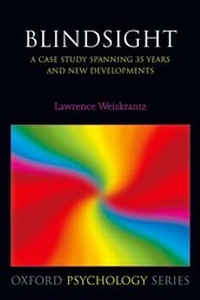
Blindsight
a case study spanning 35 years and new developments
2nd Edition
Published on 19. March 2009
Book
Paperback/Softback
266 pages
978-0-19-956721-8 (ISBN)
Description
Blindsight is an unusual condition where the sufferer can respond to visual stimuli, while lacking any conscious feeling of having seen the stimuli. It occurs after a particular form of brain injury.
The first edition of 'Blindsight', by one of the pioneers in the field - Lawrence Weiskrantz, reported studies of a patient with this condition. It was an important, much cited publication. In the past twenty years, further work has been done in this area, and this new edition brings the book up to date. Retaining the original text, but adding substantial new chapters and colour illustrations, the first section of the book summarizes findings on DB since the last published account in 1986. The second part includes information on other new research that has occurred since the last edition. As well as giving an account of research over a number of years into a particular case of blindsight, it provides a discussion of the historical and neurological background, a review of cases reported by other investigators, and a number of theoretical and practical issues and implications.
The book will be valuable for cognitive psychologists and cognitive neuroscientists, as well as philosophers of mind.
The first edition of 'Blindsight', by one of the pioneers in the field - Lawrence Weiskrantz, reported studies of a patient with this condition. It was an important, much cited publication. In the past twenty years, further work has been done in this area, and this new edition brings the book up to date. Retaining the original text, but adding substantial new chapters and colour illustrations, the first section of the book summarizes findings on DB since the last published account in 1986. The second part includes information on other new research that has occurred since the last edition. As well as giving an account of research over a number of years into a particular case of blindsight, it provides a discussion of the historical and neurological background, a review of cases reported by other investigators, and a number of theoretical and practical issues and implications.
The book will be valuable for cognitive psychologists and cognitive neuroscientists, as well as philosophers of mind.
Reviews / Votes
Review from previous edition a comprehensive review of an intriguing topic by a leading investigator in the field... Blindsight is a convenient source-book for multidisciplinary investigators and students with open minds. * Trends in Neuroscience * extremely clearly written and will be of interest to all clinicians and neuroscientists interested in vision. As an exemplary example of the insights that can arise from the single case study it deserves a wider readership. * Brain * This book makes very enjoyable reading... the style is entertaining... presentation of the data is original in that it departs from the usual austere psychological format... quantified data are interweaved with other (no less important) aspects of the study: informal attempts, failures, anecdotes and verbal repots from the patient are also included, which gives the book a nice clinical touch... I recommend Blindsight not only to those interested in the study of the mechanisms of visual perception, but also to those interested in the more general issues of cognitve processing and modular organization of mental functions. * Neuropsychologia * ... a thoughtful and comprehensive analysis of the status of residual vision,..This monograph is a valuable contribution on a number of grounds.
This clearly written monograph, particularly the third part, provides valuable insights into a wide range of conceptual and methodological problems and is recommended as a useful, challenging, and stimulating contribution for the general reader as well as the vision specialist. * Contemporary Psycology *
More details
Series
Edition
2nd Revised edition
Language
English
Place of publication
Oxford
United Kingdom
Target group
Professional and scholarly
College/higher education
Edition type
Revised edition
Illustrations
39 black & white figures, 7 colour figures & 5 photos
Dimensions
Height: 234 mm
Width: 156 mm
Thickness: 16 mm
Weight
427 gr
ISBN-13
978-0-19-956721-8 (9780199567218)
Copyright in bibliographic data and cover images is held by Nielsen Book Services Limited or by the publishers or by their respective licensors: all rights reserved.
Schweitzer Classification
Other editions
Previous edition
Book
08/1990
Clarendon Press
€44.57
Article exhausted; check for reprint
Person
Content
Introduction to 'Blindsight' after 35 years ; New departures in blindsight research ; Introduction to the new paperback edition of 'Blindsight' ; PART I ; 1. Background ; 2. D.B.: clinical history and early testing ; PART II ; 3. Reaching for randomly located targets ; 4. 'Presence' versus 'absence' ; 5. Visual acuity ; 6. Movement thresholds ; 7. Discrimination of orientation ; 8. 'Form' discrimination ; 9. Detection with slow rate of onset ; 10. The natural blind-spot (optic disc) within the scotoma ; 11. Left versus right eye ; 12. Detection of direction of contrast ; 13. 'Waves' ; 14. Matching between impaired and intact fields ; 15. Matching within the impaired field ; 16. Double dissociations between form and detection ; 17. Standard situation ; PART III ; 18. Review of other cases ; 19. Status, issues and implications