

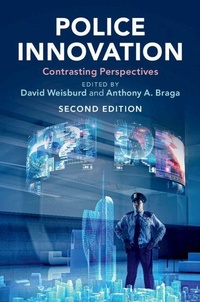
Police Innovation
Contrasting Perspectives
2nd Edition
Published on 29. August 2019
Book
Hardback
582 pages
978-1-108-41781-5 (ISBN)
Description
Over the last forty years, policing has gone through a period of significant change and innovation. The emergence of new strategies has also raised issues about effectiveness and efficiency in policing, and many of these proactive strategies have become controversial as citizens have asked whether they are also fair and unbiased. Updated and expanded for the second edition, this volume brings together leading police scholars to examine these key innovations in policing. Including advocates and critics of each innovation, this comprehensive book assesses the impacts of police innovation on crime and public safety, the extent of implementation of these new approaches in police agencies, the dilemmas these approaches have created for police management, and their impacts on communities.
More details
Edition
2nd Revised edition
Language
English
Place of publication
Cambridge
United Kingdom
Target group
College/higher education
Professional and scholarly
Edition type
Revised edition
Illustrations
Worked examples or Exercises; 6 Tables, black and white; 11 Line drawings, black and white
Dimensions
Height: 235 mm
Width: 157 mm
Thickness: 39 mm
Weight
1091 gr
ISBN-13
978-1-108-41781-5 (9781108417815)
Copyright in bibliographic data and cover images is held by Nielsen Book Services Limited or by the publishers or by their respective licensors: all rights reserved.
Schweitzer Classification
Other editions
Additional editions
E-Book
08/2019
Cambridge University Press
€34.49
Available for download
E-Book
08/2019
2nd Edition
Cambridge University Press
€39.49
Available for download
Previous edition
Book
05/2006
Cambridge University Press
€108.94
Article exhausted; check for reprint
Persons
Content
Introduction: the context of police innovation David Weisburd and Anthony Braga; Part I. Community Policing: 1. Advocate: community policing Wesley Skogan; 2. Critic: community policing: a skeptical view Stephen Mastroski; Part II. Broken Windows Policing: 3. Advocate: of 'broken windows' criminology and criminal justice William Sousa and George Kelling; 4. Critic: incivilities reduction policing, zero tolerance, and the retreat from coproduction: even weaker foundations and stronger pressures Ralph Taylor; Part III. Procedural Justice Policing: 5. Advocate: procedural justice policing Tom Tyler and Tracey Meares; 6. Critic: the limits of procedural justice David Thacher; Part IV. Problem-Oriented Policing: 7. Advocate: why problem-oriented policing John Eck; 8. Critic: problem-oriented policing: the disconnect between principles and practice Anthony Braga and David Weisburd; Part V. Pulling Levers (Focused Deterrence) Policing: 9. Advocate: policing and the lessons of focused deterrence David M. Kennedy; 10. Critic: partnership, accountability, and innovation: clarifying Boston's experience with focused deterrence Anthony Braga; Part VI. Third-Party Policing: 11. Advocate: third-party policing Lorraine Green Mazerolle and Janet Ransley; 12. Critic: third-party policing: a critical view Tracey L. Meares; Part VII. Compstat: 13. Advocate: Compstat's innovation Eli Silverman; 14. Critic: changing everything so that everything can remain the same: Compstat and American policing David Weisburd, Stephen Mastrofski, James J. Willis and Rosanne Greenspan; Part VIII. Hot Spots Policing: 15. Advocate: hot spots policing as a model for police innovation Anthony Braga and David Weisburd; 16. Critic: the limits of hot spots policing Dennis Rosenbaum; Part IX. Predictive Policing: 17. Advocate: predictive policing Jerry Ratcliffe; 18. Critic predictive policing: where's the evidence Rachel Boba; Part X. Evidence-Based / Risk-Focused Policing: 19. Advocate: evidence-based policing for crime prevention Brandon Welsh; 20. Critic which evidence? What knowledge? Broadening information about the police and their interventions Jack Greene; Part XI. Technology Policing: 21. Advocate technology in policing Barak Ariel; 22. Critic: the limits of police technology Cynthia Lum and Chris Koper; Conclusion: police innovation and the future of policing David Weisburd and Anthony Braga.