

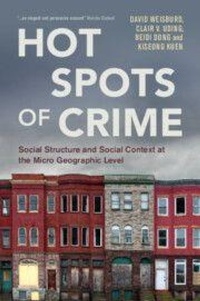
Hot Spots of Crime
Social Structure and Social Context at the Micro Geographic Level
Will be published approx. on 31. July 2026
Book
Paperback/Softback
250 pages
978-1-009-35283-3 (ISBN)
Description
While hot spots of crime have become an important focus of study in criminology and an important focus of crime prevention in programs like hot spots policing, to date we know little about these places. Who lives in hot spots of crime? What factors lead to these places becoming crime hot spots? What other social and health problems are found in these places? The book draws on more than 7,000 surveys of people living on crime hot spot and non-hot spot streets, systematic physical and social observations, and structured qualitative data collection. The results of this study illustrate that hot spots of crime are not just hot spots for crime, but also many other social ills. By shedding light on the social features of hot spots of crime, the book recognizes the importance of informal social controls in understanding and preventing crime at crime hot spots. This title is also available as open access on Cambridge Core.
Reviews / Votes
'David Weisburd has been at the forefront of a revolution in the way we understand crime. This book written with colleagues is an elegant and persuasive account of the importance of understanding hot spots of crime. When it comes to crime, we have been focused on people. It is time, they argue, that we also focus on place.' Malcolm Gladwell, author of Revenge of the Tipping Point: Overstories, Superspreaders, and the Rise of Social Engineering 'David Weisburd and colleagues marry big data with big ideas to achieve a contemporary criminological classic. Addressing the daunting challenge of the sources of crime concentration, they show that 'hot spots' and 'cold spots' are produced not only by opportunity but also by structural and contextual factors. These findings are a turning point in theoretical criminology and of immense practical significance, making a compelling case that urban crime prevention must focus simultaneously on policing and on the health and social well-being of residents. A true masterpiece!' Francis T. Cullen, Distinguished Research Professor Emeritus, University of Cincinnati 'David Weisburd has been a leader in research demonstrating that 'hot spots' of crime are highly concentrated in microgeographic places. In this book, he and his colleagues address a new challenge: the social structure and organization of these places. Drawing on community-level theory and a unique study of Baltimore, they show that informal social control is a key mechanism through which crime concentrates at hot spots. This is a novel insight, as is the finding that social, but not physical, disorder matters for the concentration of crime. Creatively bridging the communities and place literatures, which are often separated, Hot Spots of Crime has important implications for criminological theory and policy.' Robert J. Sampson, Harvard University and author of Great American City: Chicago and the Enduring Neighborhood EffectMore details
Language
English
Place of publication
Cambridge
United Kingdom
Product notice
Paperback (trade)
Illustrations
Worked examples or Exercises
Weight
366 gr
ISBN-13
978-1-009-35283-3 (9781009352833)
Copyright in bibliographic data and cover images is held by Nielsen Book Services Limited or by the publishers or by their respective licensors: all rights reserved.
Schweitzer Classification
Other editions
Additional editions
David Weisburd | Clair V. Uding | Beidi Dong
Hot Spots of Crime
Social Structure and Social Context at the Micro Geographic Level
Book
approx. 07/2026
Cambridge University Press
€99.50
Not yet published
Persons
David Weisburd is Distinguished Professor of Criminology, Law and Society at George Mason University and Walter E. Meyer Professor Emeritus of Law and Criminal Justice at the Hebrew University. He is the recipient of the Stockholm Prize in Criminology, the Sutherland and Vollmer Awards from the American Society of Criminology, and the Rothschild Prize in Social Science. Clair V. Uding is an Associate Professor in the Department of Criminal Justice and Sociology at the University of Wyoming. Her research focuses on mental health and criminal justice, co-responder models in policing, and the intersection of crime, health, and place. Beidi Dong is an Associate Professor in the Department of Criminology, Law, & Society at George Mason University. His research applies spatiotemporal methods to examine how crime, violence, and punishment contribute to health disparities and social inequities, with a focus on vulnerable communities across the United States. Kiseong Kuen is a Lecturer (Assistant Professor) in the School of Criminology and Criminal Justice and a member of the Griffith Criminology Institute at Griffith University. His research interests include the criminology of place and evidence-based policing.
Content
1. Introduction; 2. The Social Structure and Social Context of Crime Hot Spots; 3. Hot Spots of Crime and Communities; 4. Does Social Structure and Social Context Matter for Understanding Crime at Place? 5. What Are the Antecedents of Informal Social Control at Crime Hot Spots? 6. Social Structure, Social Context, and Household Risk of Property Victimization; 7. Crime Hot Spots and Physical and Mental Health; 8. Conclusions.